


Cédric Gibiat leads Digital, Customer Marketing and Sales Performance for the brands of Saint-Gobain Distribution Bâtiment France (SGDBF). He explains to Soft Atlas how the company is assessing the role of AI in its future SFA, chose its GEO monitoring tool, is enriching its local data with Partoo and is preparing its product data for agentic commerce.
SGDBF is currently evaluating its next SFA (Sales Force Automation), that is, the sales management tool for its field sales force. Several vendors are in the running, including SAP and Salesforce. But the benchmark is no longer only about features: the company is trying to measure how far AI can automate visit planning, visit preparation, visit reports or customer portfolio analysis.
As we will see further on, this thinking goes beyond the CRM. It now encompasses GEO, the store locator, product data, search and BI.
What role for AI in the future SFA?
The field sales force currently uses SAP Cloud for Customer (C4C). For its overhaul, SGDBF is comparing three approaches:
- Buy:
 SAP Sales Cloud V2 or
 Salesforce Sales Cloud,
- Make: a 100% in-house development,
- Hybrid: vendor building blocks complemented by custom developments.
The level of agentic AI to build in is one of the main selection criteria. The company is looking in particular at four uses around the sales visit: smart planning, visit preparation, automatic visit reports and, finally, assisted analysis of the customer portfolio.
The comparison is therefore shifting from features, workflows and ergonomics to another question: which tasks can really be entrusted to AI, and with what real gain for the user and the customer?
A TCO that has become hard to calculate
The growing role of AI seriously complicates the calculation of total cost of ownership (TCO). On top of licenses come variable costs tied to the consumption of AI features, with pricing models that change with vendors' announcements and partnerships.
“Today, calculating the TCO of a piece of software over three or five years is becoming extremely difficult. Which model should you use? How many tokens does a given AI-assisted task cost? How does the price change if it is handed over entirely to an autonomous agent?”
It is indeed hard to predict how many requests a salesperson will make or which agentic features will actually be adopted. The question becomes very concrete: in which processes does AI create enough value to justify its cost?
GEO monitoring: why Meteoria?
Alongside the AI built into salespeople's tools, SGDBF is equipping itself to meet a new challenge: GEO (Generative Engine Optimization), that is, the visibility of a brand and its content in engines and assistants based on generative AI.
After an in-depth benchmark of eight solutions in the summer of 2026, the digital teams chose  Meteoria, with the goal of rolling it out across all brands before the end of the year. The choice of a single tool is deliberate: it avoids multiplying the methodologies used to build the lists of prompts to track.
Two criteria were decisive:
- The methodology. Measuring a brand's visibility in ChatGPT or other assistants requires building a sample of queries. SGDBF examined how each solution ensures that these prompts truly reflect its market, its customers' intentions and its product universe.
- Actionability. A dashboard showing that visibility is rising or falling is not enough. The tool must show where to act: on a product family, a supplier, a brand, a type of intent or, eventually, a strategic prompt.
On the content side, SGDBF is working in parallel on E-E-A-T (experience, expertise, authoritativeness, trustworthiness): more content produced or fronted by experts, and more frequent structuring of FAQs and answers to customers' recurring questions.

Local GEO: Partoo and the branch network
GEO is not limited to national content or product pages. For a physical network the size of Saint-Gobain Distribution's, the way engines understand each location becomes strategic.
SGDBF's branches generate more than 70 million impressions on Google Maps every year, which translate into more than 9 million actions: clicks to websites, direction requests or calls.
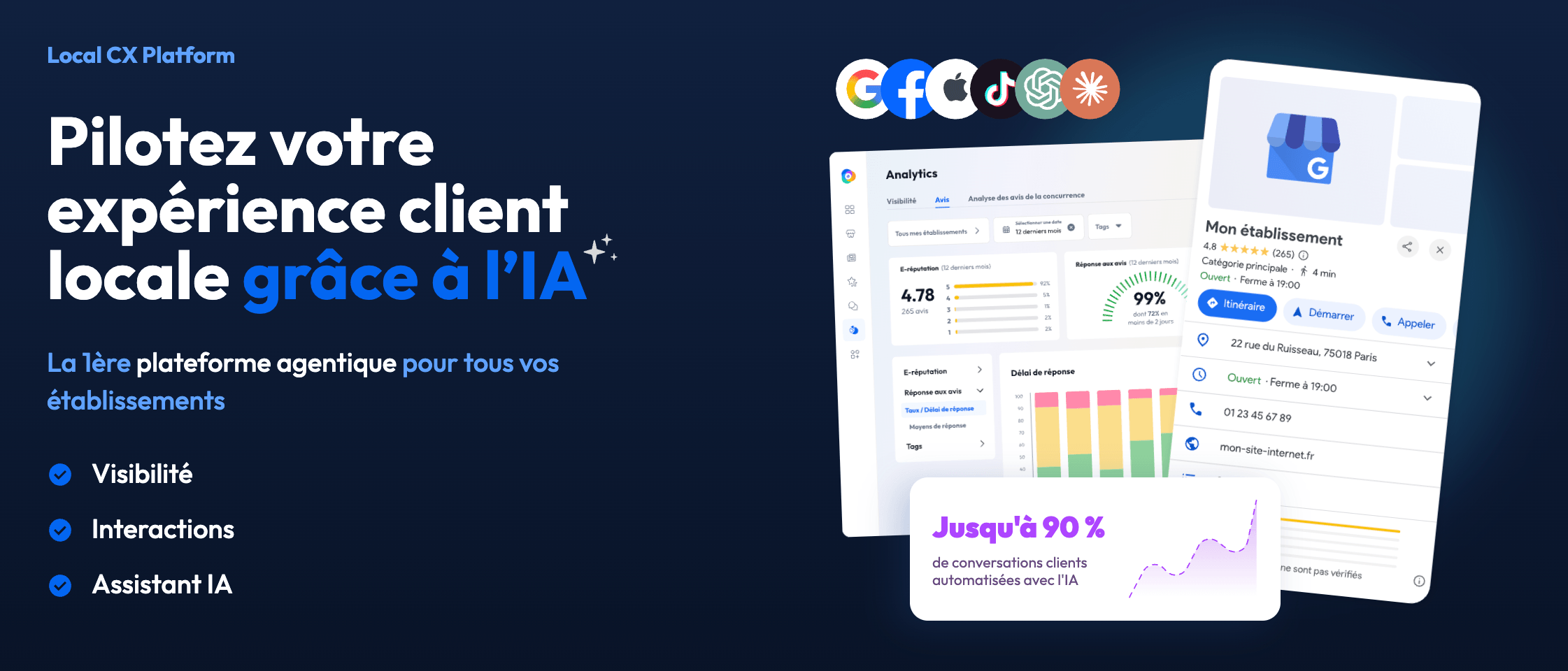
SGDBF relies on  Partoo to manage and optimize its locations' information on Google and other local platforms (Apple, Waze, TomTom, HERE). Historically, the challenge was reliability: opening hours, contact details, categories, services, photos.
With the rise of answer engines and AI agents, the goal is shifting toward enrichment: describing each branch, its products and its services in finer detail. The question becomes: does an engine have enough information to understand precisely what a store offers?
Reviews also contribute to this local information. The branches of the different brands total nearly 100,000 online reviews, with an average rating above 4/5. Over five years of working with Partoo, some brands have improved their response rate and cut the time it takes them to handle reviews in half.
Putting branch teams in charge
The next challenge is to bring the production of information closer to those who know the field best: branch employees.
A large share of the content is still managed today by the central or regional marketing teams. A Saint-Gobain Distribution brand will soon test with Partoo a setup that gives more room to branch employees, who are better placed to flag the services actually available, update local information, share sales events and branch life and, of course, answer the questions of the branch's customers.
“To maximize relevance and local roots, we will need to hand the solution over to branch employees going forward.”
The idea is not to decentralize all content management, but to let local teams contribute to it to keep the information “up to date, fresh and alive.” The thinking extends to the store locator and branch pages, with the goal of consistency between Google listings, location data, reviews and the brands' local pages.
Toward an “agentic catalog”
AI is also transforming product information management. SGDBF uses  Stibo as its PIM and has begun its transition toward what Cédric Gibiat calls the “agentic catalog.”
The company has already tested several in-house developments that use AI to automate scoring and part of the enrichment of product listings. The topic ties in with local GEO: for an agent to recommend a product, a service or a branch precisely, the data made available to it must allow it to connect that product, service or solution to the customer's search intent.

From AI-assisted search to agentic commerce
SGDBF's e-commerce sites use Google's search engine, historically called Vertex AI Search for Commerce, renamed AI Commerce Search in June 2026 and integrated into  Gemini Enterprise for Customer Experience.
The operational feedback is very positive:
“Since we deployed this solution, we have cut the rate of searches with no results by a factor of three.”
Cédric Gibiat also highlights the engine's ability to learn, which has allowed the brands to achieve a real leap in search performance.
SGDBF now wants to build on this foundation to launch its first agentic commerce experiments by early 2027. Here again, success will depend less on adding an AI feature than on the quality and structure of the data it accesses.
Tools in this section
Summary of the software this article mentions in Saint-Gobain's stack
| Status | Workflow | Tool | Usage |
|---|---|---|---|
| In use | CRM / SFA | SAP | Tool for managing the field sales force, whose overhaul is under review. |
| Dropped | CRM / SFA | Salesforce Sales CloudDropped | Alternative to SAP for the future SFA, compared on automation and AI capabilities. |
| In use | GEO / AI Search Monitoring | Meteoria | Monitoring of the brands' visibility in AI engines, prompt analysis and identification of optimization actions. |
| In use | Presence Management / Reputation Management | Partoo | Management of local information, optimization of location listings, review tracking and enrichment of local data. |
| In use | PIM / Product Information Management | Stibo Systems | Management of product data and preparation of an enriched catalog that AI agents can use. |
| In use | E-commerce Search / AI |  Google Antigravity | Search engine for the e-commerce sites. Rate of searches with no results cut by a factor of three after rollout. |
| In use | AI / Agentic commerce | Gemini | Google environment that includes AI Commerce Search, tied to future agentic commerce uses. |
| In use | AI assistant / Answer engine |  OpenAI | Engine in which SGDBF wants to measure and improve the visibility of its brands. |