



With nearly 35 employees, Figures uses several pieces of software to manage its human resources. The company replaced PayFit with Factorial, kept Culture Amp for its performance reviews and chose Epsor to manage its profit-sharing plan. Its founder, Virgile Raingeard, looks back at these decisions and explains why he would not necessarily make the same choices today.
Figures is a French software vendor specializing in compensation management. Its platform lets companies build their salary ranges, organize their salary reviews, benchmark their compensation against the market and prepare for pay transparency obligations.
The company works with organizations of 20 to 130,000 employees, with slightly more than a third of its customers outside France, mainly in Germany and the United Kingdom.
Interviewed by Soft Atlas, Virgile Raingeard, CEO and founder of Figures, details the software his teams use, the reasons behind his migrations and the tools he could now do without thanks to AI.
Why did Figures replace PayFit with Factorial?
Figures started with  PayFit to handle payroll and its first HR administrative processes. But as the company grew, it wanted to bring in a payroll firm and felt the need for a more complete HRIS, able to handle onboarding, time off and, above all, employees abroad.
The team compared three solutions:  Factorial,
 Lucca and
 HiBob. The main criterion was the ability to support an international company.
“We had the choice between Lucca, Factorial and HiBob. Lucca seemed less international to me at the time, which is less the case now. HiBob and Factorial seemed better suited to our international needs.”
The choice therefore came down mainly to Factorial and HiBob. One factor ultimately tipped the balance: Factorial was already a business partner of Figures.
Factorial is now the central HRIS at Figures. The company did not, however, try to hand it all of its HR processes, and notably still uses Culture Amp for performance reviews.
Culture Amp: reviews too complex for the HRIS
Every six months, Figures runs a review campaign for its employees. These reviews go beyond the traditional meeting between an employee and their manager.
They include peer feedback, to gather input from colleagues, upward feedback, to evaluate managers, and downward reviews, known as top-down.  Culture Amp is also used to collect one-off feedback, notably at the end of probationary periods.
When the software was chosen, these different formats were not available in the HRIS platforms Figures was using.
“We use Culture Amp mainly for our semiannual reviews. We have quite a few specifics: peer feedback, upward feedback for managers and top-down reviews. At the time, that wasn't possible in either PayFit or Factorial.”
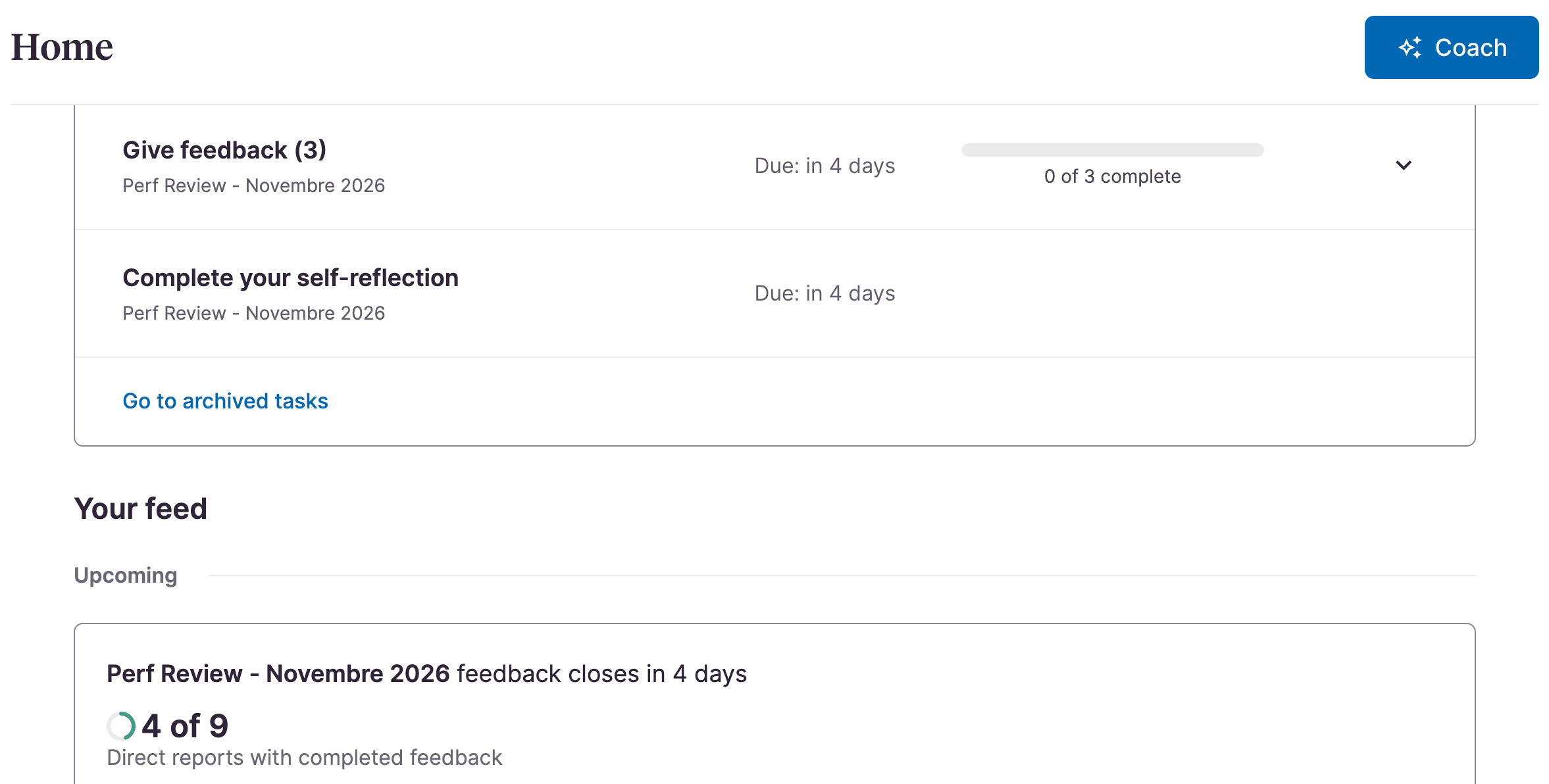
Figures therefore kept Culture Amp as a specialized tool, by connecting it to Factorial to sync employee data.
This choice fits the company's philosophy fairly well. Figures itself sells highly specialized software and regularly works with customers whose HR teams use several complementary solutions.
“It also helps us better understand our customers' setup, as they often have fairly distributed tools.”
In hindsight, however, Virgile believes Culture Amp is aimed more at companies of 100 to 1,000 employees. For a 35-person organization like Figures, the software can seem rather sophisticated.
It notably offers features to prepare one-on-one meetings, but Virgile thinks it would now be possible to quickly build an equivalent tool with Claude.
HRIS platforms have also evolved since the original decision. If Figures had to make its choice again today, the need to keep a separate piece of software for reviews would deserve a second look.
Tools in this section
Teamtailor and Welcome to the Jungle: are two tools still necessary?
For recruiting, Figures first used  Welcome to the Jungle, before adding
 Teamtailor to get more advanced ATS features.
Virgile particularly likes Teamtailor for the quality of its career pages, its employer pages and the experience it offers candidates.
But he draws an important distinction between two ways of recruiting: inbound, where candidates apply on their own, and outbound, where recruiters go out and source profiles directly.
“Teamtailor is very good for an inbound recruiting approach. For creating a great candidate experience, a great employer page and a great career page, it's really very good. On the other hand, from my own use, I'm not sure it's the best ATS for outbound and candidate sourcing.”
He compares this difference to that of sales CRMs: some tools are very effective at handling inbound requests, but less suited to prospecting.
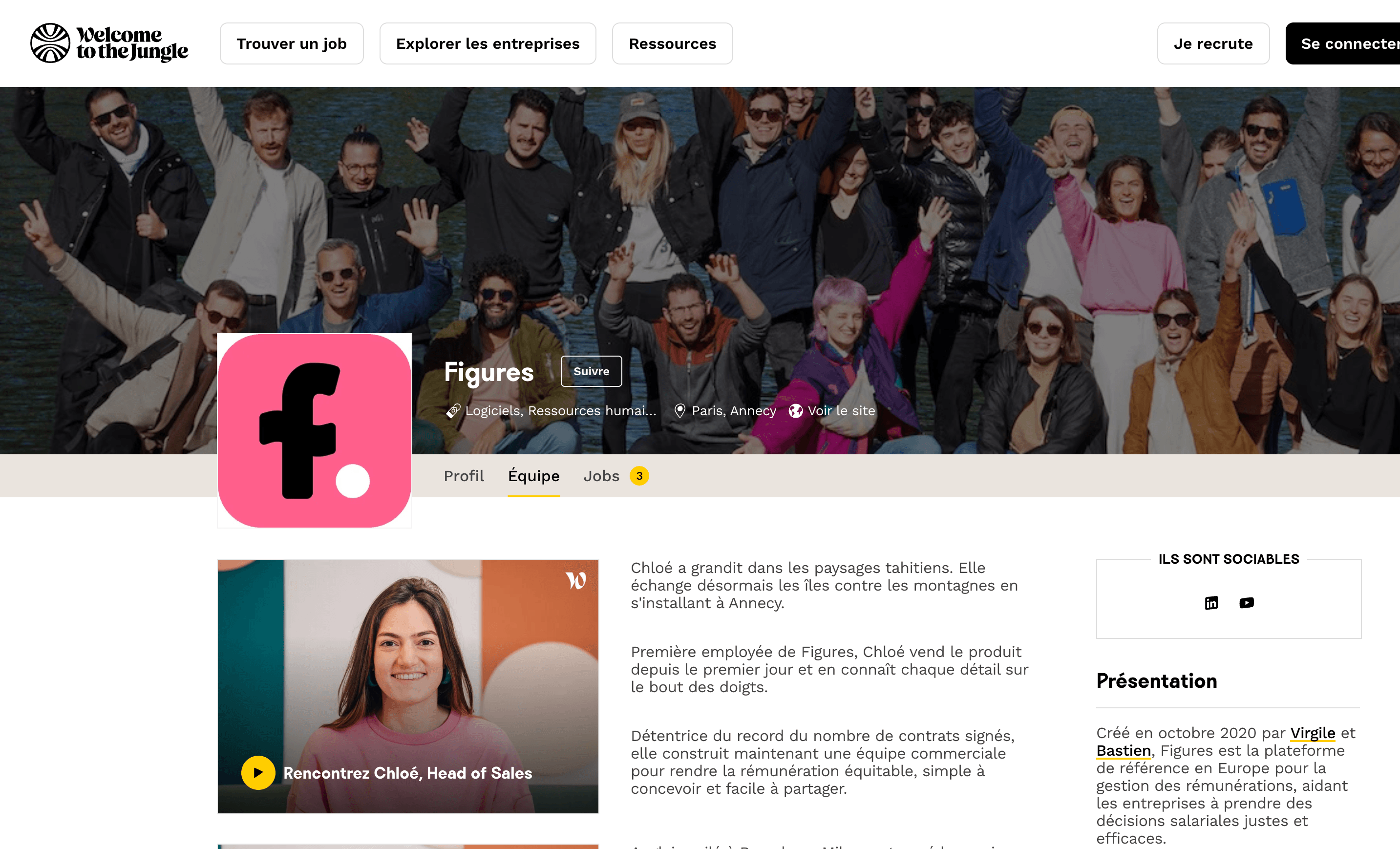
Today, the main question is whether Figures still needs two recruiting tools. With about 35 employees and relatively few hires to manage, Virgile thinks that Welcome to the Jungle could be enough. The missing features could possibly be developed in-house with AI.
Epsor and Figures: how the company manages compensation and profit-sharing
Figures set up a profit-sharing plan when the company was still relatively small.
To manage it, it chose  Epsor, notably because the software simplified defining the plan, administering it and making payouts to employees. The commercial offer was also attractive for a company of that size.
“Epsor made defining the profit-sharing plan, managing it and making the payouts super simple. They also had a very attractive package for small companies. We've been using it from the start.”
But what interests Virgile most, beyond the software, is the principle of profit-sharing itself. He sees this mechanism as widely underused by companies, even though it makes it possible to tie part of employees' compensation to collective goals.
At Figures, the plan can notably be tied to the company's OKRs. The benefit is quite simple: when a goal is tied to a bonus, employees are more likely to keep it in mind.
“Profit-sharing plans are one of the most underrated and underused compensation mechanisms. You can align your company's goals with a profit-sharing plan, and since it's tied to a bonus, employees are less likely to forget those goals.”
Virgile also highlights the tax and social charge advantages of profit-sharing, notably when the amounts are placed in an employee savings plan. In his view, it can be more advantageous than a standard bonus, for the company as well as for employees.
A mechanism that is still hard to promote when recruiting
Despite these advantages, Virgile acknowledges that profit-sharing is not always easy to present to candidates. The mechanism still has a rather old-fashioned image, often associated with large companies and complicated compensation schemes.
Figures tries to highlight it more during recruiting, but Virgile notes that candidates tend to undervalue profit-sharing, just as they can with BSPCE.
For a company specializing in compensation, explaining these mechanisms is probably more natural than for other organizations of comparable size.
Above all, Epsor lets Figures manage this plan easily, without having to handle all of its administration manually.
Figures uses its own software for salary reviews
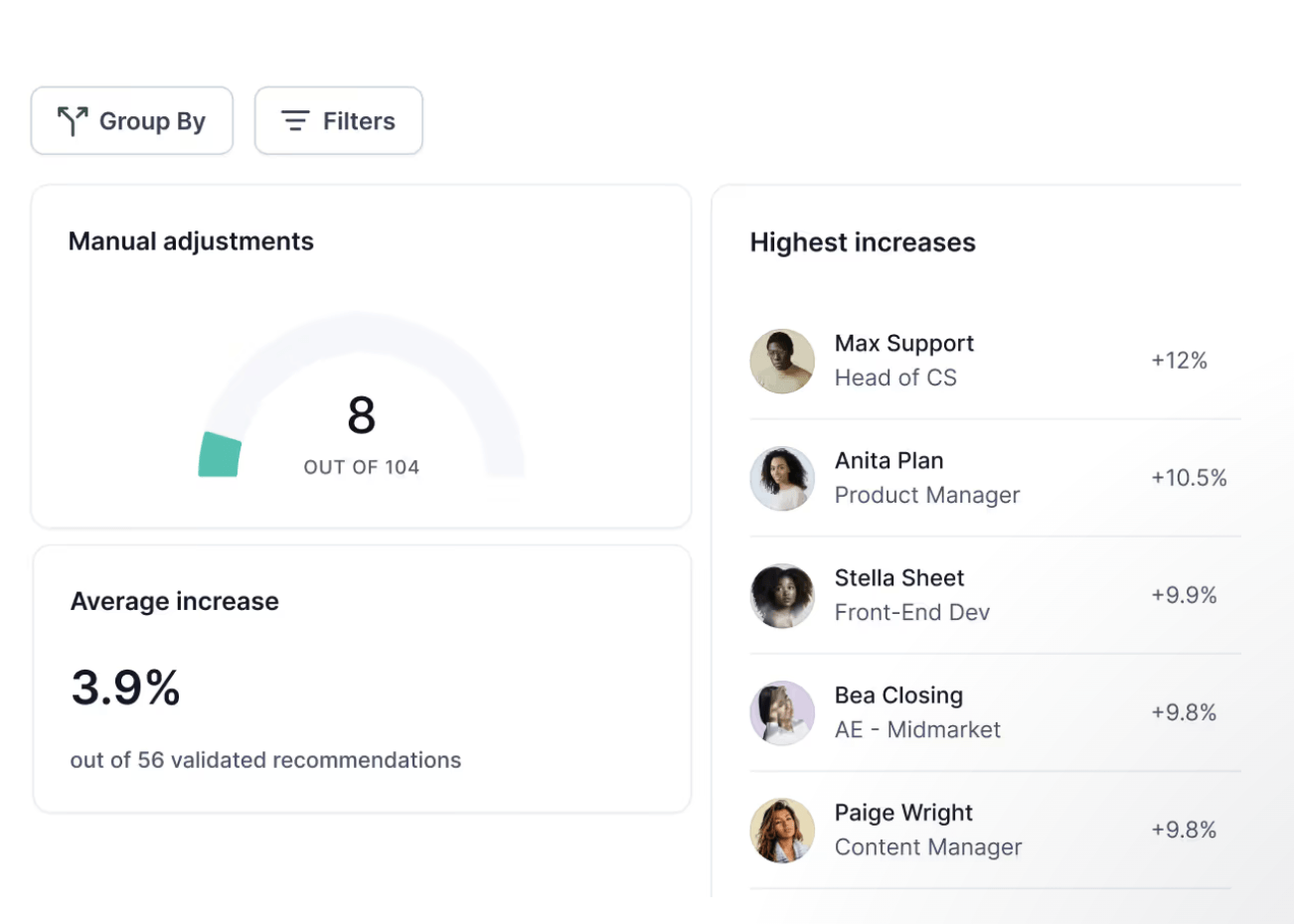
At the same time,  Figures uses its own platform to manage its employees' compensation.
The software lets it compare the salaries paid in the company with market data, build salary ranges and organize compensation reviews.
These are the same features it offers its customers, whether small companies of 20 employees or large organizations with up to 130,000 employees.
HR management thus relies on several complementary tools: Figures for compensation, Factorial for administrative information and Culture Amp for performance reviews.
Four-day week*, remote work and employee benefits
Figures has also offered its employees a fitness benefit for about five years, through a dedicated solution. Virgile says he is satisfied with this service.
But one of the benefits employees value most does not rely on any software: the nine-day fortnight.
In practice, employees work nine days instead of ten over two weeks. The company therefore gives them an extra day off every two weeks.
Why did Figures drop the four-day week?
Before moving to the nine-day fortnight, Figures had tested the four-day week.
In practice, employees struggled to finish their work in four days. Some kept working on their day off, feeling that they were not managing to fully enjoy this benefit.
“With the four-day week, people sometimes ended up working on their day off and feeling bad about working when it was supposed to be a day of rest. Even working four and a half days, they were ultimately less happy.”
Figures ultimately adopted the nine-day fortnight, which the company has practiced for about three and a half to four years. Virgile finds this arrangement more sustainable and believes employees particularly appreciate it.
The company also works in a distributed way, with two offices, in Paris and Annecy.
The sales team works on-site in Annecy, while other employees can work hybrid or fully remote. At its current size, Figures has not needed to add specific software to organize office attendance.
How Claude could reshape Figures' HR stack
Claude is now deployed across the entire company and the teams are gradually developing their own automations and internal tools.
On the product side, Figures notably uses  Linear to track its roadmap and customer requests. But some of the interactions with the software now go directly through Claude, thanks to MCP connections, rather than through the Linear interface.
Virgile imagines that some HR processes could evolve in the same way.
This is notably what leads him to reconsider the value of keeping certain specialized software, such as Culture Amp or Teamtailor, when equivalent features can be offered by an HRIS or developed in-house.
For Figures, the point is not to abandon its current tools, but to regularly reassess the features actually used and whether paying for an additional piece of software is worth it.
Summary of the software this article mentions in Figures's stack
| Status | Workflow | Tool | Usage |
|---|---|---|---|
| In use | Compensation management | Figures | Salary benchmarking, pay ranges and compensation reviews |
| Replaced by Factorial | Payroll / HRIS | PayFitReplaced by Factorial | Former HR tool, replaced by Factorial |
| In use | HRIS | Factorial | HR administration, onboarding, time off and international management |
| Dropped | HRIS | LuccaDropped | Alternative considered when choosing Factorial |
| Dropped | HRIS | HiBobDropped | Finalist against Factorial |
| In use | Performance reviews | Culture Amp | Semiannual reviews, feedback and one-on-ones |
| In use | AI / automation |  Claude | Automations, skills and internal tool development |
| In use | Recruiting / ATS | Teamtailor | Application management, career pages and candidate experience |
| In use | Recruiting | Welcome to the Jungle | Employer pages and recruiting |
| Replaced by Benefiz | Health insurance |  AlanReplaced by Benefiz | Former health insurance, replaced by Benefiz |
| Replaced by Benefiz | Meal vouchers |  SwileReplaced by Benefiz | Former solution, replaced by Benefiz |
| In use | Employee benefits |  Benefiz | Health insurance, meal vouchers and employee benefits |
| In use | Employee savings | Epsor | Setup and management of the profit-sharing plan |
| In use | Product management | Linear | Roadmap and customer requests, with access through Claude and MCP |