



At Figures, asynchronous video has replaced some of the meetings and long emails. Virgile Raingeard, CEO and founder of the company, explains how he uses Claap to communicate with his teams, prepare his board meetings, recruit and respond to customers. A practice adopted from Figures' early days, with about 250 videos recorded per year.
Virgile Raingeard has used  Claap since the early days of Figures, a SaaS vendor specializing in compensation that is approaching 35 employees. Interviewed by Soft Atlas in November 2026, he describes how asynchronous video became a reflex in the way he works.
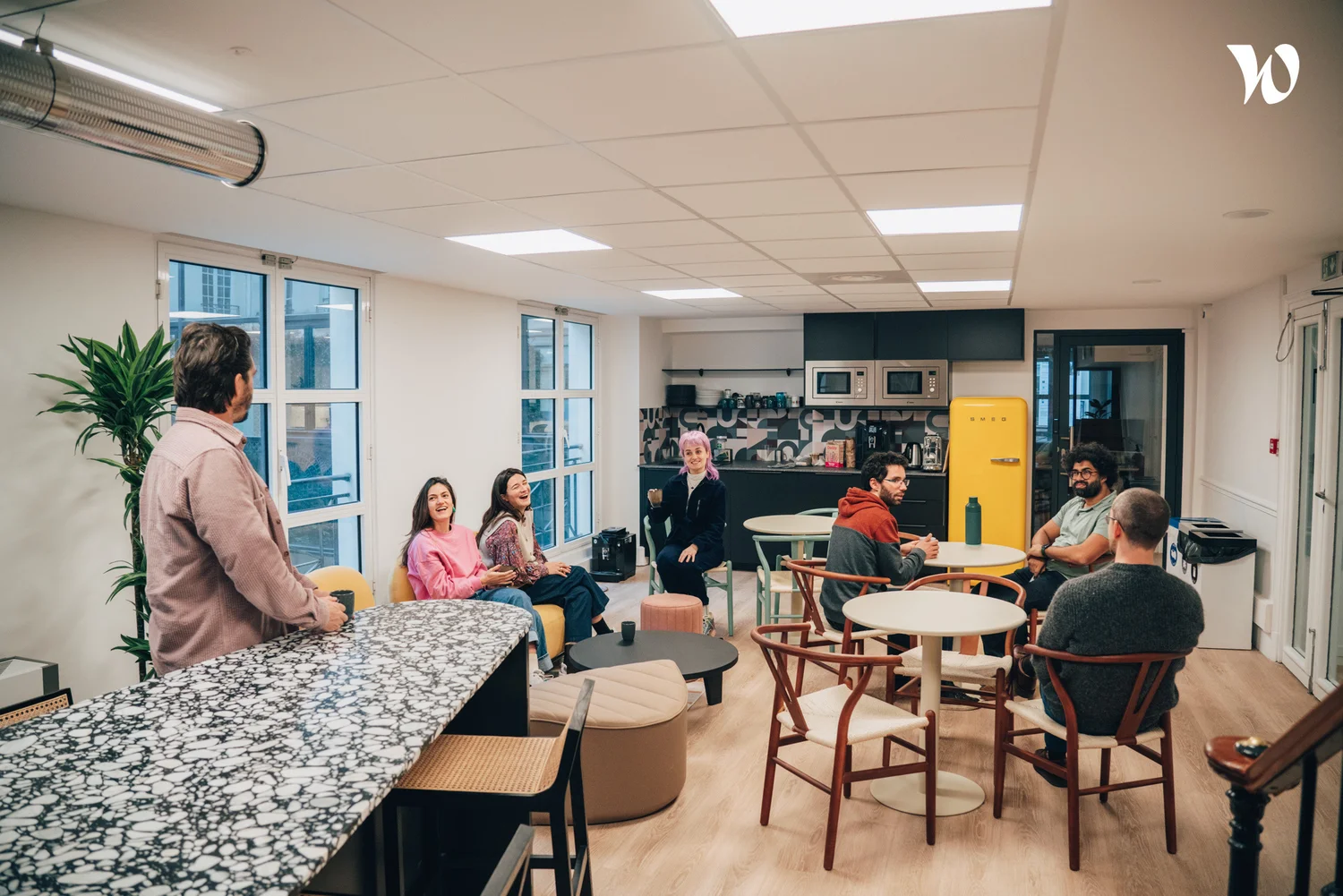
With offices in Paris and Annecy and several fully remote employees, Figures has developed an asynchronous culture. Claap is used to share company news, prepare meetings, comment on documents or communicate with investors and candidates.
For Virgile, the principle is simple: when a topic takes several minutes to explain, it is sometimes better to record a video than to gather everyone or write a long email.
Tools in this section
Why has Figures used Claap since its early days?
Figures adopted Claap at a time when the software was mainly positioned on asynchronous video, working much like Loom. This was before Lemlist acquired it.
Since then, Claap has moved toward sales use cases, notably recording customer conversations and the related automations. But Virgile still uses it first and foremost as a communication tool.
“We were Claap power users from the very beginning of the company, before they moved toward sales use cases. Historically, I made about 250 Claaps a year on average.”
He is not necessarily trying to produce reusable videos or to automate every exchange. Often, he simply opens Claap, shares his screen and talks through what he wants to convey.
This habit has gradually extended to almost everyone he works with, internally and externally.
How does Figures use Claap to reduce internal meetings?
At Figures, there is no big all-hands every week. The company holds one company-wide meeting per quarter.
Between these meetings, Virgile regularly records videos to share company news. Depending on the period, he publishes one every week, every two weeks or every three weeks.
In them, he goes over the main events, the decisions made and the changes underway.
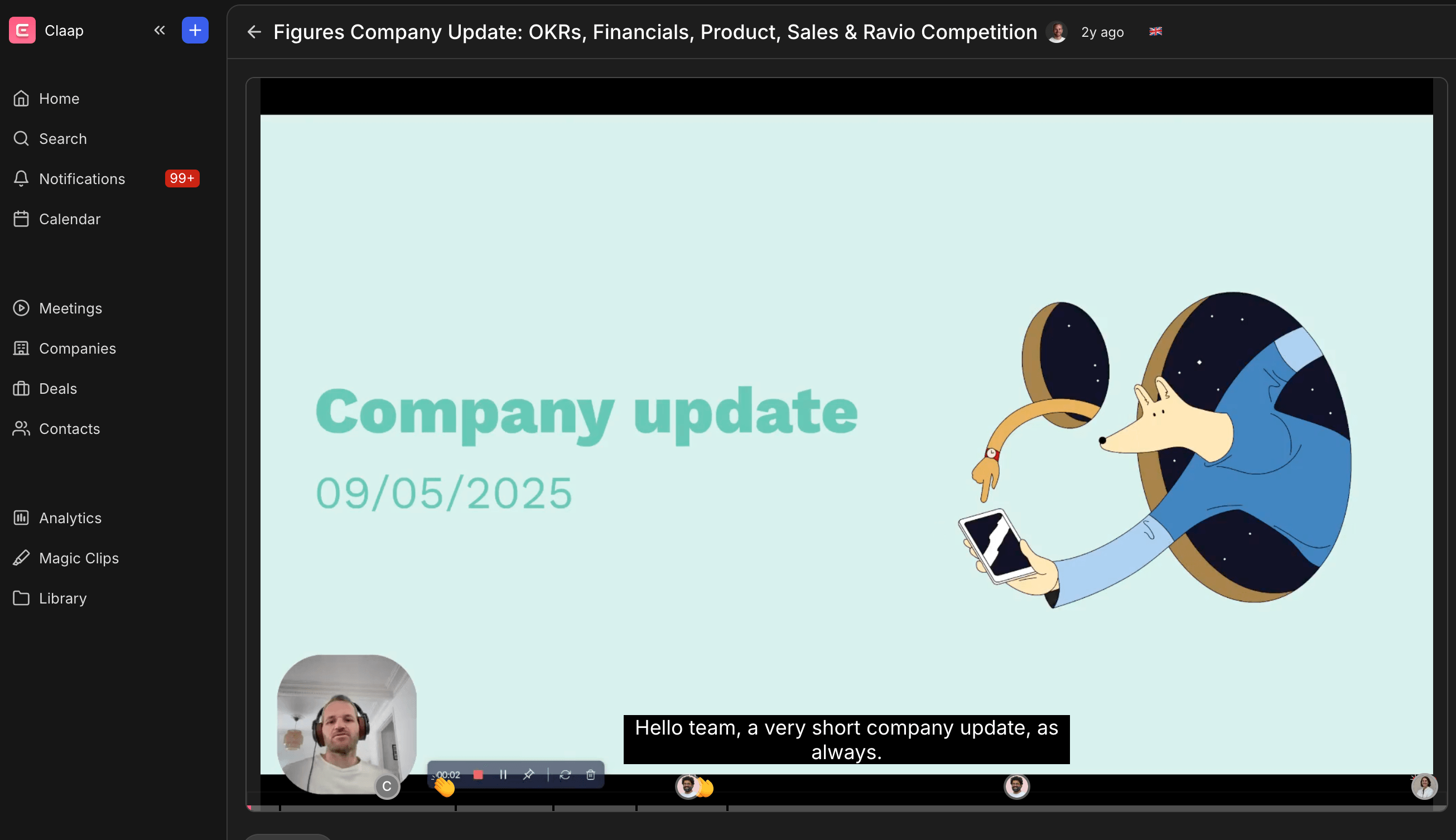
“We have an asynchronous culture at Figures. If you hold meetings so that people sit and listen to someone talk for half an hour, that's wasted time. We'd rather do a lot of company updates via Claap.”
Virgile acknowledges that this conviction also comes from his own experience. He has always found big company-wide meetings rather tiring, especially when they consist of listening to one presentation after another.
With Claap, everyone can watch the company news whenever suits them, without having to block thirty minutes in their calendar at the same time as all their colleagues.
Figures keeps meetings for topics that truly require a group discussion.
How does Figures prepare its meetings and board meetings with Claap videos?
One of the most frequent uses of Claap at Figures is video pre-reads, sent before meetings so that participants can review the information ahead of time.
Virgile gives the example of recent work on Figures' pricing and packaging.
“Before a meeting on our pricing and packaging, the person can make a fifteen-minute Claap to present the deck. That way, everyone shows up having seen the presentation. Personally, I lose my mind when we have a meeting with someone just clicking through slides.”
During the meeting, the team can go straight to the disagreements, the open questions and the decisions to be made.
Virgile particularly likes this format compared with written-only pre-reads. Video makes it possible to explain the nuances of a line of reasoning and to emphasize certain points without having to write several pages.
That said, writing remains essential when a document needs to be consulted, edited or reused over time. Figures therefore keeps its Notion pages and encourages people to accompany long or complex documents with a short explanatory video.
A video sent to investors before every board meeting
Virgile applies the same method with his investors.
Before every board meeting, he shares the presentation deck along with a Claap video in which he walks through the slides, comments on the results and explains the decisions or trade-offs.
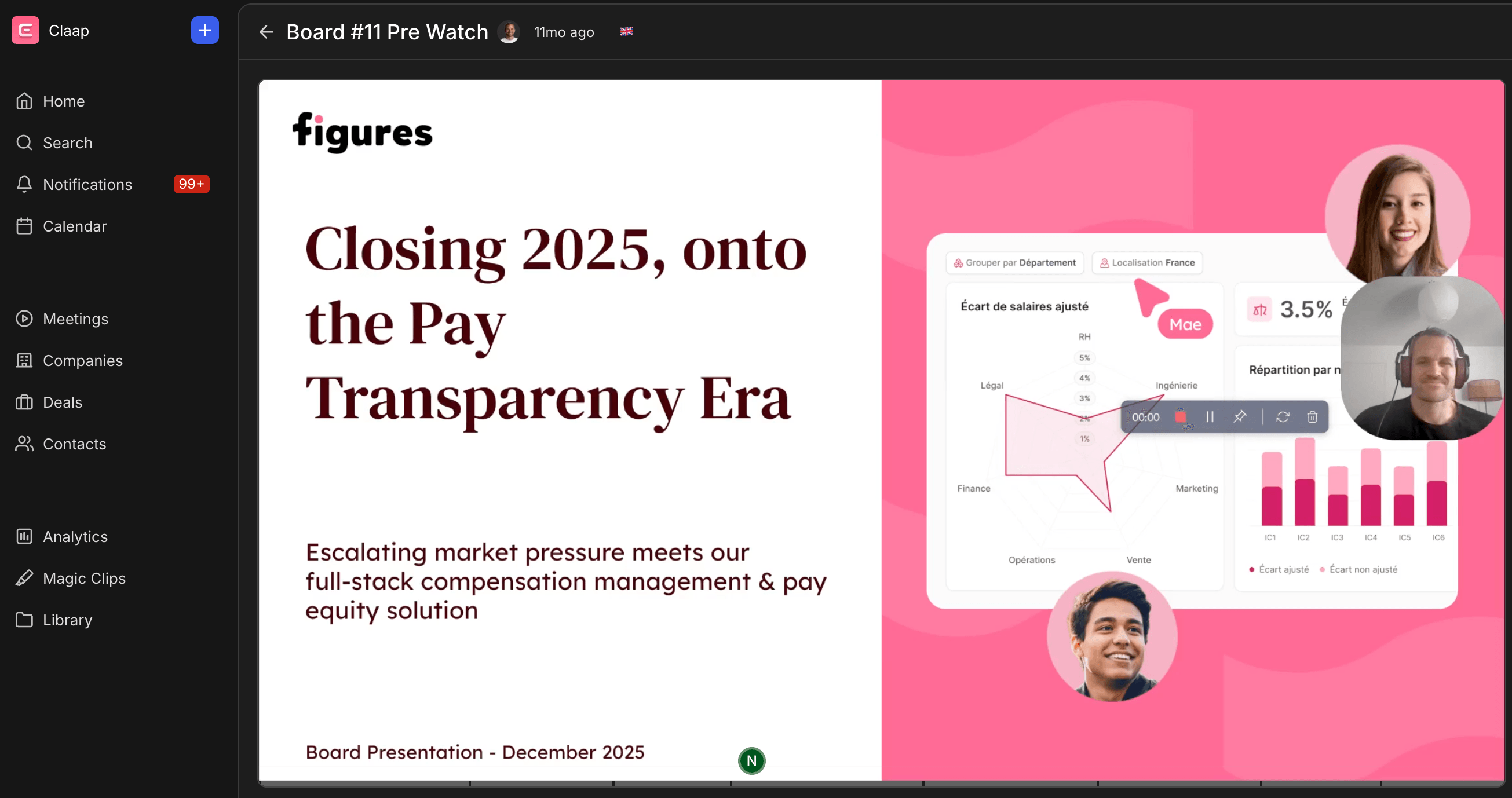
“Instead of doing long pre-reads, before every board meeting I send a deck to my investors, but I also make them a Claap video in which I walk through the deck. I find it's a tremendous way to do pre-reads.”
Investors thus arrive with the information they need to discuss the important topics directly. Virgile also finds video more personal than a long written document.
Why do final-round candidates receive a video from the CEO?
Virgile has also developed a rather unusual habit in recruiting.
Since Figures' early days, every candidate who reaches the final stage receives a Claap video recorded personally by the CEO.
He tells them the team wants to make them an offer, explains why it would like to work with them and goes over what it appreciated during the interviews.
“Every candidate in the final stage of recruiting receives a Claap from me. I explain that we're very happy to make them an offer, why we're happy and what we appreciated about them.”
The candidate thus receives a personal message from the founder, without the need to schedule an additional call. Figures also uses  Welcome to the Jungle and
 Teamtailor to manage its recruiting. Virgile particularly likes Teamtailor for the quality of its career pages and candidate experience.
Claap comes in at a different point in the process. It does not replace the ATS, but it makes it possible to personalize the communication around the offer.
How does Figures use Claap in its conversations with customers?
Asynchronous video is also used to answer customer questions. When a user asks how a feature works, the team can record a demo directly in the product rather than write a long reply.
“When a customer asks us a question, rather than writing a one-page document, we can make them a Claap video. We show them directly what they can do in the product. It's warmer, and the reactions are pretty positive.”
Virgile also uses this format with prospects and finds that the reactions are generally positive.
He is not necessarily trying to build a library of standardized videos. He often prefers to record an answer specific to the question asked, even when existing content could be reused.
Claap's price makes this spontaneous use easier. Virgile mentions a cost of about €10 to €15 per month for a plan that lets you record videos.
Another practical benefit: recipients do not need a Claap account to view the shared videos.
How do Claap and Wispr Flow complement each other at Figures?
Virgile also uses  Wispr Flow a lot, mainly for voice dictation.
He even considers himself a particularly heavy user. Figures has also started using Wispr Flow's meeting note-taking features.
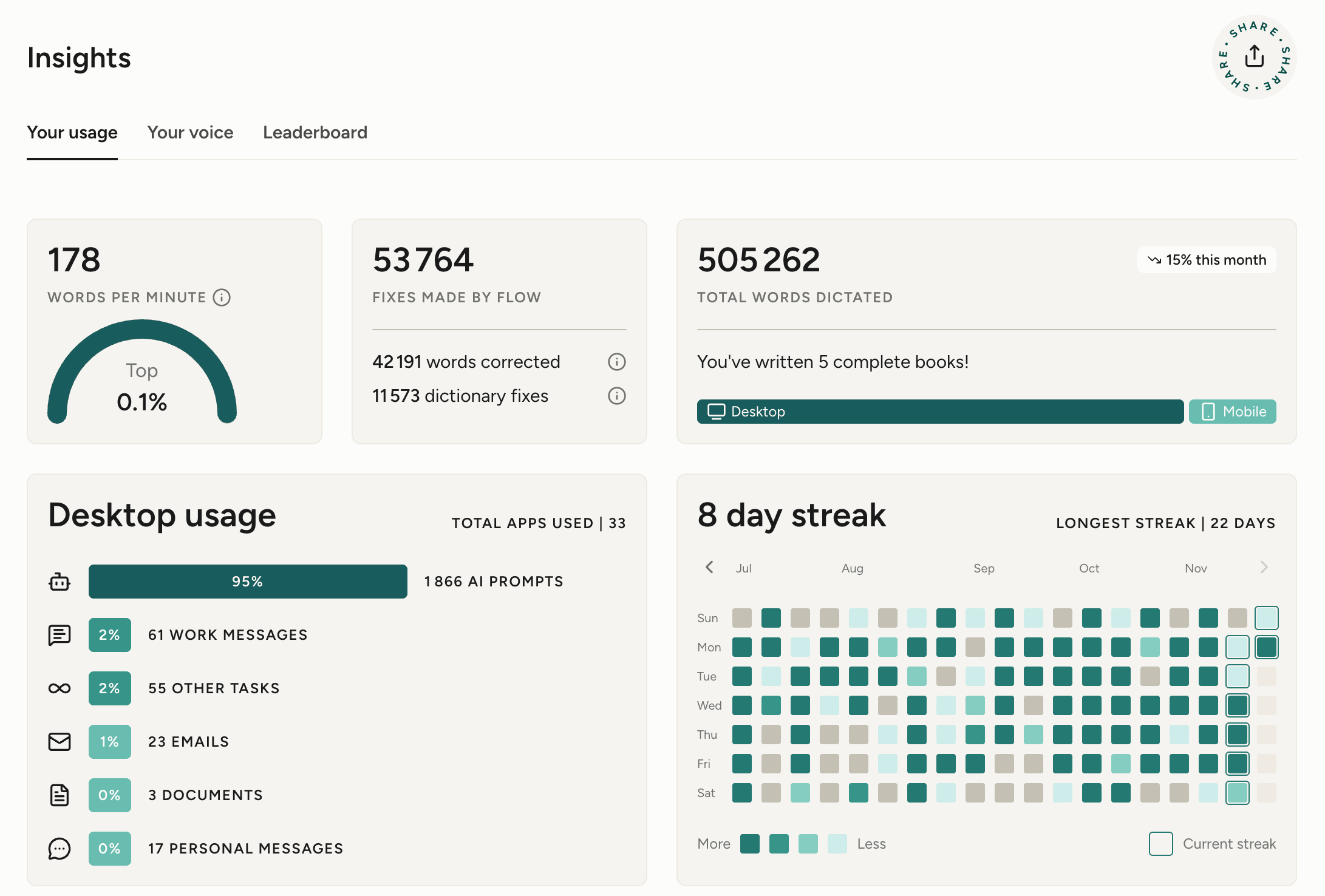
Claap remains the usual tool for recording meetings, but Wispr Flow can take over in certain situations, notably for conversations on a computer or when participants do not want an external tool to join the call.
The goal is to keep notes from every meeting, whatever the tool used.
Virgile also mentions  Plaud, a physical device paired with a phone, used by one of his acquaintances to record phone conversations.
What are the limits of asynchronous communication?
Despite all these uses, Virgile acknowledges that asynchronous communication remains hard to roll out widely.
He is personally convinced of its value, but finds that changing work habits takes a lot of effort.
“I have a real conviction about Claap. I think it's a much more productive and pleasant way of working. It's just that the change management, adapting to this way of working, is sometimes very complicated for some people.”
Employees are used to organizing meetings or writing messages. Recording a video means adopting a new reflex. Recipients also need to get into the habit of watching the videos before meetings.
At Figures, video is mainly used to convey context, while meetings are reserved for discussions that require being together.
In parallel, Claap has gradually taken on another role in the sales and product processes. The recorded conversations notably feed  HubSpot,
 Slack and
 Linear, with the help of Claude and its skills to structure the information.
The videos are then no longer used only to communicate. They also make it possible to capture the information exchanged with customers and pass it on to the sales and product teams.
Summary of the software this article mentions in Figures's stack
| Status | Workflow | Tool | Usage |
|---|---|---|---|
| In use | Asynchronous video / Conversation intelligence | Claap | Internal and external communication, meetings, calls and automations |
| In use | Documentation |  Notion | Reference documents and pre-reads |
| In use | Recruiting | Welcome to the Jungle | Recruiting and employer pages |
| In use | ATS / Recruiting | Teamtailor | Application management and candidate experience |
| In use | Voice dictation / Meeting notes | Wispr Flow | Heavy dictation and note-taking alongside Claap |
| In use | CRM | HubSpot | Receiving information from customer conversations |
| In use | Internal communication | Slack | Information sharing and notifications |
| In use | Product management | Linear | Tracking customer requests and feedback |
| In use | Artificial intelligence | Claude | Processing conversations and structuring information via skills |