




How does Lucca optimize its B2B acquisition? Quentin Lallemand and Damien Noblet present their marketing stack, from Addingwell to Meteoria, by way of LinkedIn Ads, Webflow and Livestorm, and explain the choices behind each tool.
Lucca is a French HR software vendor that sells an HRIS made up of 14 products across five product lines. To fuel its growth, the company relies on several acquisition channels, from SEO to paid, by way of webinars and content.
Quentin Lallemand is Director of Performance Marketing at Lucca. His team notably runs acquisition and seeks to generate leads qualified enough to feed the sales teams. Damien Noblet, for his part, works on Growth topics, particularly around paid and measurement.
At Lucca, paid brings in a volume of leads on the same order as SEO, with a substantial budget. But a large part of the work is not just about buying traffic: the company seeks to measure precisely where conversions come from and to send back to ad platforms data reliable enough to improve their algorithms.
This logic explains a fairly broad stack:  Addingwell for server-side tracking, LinkedIn, Google and Meta for paid,
 DatoCMS and
 Webflow for the website,
 Ahrefs and
 Monitorank for SEO,
 Meteoria for GEO, and
 Livestorm for webinars.
Taken separately, these tools meet different needs. But their value depends largely on how Lucca moves data between them.
Why does Lucca use Addingwell for its server-side tracking?
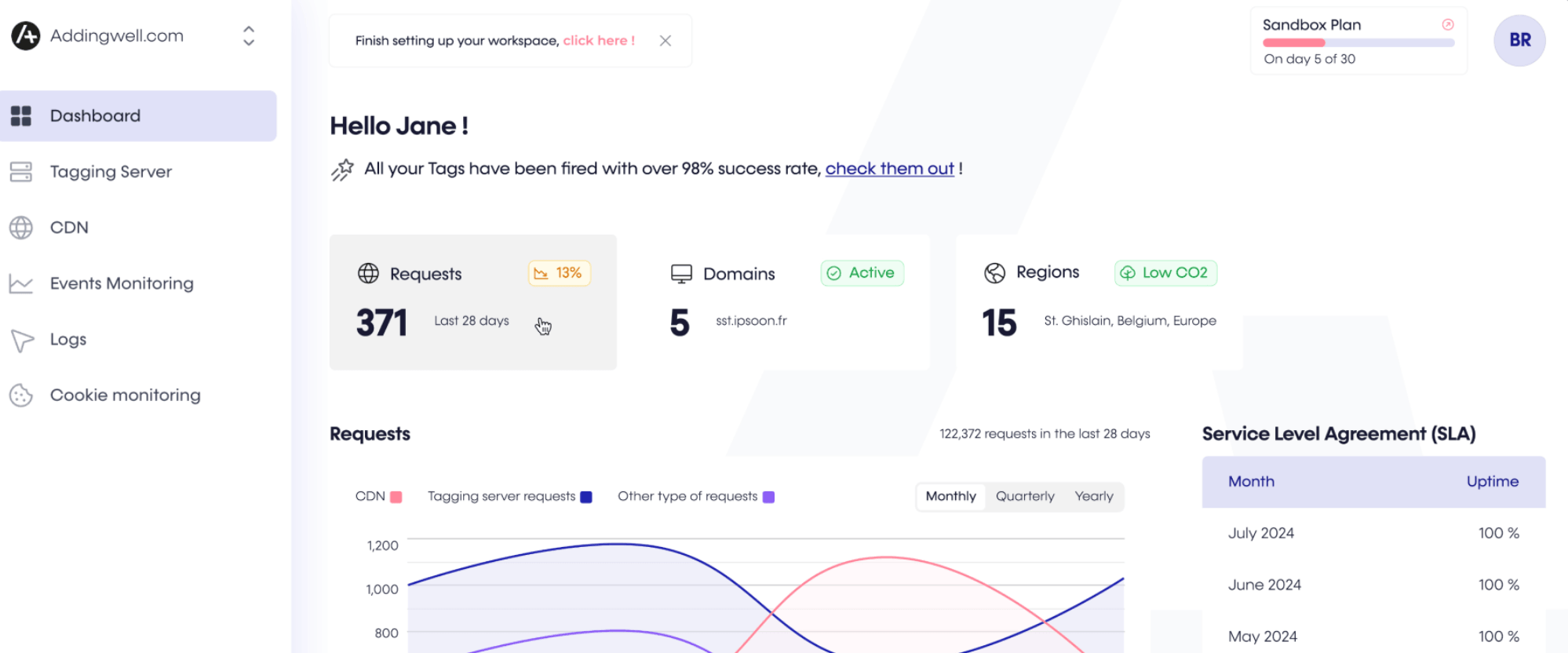
Lucca uses Google Tag Manager and GA4 for part of its website tracking, complemented by Addingwell to handle server-side tracking.
Lucca uses  Axeptio as its CMP (Consent Management Platform) and applies consent rules. The difficulty comes next: some browsers or ad blockers can still prevent part of the tracking scripts from working properly.
Addingwell makes it possible to route more data collection through the server side and to recover more complete data when consent allows it. It also helps Lucca handle certain issues with cookies across several domains and their lifespan.
For Lucca, the stakes are directly tied to the performance of its ad campaigns.
The algorithms of Google, Meta or LinkedIn rely on the conversions reported to them to optimize ad delivery. A poorly measured conversion therefore does not only degrade reporting: it also reduces the amount of information available to the platforms.
“On ads, the battle is largely fought over the quality of the data sent to the platforms. Addingwell helps us with that goal.”
Going server-side also makes it possible to enrich certain events before sending them to ad platforms. When Lucca has sufficiently precise CRM data, some information can be used securely to improve matching with the profiles the platforms already know.
This issue grows in importance as campaigns become more automated. Performance marketing work is no longer just about setting up campaigns, but also about feeding their algorithms properly.
Tools in this section
Why doesn't Lucca use LinkedIn, Meta and Google Ads the same way?
The three platforms do not work on exactly the same logic.
- Google Ads comes into play in particular when the user is already expressing intent through a search.
- LinkedIn and Meta can also be used higher in the funnel, but with different approaches.
For Damien Noblet, LinkedIn stands out above all for its self-reported data. The platform knows, among other things, the company, job title, industry or company size entered by the user. For a B2B player like Lucca, this data makes it possible to build audiences based on precise professional criteria.
Meta relies more on the power of its algorithms. Lucca sends it tracking events and some data from its CRM environment. The platform can then look for profiles similar to those showing the most valuable behaviors (lookalike).
Google Ads combines the strength of the explicit intent behind a query with the richness of the audience signals collected across its entire ecosystem. Trying to cover 100% of the volume on your target keywords is no longer relevant: performance now depends on adjusting bids on the highest-value profiles that the algorithm identifies within those queries.
Two approaches therefore coexist: precisely defining an audience with LinkedIn, or providing enough good signals to Google and Meta to let their algorithms find the relevant profiles.
How does Lucca use LinkedIn and Tinct.ai to test ABM?
Lucca is also starting to experiment with ABM campaigns on LinkedIn.
When the company has a list of target accounts, it can more precisely target certain companies and certain professional profiles thanks to the data available on the platform.
In parallel, Lucca is testing  Tinct.ai to personalize the landing pages tied to these campaigns. The idea is to extend personalization beyond the click: depending on the target account, the page can be tailored to the company Lucca is trying to reach. Personalization can also apply to the person delivering the message. On an HR topic, for example, a campaign can be fronted by a CHRO and aimed at an audience of CHROs.
ABM can thus come into play at several levels: target account, audience, message, landing page and the person delivering the communication.
At the time of the interview, the Tinct.ai test is still recent and Lucca does not yet have enough perspective to evaluate the results.
The company had also looked at  Userled, positioned on comparable uses. Tinct.ai was chosen in particular because the team wanted to move quickly, with a lower entry cost and enough flexibility to manage the pages directly.
Tools in this section
Why does Lucca combine DatoCMS and Webflow for its website?
A campaign's performance also depends on how quickly the teams can create the pages it needs.
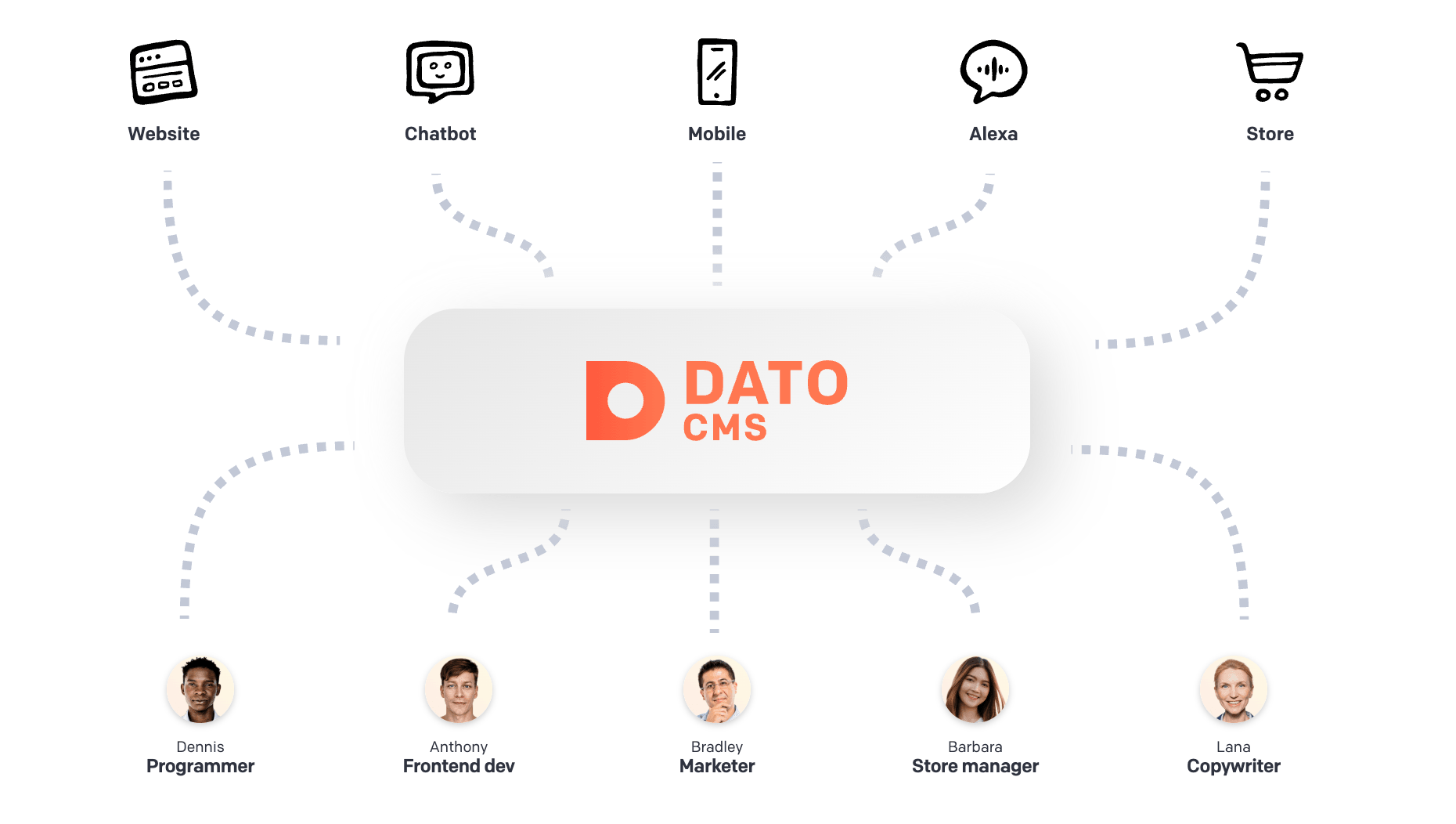
Lucca uses DatoCMS for its main website and Webflow for part of its marketing landing pages.
This setup stems from a historically more fragmented architecture, with different parts of the site and several languages or countries to manage. DatoCMS made it possible to bring content closer together in a shared headless CMS while keeping flexibility for local teams.
Webflow meets a different need: marketers' autonomy.
The teams can prepare templates and then let marketers edit titles, copy and content without always calling on developers. The main website changes less often, while the landing pages tied to campaigns or emails need to be able to evolve much faster.
Lucca applies a similar logic with  Canva for some graphic content: a specialized team prepares the framework, then the marketing teams can more easily create variations of the designs.
Tools in this section
Why does Lucca use Microsoft Clarity alongside GA4?
GA4 makes it possible to measure a page's performance, but not always to understand what visitors do on it.
Lucca therefore uses  Microsoft Clarity to observe click areas, scroll depth and various interactions. This behavioral data helps in particular to understand why a landing page underperforms, and it complements the quantitative view provided by
 GA4. The fact that Clarity is free is also an advantage for this use.
Tools in this section
How does Lucca combine Ahrefs, Monitorank and Screaming Frog for its SEO?
Lucca handles most of its SEO in-house, with occasional support from agencies, mainly for capacity reasons.
The stack relies on four complementary tools.
- Google Search Console is used to manage overall SEO performance, monitor page indexing and identify users' key queries. In parallel, the rollout of features dedicated to measuring AI visibility (GEO), YouTube and social networks makes it possible to refine the analysis of traffic coming from these different channels.
- Ahrefs is used for semantic research, keyword analysis, competitive analysis and identifying opportunities.
- Monitorank is used for precise tracking of rankings on important keywords. Part of this analysis could also be done in Ahrefs, but Lucca keeps Monitorank to have an environment historically configured around rank tracking.
 Screaming Frog handles technical SEO. The team regularly crawls the site to identify problems, broken links or anomalies that could affect how Google crawls it. Quentin Lallemand describes this use as a technical “sanity check”.
The three tools are therefore not really interchangeable in the way Lucca uses them: Ahrefs is used mainly to understand opportunities, Monitorank to track rankings and Screaming Frog to check the technical health of the site.
Tools in this section
Why does Lucca use Meteoria to measure its visibility in ChatGPT?
Lucca more recently added Meteoria to its stack to track its visibility in generative engines.
The measurement problem is very different from that of traditional SEO.
On Google, teams can track keywords, their volumes and their rankings. In ChatGPT, Perplexity and AI Overview, it is not possible to track keywords that way (not available via API).
Lucca therefore selects a set of queries or prompts considered important and monitors its presence on them.
Meteoria lets Lucca track in particular its presence in generative engine answers, its level of visibility against certain competitors and the sources cited. The team started by tracking ChatGPT before gradually extending the scope to Perplexity and AIO, then Gemini and Claude.
In a field that is still new, where tracking is less deterministic than in classic SEO, Meteoria thus gives Lucca a first framework to measure its visibility and follow how it changes over time.
The team also highlights the quality of the support provided by Meteoria, in a market that is evolving quickly:
“We get really good support from Meteoria. We've asked them for advice quite a bit because things change very fast. Honestly, they're great.”
Tools in this section
Why did Lucca leave Zoom Events and return to Livestorm?
Webinars play an important role in Lucca's marketing strategy, both for acquisition and for cross-sell.
The company now uses Livestorm, after testing  Zoom Events for reasons of price and consolidation, since Lucca already used Zoom for its meetings. The test was ultimately not kept. The main limitation mentioned does not concern the quality of the video conferencing but the depth of the tracking.
Lucca wants to be able to know who registered, who attended, how long a person stayed and, above all, which marketing source brought them to the webinar.
When an acquisition campaign represents several thousand euros in spend, the team wants to be able to tie registrations and attendees to their sources and send them into Pardot/Salesforce.
Zoom Events did not meet this need well enough during the test. Lucca therefore returned to Livestorm, which it considers better suited to its needs for webinars, polls, interactions and measurement.
Tools in this section
Summary of the software this article mentions in Lucca's stack
| Status | Workflow | Tool | Usage |
|---|---|---|---|
| In use | CMS | DatoCMS | Headless CMS used for the main website and its variants |
| In use | Landing Pages | Webflow | Lets marketing teams quickly create and edit landing pages |
| In use | Web AnalyticsPaid Acquisition |  Google Ads | Traffic and conversion measurementAcquisition in particular on searches that already express intent |
| In use | Tracking |  Google Tag Manager | Management of the website's events and tracking |
| In use | Web Analytics | Microsoft Clarity | Heatmaps, scroll and analysis of on-page behavior |
| In use | Server-side Tracking | Addingwell | Improves data collection and the data sent to ad platforms |
| In use | Paid Acquisition |  LinkedIn | B2B targeting, paid campaigns and first ABM uses |
| In use | Paid Acquisition |  Meta | Campaigns driven more by algorithms and data |
| In use | ABM | Tinct | Personalization of landing pages based on target accounts |
| In use | ABM | Userled · Écarté | Alternative to Tinct.ai that was considered |
| In use | SEO | Ahrefs | Semantic research, competitive analysis and identification of opportunities |
| In use | SEO | Monitorank | Precise tracking of keyword rankings |
| In use | SEO | Screaming Frog | Crawls and technical checks of the website |
| In use | GEO | Meteoria | Measurement of Lucca's visibility in ChatGPT and generative engines |
| In use | Webinar | Livestorm | Webinars, interactions with attendees and flow of marketing data |
| In use | Webinar | Zoom | Solution tested before returning to Livestorm |
| In use | Design | Canva | Self-serve adaptation of designs from templates |