


Julien Frèche joined Folk to grow its revenue and sales operations. He explains how the CRM combines Claude, Clay, Snitcher and Lemlist to identify prospects, enrich its data and automate its campaigns. He also discusses the limits of Clay and the reasons that led him to launch Tulina.ai.
At Folk, prospecting does not always start with a list of contacts. It can start from a company visiting a product page, an agency likely to recommend the CRM, or a new user whose profile needs to be enriched.
To make use of these signals, Folk combines  Snitcher,
 Clay,
 Claude and
 Lemlist, with its own CRM at the center of the setup. Julien Frèche gradually built AI agents capable of researching information, forming hypotheses and adapting their actions based on the results.
But he has not given up on traditional automations. Clay keeps an important place for the most predictable processes, while Claude takes on the workflows that require more flexibility.
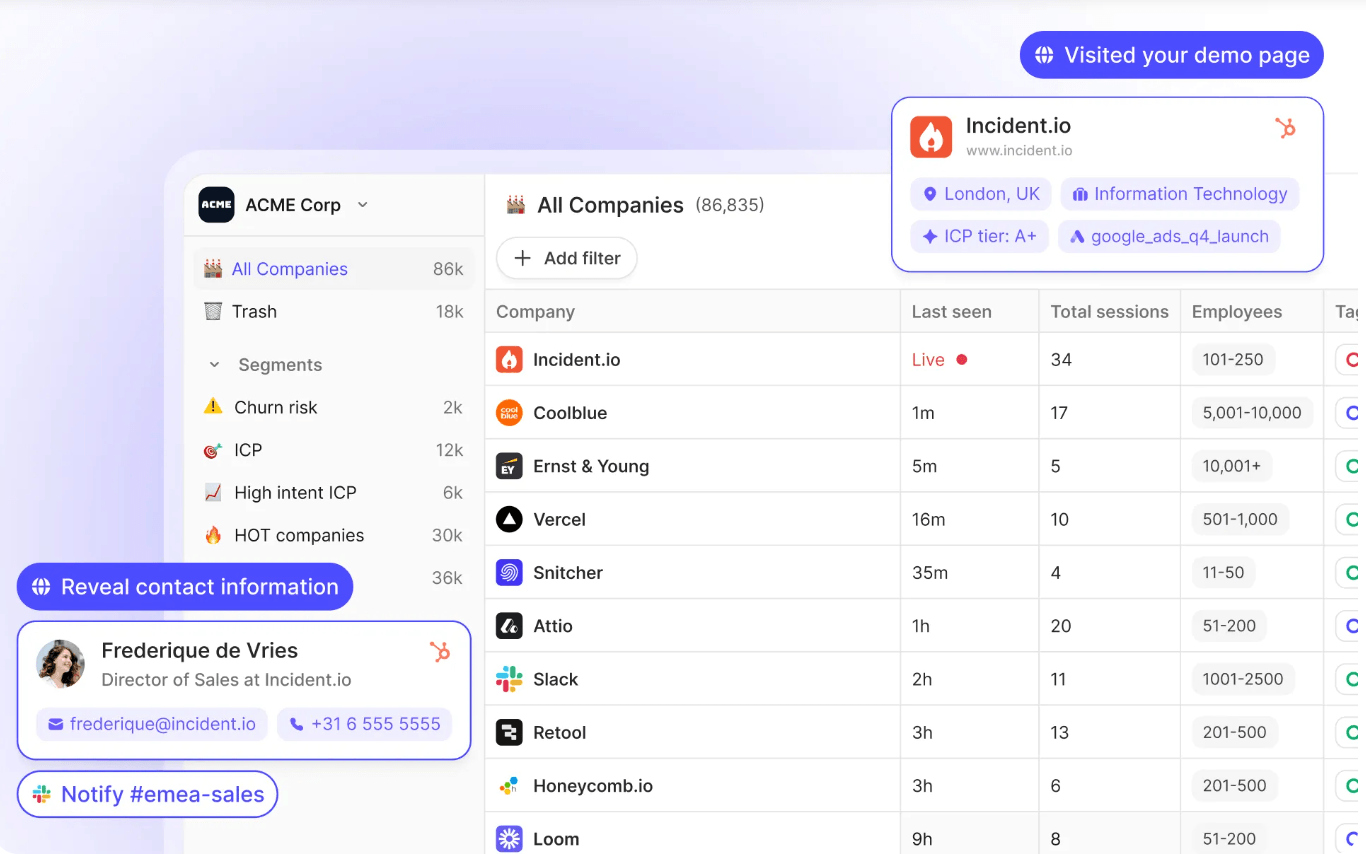
How Folk identifies the companies visiting its website with Snitcher
To find out which companies are browsing its website, Folk uses Snitcher, a B2B visitor identification tool.
Julien explains that he chose this solution in part because it was already being used behind the scenes by other players in the market, including Lemlist and Clay, based on what he knew of their integrations. Rather than going through these intermediaries, he preferred to connect directly to Snitcher to cut costs and have more ways to use the data.
“Going directly through Snitcher got us better prices, but also more options for sending the leads. We can push them into Lemlist for outreach or into Google Ads, with a more global approach.”
But identifying the companies that visit a website can quickly get expensive when you receive several thousand visits a month. Folk therefore decided to filter the signals before processing them.
“We don't track leads that only come to the homepage. It's not a strong enough signal.”
A simple visit to the home page is therefore not enough. Folk focuses on companies that browse pages revealing a stronger buying intent, such as product pages or pricing.
A geographic filter also makes it possible to focus on the countries where conversion odds are highest. This reduces the volume of visits to process and avoids paying for companies that are unlikely to become customers.
The identified companies can then be sent to Lemlist to launch prospecting campaigns. Julien also mentions the option of using them to build audiences in Google Ads.
How Claude finds the contacts most likely to have visited the website
Snitcher identifies a company, but not necessarily the person who visited the website. That is where Claude comes in.
Before searching for new contacts, the agent checks in Folk and  Intercom whether the company is already known. If a salesperson is in touch with it, they can receive a notification. If the prospect has already created an account, Folk avoids needlessly adding them to a new campaign.
For unknown companies, Claude cross-references several pieces of information: the location of the visit, the pages viewed and the company's characteristics.
Julien gives a simple example. If a visit comes from Bordeaux and the identified company has only one employee in that city, that person becomes a likely contact. In the same way, a visit to pages dedicated to Customer Success can lead Claude to prioritize employees in that function.
“We send Claude the location, the pages visited and the company. It then queries the Lemlist and Clay databases to determine the two or three contacts most likely to have visited our website.”
The goal is to identify two or three likely contacts, not to find the visitor with certainty. Julien also points out the European constraints on identifying individual internet users (vs. the US, which is not subject to the GDPR)
These routines run daily, sometimes over windows of about twelve hours, to act on the signals while they are still fresh.
Tools in this section
Clay or Claude: why Folk still uses both
Despite his interest in AI agents, Julien has not replaced all his automations with Claude. Folk has used Clay for several years, in particular to enrich the information of people who create an account.
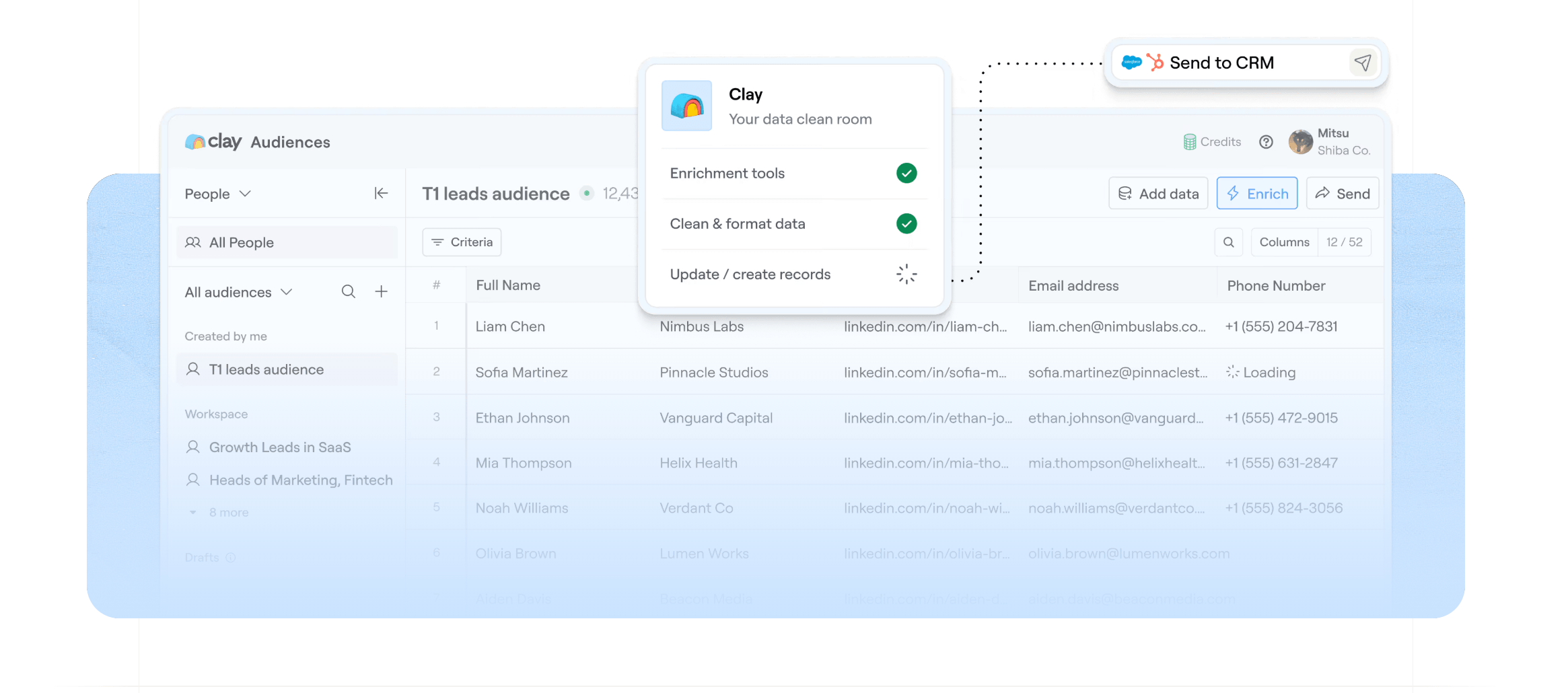
The process is fairly simple. When a user signs up,  Segment collects the event and passes the information to Intercom. Clay then retrieves the data needed to identify the company associated with the email address, enrich the profile and add information useful for qualifying it.
The data is sent back to Intercom, which can trigger onboarding communications or feed campaigns in Lemlist.
“For signups, we're sticking with Clay because it's deterministic and it's always the same process.”
For Julien, Clay works well when you know in advance which steps to run. With every signup, the same operations repeat, with no need to make new decisions.
On the other hand, as soon as a workflow requires researching information, testing different leads or changing its behavior depending on the results, he prefers to use Claude.
“I find that Clay is an old-school solution that isn't really optimized for agentic work anymore.”
His feedback is not about the quality of the data obtained with Clay, but about the way automations are built.
With Clay, the user defines a sequence of steps for the tool to run. With Claude, Julien prefers to give the agent a goal and leave it more freedom to decide how to reach it.
Claude can thus query several sources, verify information, modify a sequence or handle situations that had not been anticipated. This flexibility is particularly useful to him for prospecting partners.
How Folk prospects 50 partner agencies a day with Claude and Lemlist
Partners play an important role in Folk's acquisition. The company is notably looking to grow its network of agencies that implement CRMs and consultants likely to recommend the software to their clients.
To identify and contact these partners, Julien built several routines with Claude.
The process relies on five steps:
1. Identify new agencies. A first Claude routine regularly searches for companies in various databases, including those accessible through Lemlist.
2. Centralize the information in Folk. The identified agencies are added to the CRM.
3. Select 50 qualified agencies a day. A second routine chooses the companies to prospect.
4. Identify the right people and personalize the messages. Claude searches for the right contacts, enriches their information and writes each email and LinkedIn message individually.
5. Run the campaigns in Lemlist. Claude drives the sequences through the Lemlist MCP.
“Everything is written by Claude and everything is orchestrated by Claude.”
The personalization goes well beyond inserting a first name or company name into an email template.
Julien recalls that, historically, Lemlist offered spintax mechanisms, among others. The idea was to automatically vary certain words or phrases. A message could, for example, start with “Bonjour,” “Hello” or “Hi,” to avoid sending exactly the same text to every recipient.
With Claude, the entire message can be written differently, depending on the company, the recipient and the sales context. Julien believes this variety can also improve deliverability, by limiting the sending of identical content at scale.
Folk could use the AI features built directly into Lemlist. But Julien prefers to hand the writing and orchestration over to Claude, which has more context about the company.
“Lemlist offers its own agent, but we prefer to use Claude to create our sequences in Lemlist. Claude knows our context, which Lemlist's agent doesn't, and it can handle the edge cases in our workflows.”
In this setup, Claude prepares the actions and writes the messages, while Lemlist runs the campaigns.
Julien reports getting about a 10% response rate on these partnership campaigns. He notes, however, that the offer is attractive for agencies: Folk offers them a revenue share system, with compensation on the deals they bring in.
Why Folk went back from LaGrowthMachine to Lemlist
Before building these routines with Claude, Folk had already tested several prospecting solutions. The company initially used Lemlist, then switched to  LaGrowthMachine, before coming back to Lemlist about a year and a half before the interview.
Julien particularly liked LaGrowthMachine for its ability to handle complex scenarios, with many conditional branches.
But Lemlist gradually expanded its features. The tool now handles email, LinkedIn, calls and other prospecting channels. It is also used to enrich contacts and prepare outreach sequences.
For Folk, this makes it possible to bring more use cases together in a single piece of software, rather than multiplying the tools available to salespeople.
In parallel, Folk relies on several enrichment providers integrated into its CRM, including  Apollo,
 Dropcontact,
 Datagma,
 Prospeo and
 Wiza. Julien also mentions FullEnrich among the complementary solutions available.
The idea is to cross-reference different sources rather than depend on a single provider. According to Julien, no database covers the entire market on its own.
From Folk to Tulina.ai: letting teams share their AI agents
It was while building these automations at Folk that Julien identified a new difficulty: the routines he builds with Claude work in his personal environment, but are hard to share with his colleagues.
“If I want to share my workflow with my CEO or another Ops person at the company, I can't share my routine.”
A colleague therefore cannot easily take over a routine, modify it or evolve it with the rest of the team. This is one of the reasons that led Julien to leave Folk and launch  Tulina.ai.
Tulina is designed to let Revenue Operations teams create, host and share agentic workflows, while connecting their software and their data providers.
It simplifies access to enrichment databases. Today, a team may need several subscriptions to search for contacts or enrich its data, with each provider having its own strengths and limitations.
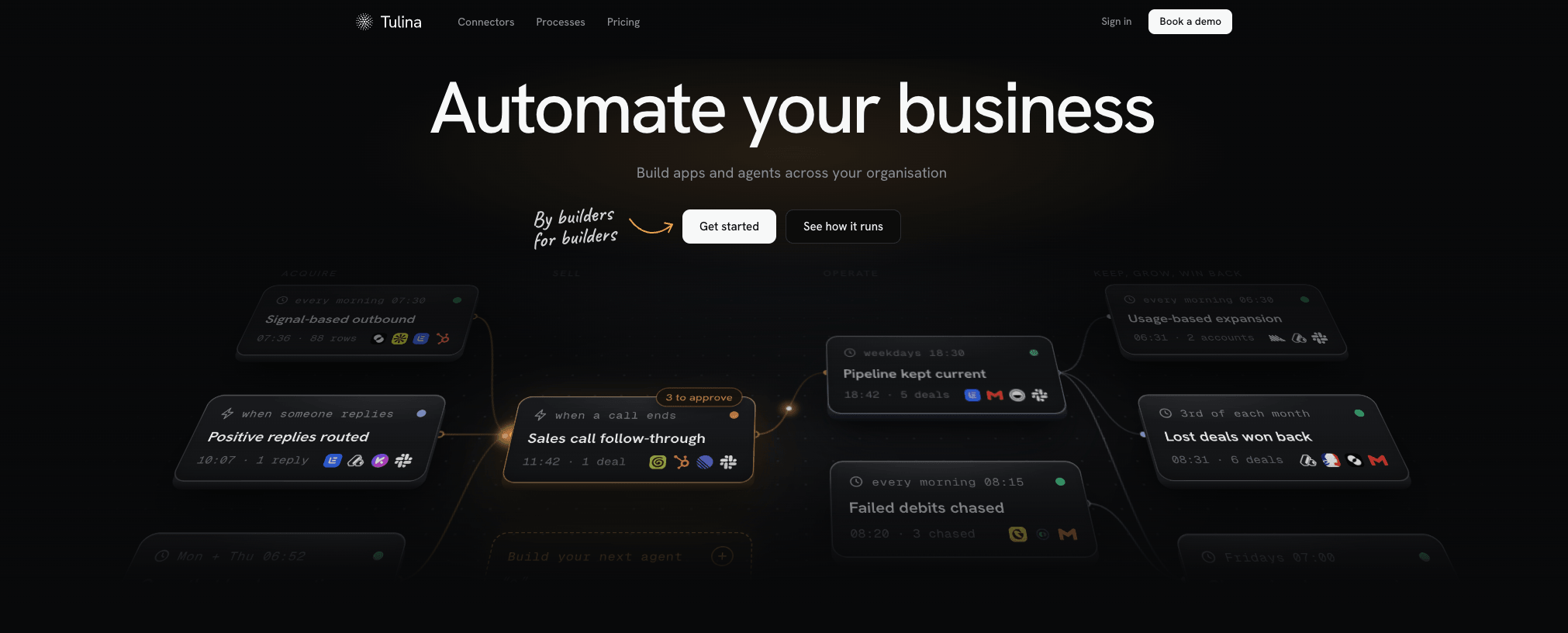
With Tulina, Julien offers a pooled credit system that provides access to several sources from a single subscription.
“No data provider has the whole market. With Tulina, the idea is to have one subscription and a credit system that give access to several databases, like Apollo or Ai Ark, rather than piling up subscriptions.”
He notably cites Apollo,  Ai Ark and
 Apify among the providers or services that can be accessed this way.
The same principle applies to other categories of software, such as the SEO tools Ahrefs and Semrush, or solutions for tracking visibility in AI engines.
Julien also compares Tulina to  Cargo, which he considers, like Clay, more geared toward building deterministic workflows.
With Tulina, he is extending what he started building at Folk, by allowing other teams to create, share and collectively evolve their own Growth AI agents.
Summary of the software this article mentions in folk's stack
| Status | Workflow | Tool | Usage |
|---|---|---|---|
| In use | CRM |  folk | Managing contacts, companies and sales context |
| In use | AI / orchestration | Anthropic | Qualification, research, writing and workflow orchestration |
| In use | Visitor identification | Snitcher | Identifying companies visiting the website |
| In use | Multichannel prospecting | lemlist | Enrichment and campaign execution |
| In use | Enrichment / automation | Clay | Signup enrichment and deterministic workflows |
| In use | Customer relations | Intercom | Checking existing users and onboarding |
| In use | Data collection | Segment | Collecting signup events |
| Replaced by Lemlist | Multichannel prospecting | La Growth MachineReplaced by Lemlist | Former prospecting tool, replaced by Lemlist |
| In use | B2B enrichment | Apollo.io | Data provider integrated into Folk |
| In use | B2B enrichment | Dropcontact | Data provider integrated into Folk |
| In use | B2B enrichment | Datagma | Data provider integrated into Folk |
| In use | B2B enrichment | Prospeo | Data provider integrated into Folk |
| In use | B2B enrichment | Wiza | Data provider integrated into Folk |
| In use | SEO |  Ahrefs | SEO tool also cited as an example for Tulina credits |
| In use | Prospecting / professional network |  LinkedIn | Prospecting channel for partner agencies |