



Guillaume Vignerot, freelance VP Sales at Modjo, whose mission has refocused on outbound, explains to Soft Atlas how the company combines its own technology with Salesforce and Dust. From qualifying opportunities to preparing forecasts and generating sales presentations, he details the internally developed AI agents and the choices that structure their use.
At Modjo, salespeople use  Dust to query data from Salesforce and their own platform, analyze their opportunities, and prepare their forecasts. They can also generate personalized sales presentations of five or six slides from recorded conversations with their prospects.
These uses go beyond call transcription.  Modjo creates a sales memory that AI agents can exploit to identify risks, recommend actions, and prepare meetings.
The Sales team chose to standardize its AI uses on Dust, while Marketing extensively uses Claude. Meanwhile, Modjo seeks to integrate more features into its own product and invests in its MCP to make its data accessible to external tools.
Guillaume Vignerot, who has been with the company for about six months, explains how this organization transforms the daily lives of salespeople and their managers.
Tools in this section
How does Modjo transform sales conversations into actionable data?
Modjo captures interactions between sales teams and their prospects or clients: phone calls, emails, video conferences, and in-person meetings. The AI then structures this information to make it actionable.
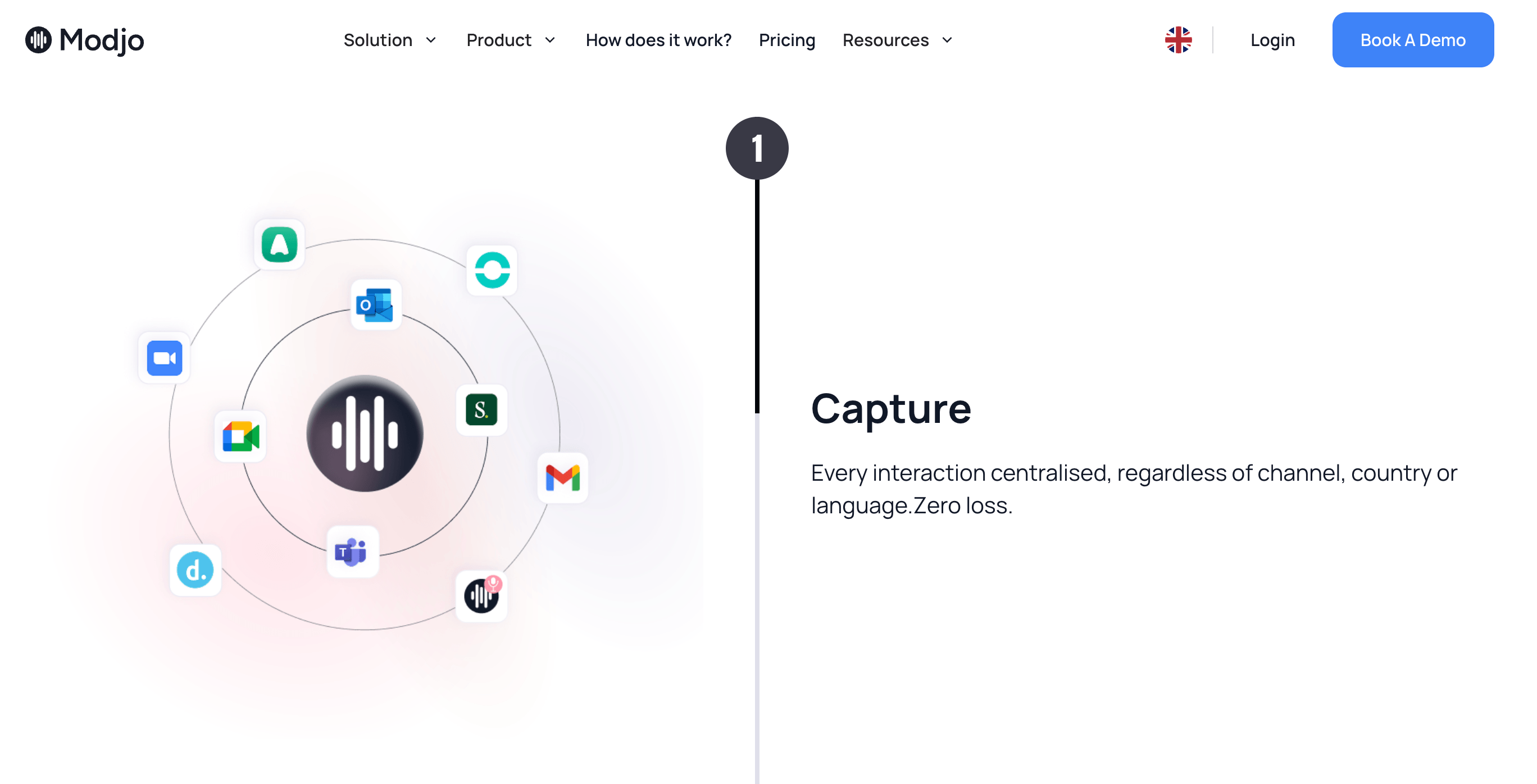
Guillaume distinguishes three main uses: productivity, sales performance, and execution quality.
The first concerns administrative tasks. After a meeting, a salesperson must write a report, send a follow-up email, update their CRM, and prepare the next steps. Modjo automates part of these operations from recorded conversations. According to Guillaume, these tasks typically represent two to four hours per week for a salesperson.
The second use concerns sales management. The collected data allows AI agents to detect opportunities, identify churn risks, and help managers consolidate their forecasts.
Finally, Modjo is used to analyze sales practices, especially during the onboarding of new BDRs, AEs, AMs, or CSMs.
“Modjo creates a kind of sales memory and sales identity that generalist LLMs cannot have on their own.”
Guillaume compares this approach to that of generalist LLMs like ChatGPT, Claude, or Dust. These solutions can analyze and produce content, but they do not spontaneously have the history of a company's sales interactions.
The value of Modjo lies in this context: the conversations, decisions, commitments, and business relationships, which different AI agents can then exploit.

How does Modjo enrich Salesforce and prioritize opportunities?
 Salesforce is Modjo's main CRM, while
 HubSpot is used for marketing activities. The sales workflows described by Guillaume rely primarily on Salesforce.
When a salesperson takes over an account, they often need to consult multiple sources to understand previous exchanges: the CRM, emails, reports, and notes from colleagues. The integration between Modjo and Salesforce allows them to more easily retrieve this history.
An AE or AM can thus identify decision-makers, champions already met, commitments made, and next actions. Modjo adds a layer of context to the structured data of the CRM.
This logic also applies to pipeline prioritization. Guillaume gives the example of a portfolio of 60 active accounts. Rather than having the salesperson go through all their opportunities, Modjo can recommend the three accounts to prioritize.
The platform relies notably on conversations to identify progress signals. Has a champion been identified? Can they connect the salesperson with the economic buyer, the decision-maker? Are the qualification criteria sufficiently documented?
The analysis no longer relies solely on the amount or stage declared in the CRM. It incorporates the information actually exchanged with prospects.
The same logic applies to risks. Guillaume mentions the case of a dormant account whose renewal is due in three months. If no discussion has been initiated, Modjo can signal the risk of missing the next competitive bid.
“Out of your 60 active accounts, Modjo can tell you which three accounts you should prioritize. It has conducted a diagnosis and identified the elements that justify treating these opportunities as a priority.”
The salesperson has contextualized recommendations rather than just a simple list of opportunities. They retain the final decision but can rely on a diagnosis built from their interactions.
“We move from a passive mode to an active mode, with the ability to take initiatives.”
The CRM is no longer just for recording sales activity. The data it contains, enriched by conversations, allows for recommending the next actions.
How does Modjo automate its forecasts with Dust and the Modjo MCP?
This is one of the most concrete internal workflows described by Guillaume. The Sales team uses Dust to create agents capable of simultaneously querying Salesforce and the Modjo MCP.
The two platforms provide complementary information:
- Salesforce provides structured pipeline data: opportunities, sales stages, and information recorded in the CRM.
- Modjo provides the context of conversations: qualification elements, objections, commitments, identified contacts, and information exchanged during meetings.
The Dust agents cross-reference this data to analyze each opportunity. They can examine the qualification criteria of a deal, identify those that are confirmed, and find the elements that justify this qualification.
An agent can, for example, indicate that an opportunity is advanced in Salesforce while several criteria remain insufficiently documented in the conversations. Conversely, it can find the precise commitments of a prospect to justify the presence of a deal in the forecast.
The goal is to build forecasts that no longer rely solely on the statements of salespeople.
Guillaume also appreciates Dust's ability to produce personalized reports. The agents generate forecast artifacts presenting the pipeline, confirmed criteria, points to clarify, and possible action plans for each opportunity.
Managers thus have a structured summary before their sales reviews.
Guillaume estimates that some sales directors spend three to four hours on Friday afternoons preparing their forecast. With this type of automation, the potential gain would be two to three hours per week.
The benefit is not limited to time saved. Pipeline reviews can focus more on decisions to be made, risks to be mitigated, and actions to be taken, rather than on reconstructing information.
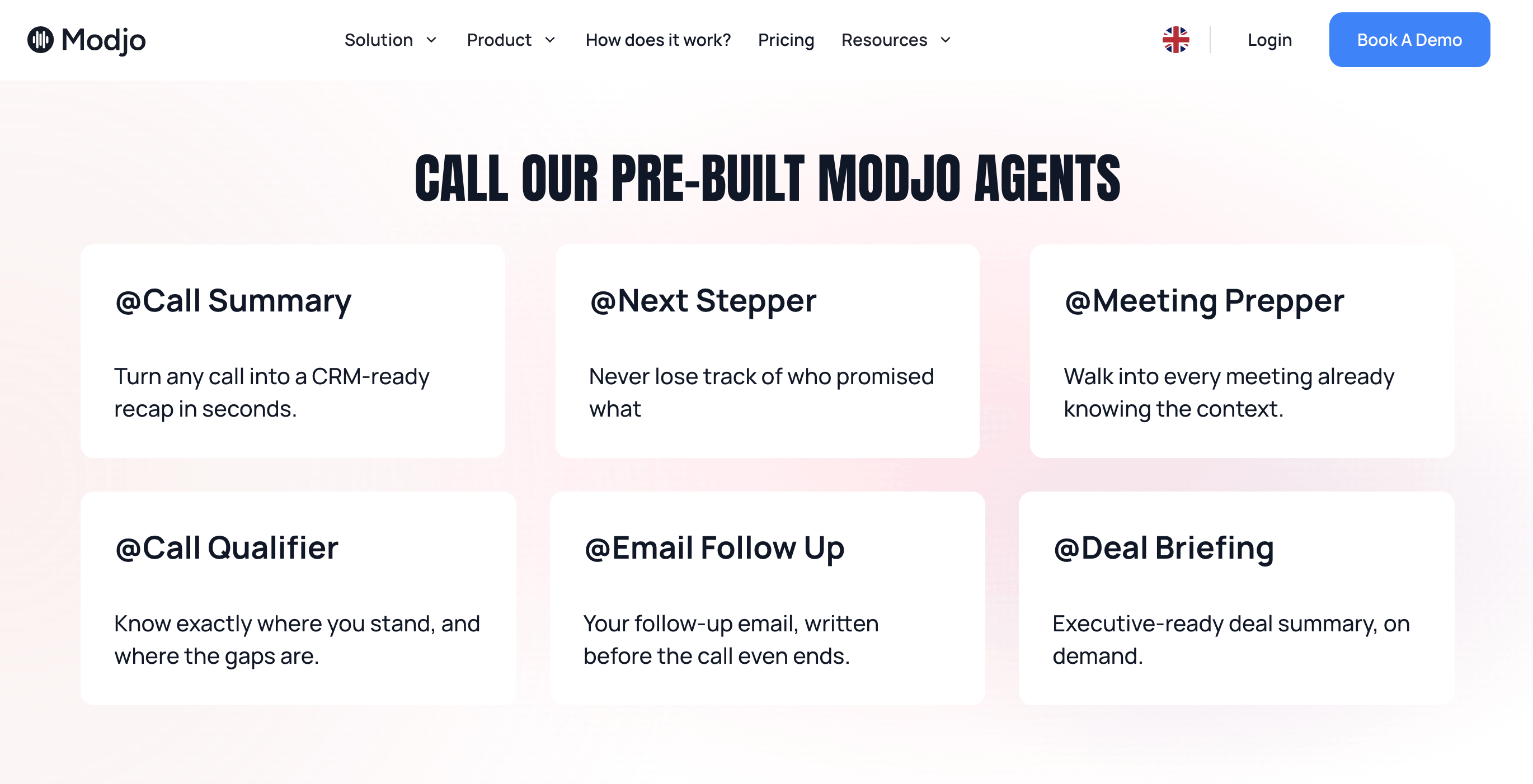
Tools in this section
How does Dust generate personalized sales presentations?
The Sales team also uses Dust to produce value decks, based on the information collected during the sales cycle.
“With Dust, we have a template of five or six slides where we present the observed challenges, the Modjo proposal, and the ROI we were able to calculate.”
The agents use the conversations recorded in Modjo to feed the different parts of the presentation. The salesperson no longer needs to manually go through all the reports to build their support.
The presentations can then be exported in PDF, Microsoft PowerPoint, or Google Slides.
Guillaume emphasizes the importance of these documents during meetings with executives. Instead of presenting a generic proposal, the salesperson arrives with a support document that includes the prospect's challenges, identified problems, and expected return on investment.
This customization is particularly relevant when facing a CEO, who finds in the presentation the topics discussed with their teams.
Modjo retains the memory of the deal, while Dust transforms this information into a sales presentation. This is a concrete example of how AI can leverage data collected during the sales cycle to produce a directly usable deliverable.
What role does the MCP play in Modjo's AI strategy?
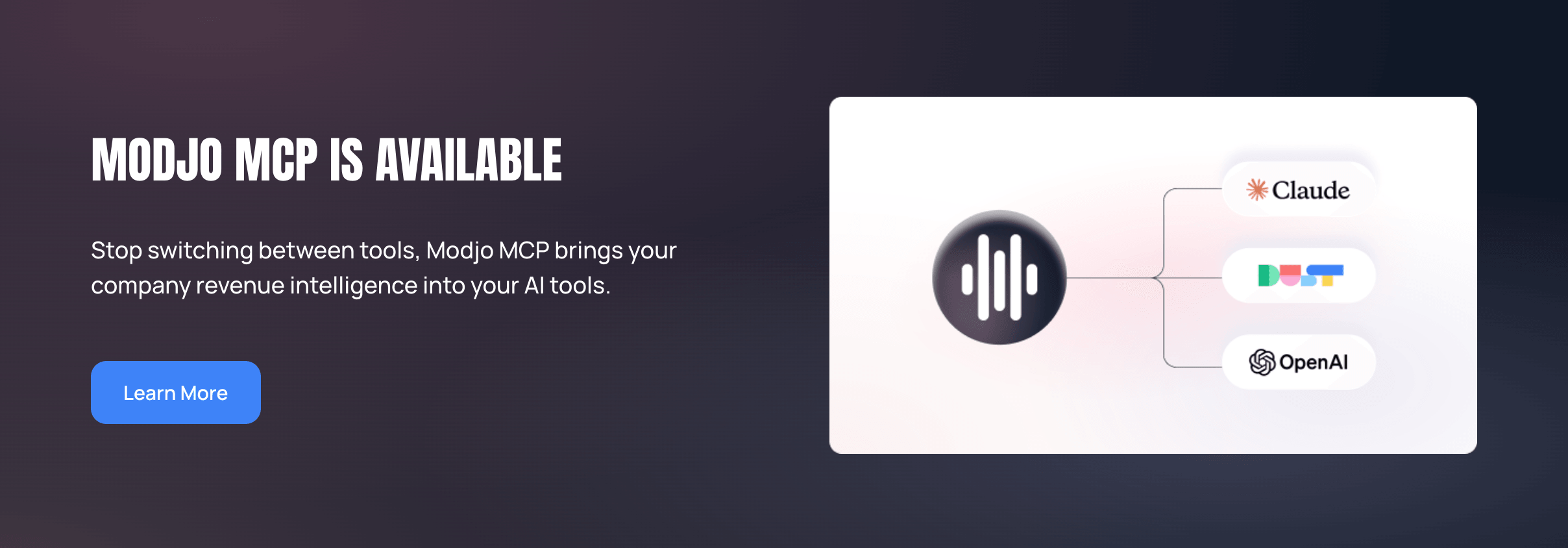
The Model Context Protocol (MCP) is another important aspect of this strategy.
It allows external tools to access the information available in Modjo, via appropriate connections and permissions. AI platforms like Dust or  Claude can thus leverage commercial data without requiring users to systematically go through the Modjo interface.
For Guillaume, this openness is a major differentiating factor.
“For us, Modjo's MCP is essential. We devote a lot of effort to developing an extremely efficient and robust MCP.”
This approach also allows for use cases beyond sales teams.
Marketing can leverage conversations to better understand the objections encountered in the field, the expectations of prospects, or the arguments that work.
Product and Product Marketing teams can also benefit from the feedback collected during sales meetings and interactions with clients.
Guillaume points out that Modjo is historically identified as a Sales tool, while the data it collects can be of interest to all Go-to-Market teams.
“We are recognized as a Sales tool, but we have a tool that can be extremely effective for all Go-to-Market teams.”
The MCP allows Modjo to make its commercial memory accessible to different AI agents, including for use cases that go beyond sales management.
This openness complements the strategy of integrating features into the product: users can work directly in Modjo or leverage its data from other environments.
How does Modjo use AI to improve sales coaching?
Beyond forecasts and opportunity management, Modjo is used to analyze sales practices and support team development.
This use is particularly important during onboarding. When a company hires several BDRs, AEs, AMs, or CSMs, managers must quickly identify each person's strengths and areas for improvement.
The analysis of conversations provides more precise elements than an evaluation based solely on sales results.
In prospecting, for example, Modjo allows the study of encountered objections, the quality of exchanges, or the frequency of competitor mentions. Interactions from prospecting and telephony tools, notably  Outreach and
 Aircall, feed this commercial memory.
The platform also facilitates the handover between a BDR and an AE. The salesperson who takes over a prospect can find the context of exchanges, expressed needs, and commitments made.
For Guillaume, one of the most significant changes concerns individual meetings between salespeople and managers.
Traditionally, one-to-ones are partly used to gather information: status of opportunities, next steps, risks, or commitments made by prospects. When these elements are already accessible, the manager can devote more time to coaching.
“With Modjo, one-to-ones will rather allow the implementation of action plans than gathering information.”
The manager's role thus evolves from information gathering to analysis and decision-making. AI prepares the exchanges, but commercial decisions and coaching remain in the hands of the teams.
What Modjo's organization reveals about the evolution of sales tools
The organization described by Guillaume relies on a complementarity between three solutions: Salesforce for structured data, Modjo for building commercial memory and intelligence and contextualization, and Dust for exploitation.
This combination allows for the preparation of forecasts, prioritization of opportunities, generation of personalized presentations, and improvement of sales coaching.
The value lies not only in the AI's ability to generate responses but in the quality of commercial information it can exploit. This is what allows the transition from a simple assistant to agents capable of concretely helping teams to manage and accelerate their sales.
Summary of the software this article mentions in Modjo's stack
| Status | Workflow | Tool | Usage |
|---|---|---|---|
| In use | Sales intelligence / AI | Modjo | Capture and analysis of conversations, sales memory, AI agents, coaching and opportunity management. |
| In use | CRM |  Salesforce | Management of accounts, pipeline, and opportunities. Data leveraged with Modjo and Dust. |
| In use | AI agent platform | Dust | Forecast agents, deal analysis, generation of artifacts and personalized value decks. |
| In use | AI assistant | Claude | Used by Marketing. Possible alternative to Dust for certain Sales workflows. |
| In use | CRM / Marketing | HubSpot | Marketing activities and integration with Modjo mentioned. |
| In use | Sales engagement | Outreach | Prospecting and calls feeding Modjo's analyses. |
| In use | Telephony | Aircall | Management of numbers and prospecting calls. |