




Guillaume Blanc, CEO of MerciYanis, explains how the company organizes its knowledge across Slack, Notion and Claude. The interview, conducted in September 2026, also details several concrete uses of AI: internal search, shared skills, margin control and analysis of customer conversations.
At MerciYanis, an email is almost never sent from one employee to another. Discussions go through  Slack. When a piece of information needs to remain valid over time, it is documented in Notion. And when a team member wants to find or use this knowledge, they can go through the
 Notion assistant or through Claude.
This separation between conversation, documentation and use of data was built gradually. It became especially important with the arrival of AI assistants.
MerciYanis has a little more than twenty employees and generates about €3 million in revenue. The team is mainly based in Toulouse, now with a few team members in the Paris area.
At this scale, the question is already no longer just about storing information. You need to know where the right version is, who can edit it and how to make it usable by the different teams.

Why does MerciYanis use almost no email internally?
Slack is MerciYanis's internal communication tool.
“We'll never send an email to a colleague if we have something to discuss. We use Slack.”
To keep Slack from becoming unreadable, the company gradually standardized how it is used. Each team has several types of channels with different functions: some are for top-down information, others for discussions, and others automatically receive data coming from the company's software.
Discussions also follow a simple rule: a message starts the topic, then the replies continue in the thread. The goal is to keep discussions easy to find without multiplying private conversations or internal emails.
Slack also serves as an entry point to several tools used day to day. Rather than asking team members to systematically open yet another application, MerciYanis tries, whenever possible, to bring information and actions directly into Slack.
Tools in this section
Why choose Deskare to manage flex office?
This is notably the case with  Deskare, which MerciYanis has been using for a little more than a year and a half to organize its team members' presence at the office.
The team can indicate from Slack whether they are working from home, traveling or coming on site. Deskare also sends a reminder every week so that team members fill in their attendance. For Guillaume Blanc, the point is precisely to avoid creating a new tool that people would have to remember to check separately.
Before choosing Deskare, MerciYanis had also looked at other solutions. Guillaume Blanc mainly highlights two reasons for his final choice:
“We chose Deskare for its simplicity and its integration with Slack.”
This integration is all the more useful as MerciYanis is starting to have team members outside Toulouse, notably in the Paris area. Visibility on attendance days therefore becomes more important as the team spreads across several locations.
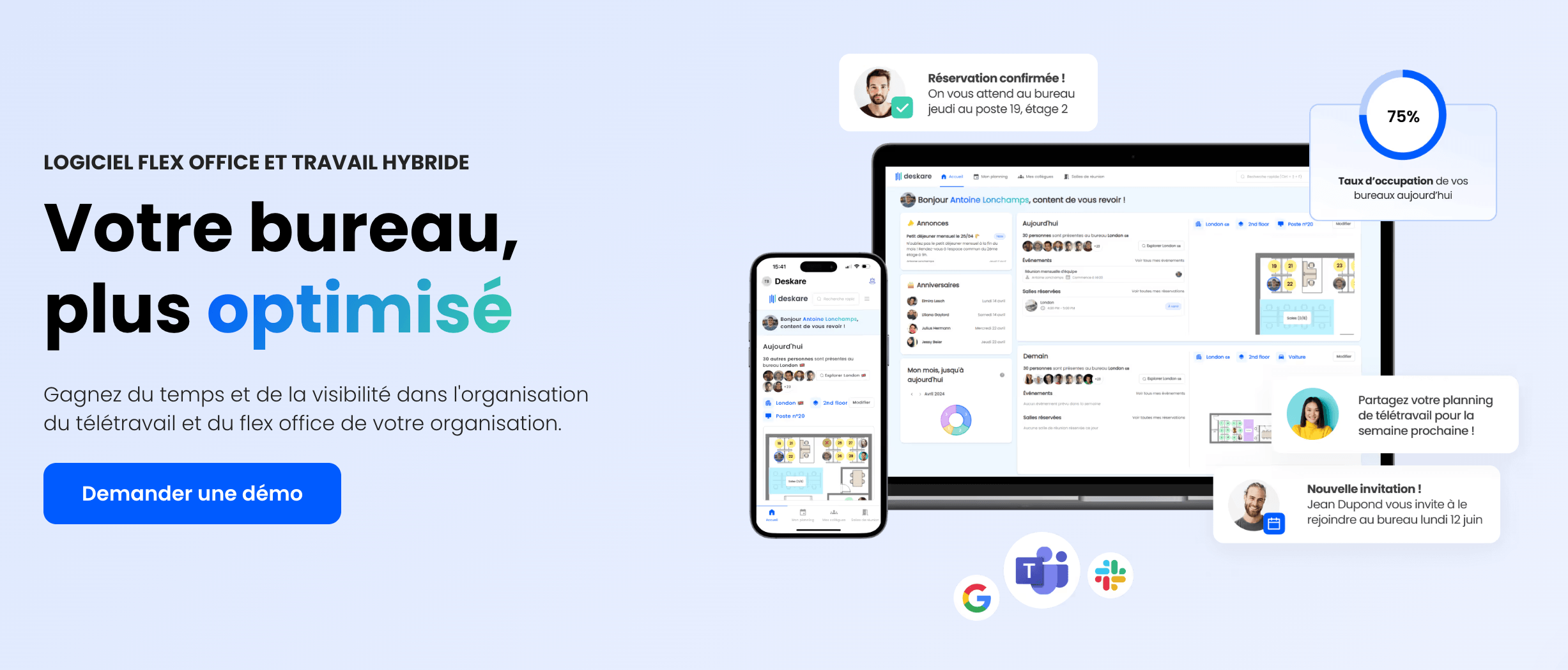
Deskare also offers desk and meeting room booking features. MerciYanis does not use room booking, however: rooms are managed directly by IoT Valley, where the company has its offices.
The Deskare case sums up fairly well the logic MerciYanis follows with Slack: keep one central tool for daily discussions and integrate into it, whenever possible, the recurring actions that do not require opening a dedicated application.
Tools in this section
Why does MerciYanis keep Slack and Notion separate?
For Guillaume Blanc, the line is clear:
“Everyday stuff should be handled in Slack. But when we have key information that lasts over time, it goes in Notion.”
MerciYanis has been using Notion for five or six years. Each team has its own Teamspace, with working documents but also more sensitive pages, considered sources of truth, whose editing rights are restricted.
Tools in this section
How does MerciYanis use Notion as a source of truth for its sensors?
This is notably the case for the documentation on the twenty or so types of sensors MerciYanis uses: air quality, leak detection, or foot traffic counting to trigger a cleaning service at the right time.
Notion centralizes their specifications and use cases. This knowledge can then be reused by marketing, sales or project managers through Claude.
With My Stock, MerciYanis's internal ERP, this organization is changing: structured data on the sensors is gradually being centralized there. My Stock is meant to become the main reference database, while Notion keeps a copy accessible to the teams.
How to use the AI in Slack, Notion and Claude to find information?
MerciYanis has the AI plan of Slack, which notably allows semantic searches in conversations. Adoption remains limited, though.
After asking his team members, Guillaume Blanc estimates that about a third actually use this feature. The others tend to go through the Notion assistant or directly through  Claude.
This is an important point in his feedback: adding more AI features to software does not mean team members will spontaneously use them.
Guillaume Blanc is not trying, for all that, to impose a single interface right away.
When he needs to find structured information, he favors Notion. For a more cross-cutting search, Claude can search across several sources, notably Slack and  HubSpot.
The trio he spontaneously cites for internal knowledge thus remains Notion, Slack and  Google Drive, to which Claude adds a search and action layer.
Why choose Claude vs. ChatGPT?
MerciYanis was previously mainly on  ChatGPT. The company moved mainly to Claude in January 2026.
It nevertheless keeps ChatGPT licenses to keep testing how the product evolves.  Gemini is also available through the Google environment and is used occasionally, notably for images or help writing emails.
Claude, however, holds a different place.
MerciYanis notably develops skills shared across teams and connects Claude to certain internal sources. A glossary of these skills is documented in Notion so that team members know what already exists.
HubSpot now officially offers an MCP connector for Claude that makes it possible to query CRM data and perform certain actions from Claude.
MerciYanis had also evaluated  Dust. Guillaume Blanc explains that he found the solution expensive when he looked into it, and that today he struggles to see the value of an additional layer when the teams build their skills directly in Claude.
Which Claude skills do MerciYanis's teams actually use?
To define the skills, MerciYanis's teams start from tasks the teams were already doing.
For example, a project manager needed to delete about 200 rounds in MerciYanis. The product did not make it easy to perform this operation in bulk. She showed Claude the process and created a skill able to reproduce the operation.
MerciYanis had also deployed about 5,000 QR codes at Egis and wanted to check that they were configured correctly. Testing the URLs one by one would have been especially tedious. The team therefore created a workflow, used mostly from Claude Code, that goes through the URLs and checks that the display matches what is expected.
A third skill is used on the sales side to check the margin on quotes.
The salesperson passes along the quote's URL. Claude retrieves the relevant information and compares it with the sensor reference database, which notably includes their purchase costs.
The tool can then flag that a discount on a sensor or on the setup risks eroding the margin if the project requires too much time. The salesperson keeps the decision. The skill mainly serves to surface the economic consequences of the discount before it is granted.
How to use Modjo to turn customer conversations into knowledge?
 Modjo has been in use for about three years.
The initial need was a classic one: record video calls so managers could listen to them again and coach the teams. Over time, MerciYanis realized that the value also lay in the accumulated data.
When the product team worked on changes to ticketing, it used existing calls to find the problems customers had mentioned and help prioritize development.
Marketing also uses this material. Laura regularly retrieves customer transcripts to produce content based on real conversations. For Guillaume Blanc, the difference from content produced solely from the Web is significant:
“Our Modjo discussions for our Marketing content, that's not an average of what exists on the Internet. It's based on real, concrete exchanges.”
Modjo and HubSpot do have an integration that makes it possible to link and sync sales interactions with the CRM's contacts and opportunities.
At MerciYanis, this data now also feeds Claude.
How does Claude analyze the calls and emails of CSMs & Sales at MerciYanis?
A Claude agent also runs every day on the calls of CSMs & Sales and on the emails sent. For example, it produces a summary for Estelle, head of Customer Success, with the successes but also the potentially problematic situations.
Guillaume Blanc thus aims to detect certain signals even before the project manager necessarily considers that there is a problem.
He gives a concrete example.
A project manager had advised a customer to use the same password for their computer and for MerciYanis so as not to forget it. The intention was practical, but the recommendation raised a security issue. The Claude agent detected the passage in the exchanges and flagged it in its daily summary.
The value of the workflow lies in its systematic nature: a manager no longer needs to manually listen back to every conversation to identify this kind of situation.
Modjo continues to store and structure the interactions. Claude analyzes them.
Why doesn't MerciYanis centralize all its knowledge in a single piece of software?
MerciYanis's organization does not end up with a single tool.
Slack remains suited to conversations. Notion is used for documentation. Google Drive completes this setup for files. Modjo keeps customer conversations. HubSpot structures CRM data. My Stock is gradually becoming the sensor reference database.
Claude works on top of several of these building blocks to search, analyze or act.
Even on the HR side, MerciYanis keeps this logic. PayFit is used for time off and absences, but the company did not take the additional module dedicated to performance reviews. Guillaume Blanc believes that Notion's templates and permissions already meet this need well.
The company also uses Stoïk for cyber risk, notably with a monthly report that lets Guillaume Blanc track his team members' risky behavior.
The stack is therefore not organized around the search for a single platform. The goal is rather to know which source is authoritative for each piece of information, then to make these different sources
Summary of the software this article mentions in MerciYanis's stack
| Status | Workflow | Tool | Usage |
|---|---|---|---|
| In use | Internal communication | Slack | Internal conversations, channels, AI search and integrations |
| In use | Knowledge management | Notion | Documentation, Teamspaces, reviews and sources of truth |
| In use | Document management | Google Drive | Complements Slack and Notion for files |
| In use | Workplace management | Deskare | Office attendance and Slack integration |
| In use | AI | Claude | Cross-cutting search, agents and skills |
| In use | Development / AI | Claude Code | Used notably for certain technical workflows |
| In use | AI | ChatGPT | Former main tool, licenses kept for testing |
| In use | AI | Gemini | Images and occasional writing help |
| In use | CRM | HubSpot | Data source accessible to certain Claude workflows |
| In use | Conversation intelligence | Modjo | Recording and use of conversations |
| In use | Internal ERP | My Stock | Sensor reference database set to become central |
| Dropped | Enterprise AI | DustDropped | Evaluated but not selected |
| In use | HR |  PayFit | Time off and absences |
| In use | Cybersecurity |  Stoïk | Cyber risk management and reporting |
| In use | Collaboration suite | Google Workspace | Google work environment |