



Pierre-Étienne Bidon, co-CEO of Moka.Care, explains how the company specializing in workplace mental health uses Notion AI and Claude to automate its internal processes. From analyzing customer feedback to managing BSPCE, he discusses the agents developed internally and the freedom given to employees to experiment.
At Moka.Care, an AI agent analyzes weekly interactions between consultants and their clients to identify churn risks, service strengths, and product improvements. Another automates the management of BSPCEs, from document preparation to updating the cap table.
These agents were developed internally, in an organization where each employee can create their own automations within a defined security framework, without having to request permission for each experiment.
Pierre-Étienne Bidon, co-CEO of Moka.Care, wants to go further. Within two years, he estimates that his artificial intelligence expenses will represent 3 to 5% of the payroll.
To develop these uses, the company mainly relies on Notion AI and Claude. Their features overlap in part, but Moka.Care has chosen to keep both.
Why did Moka.Care adopt Notion AI from its beta?
 Notion has been at the heart of Moka.Care's operations for several years, alongside
 Slack and
 Google Workspace.
The company has gotten into the habit of documenting all its decisions in writing. A useful practice for keeping a history of decisions, but it eventually poses a problem: the more documentation accumulates, the harder it becomes to find the right information.
Pierre-Étienne Bidon had already encountered this difficulty when he worked in consulting. According to him, as soon as a company reaches about fifty people, the volume of documentation becomes difficult to manage.
“At Moka.Care, we make all our decisions in writing in Notion. The problem was organizing the information and our ability to capitalize on it.”
This is one of the reasons why Moka.Care adopted Notion AI from its beta phase.
Rather than browsing through different pages of the workspace, employees can directly ask their questions to Notion AI, which relies on existing documentation to find the answers.
One of the most common uses concerns human resources.
Moka.Care seeks to maintain relatively light support functions. However, the People teams previously spent time answering fairly simple questions: how many RTT days do I have left? What is the company's policy on this subject? Where can I find an administrative document?
Most of the time, the answers already existed in Notion. It was just a matter of knowing where to look for them.
The company therefore encouraged its employees to ask their HR questions directly to Notion AI, rather than systematically contacting the People team on Slack.
“Before, we had many employees asking fairly basic questions to HR. Now, almost 100% of these questions are asked in Notion AI, based on the pages we've documented. People go directly to Notion rather than Slack.”
The HR team is thus less solicited for repetitive requests. However, this setup requires that internal policies be properly documented and regularly updated.
Moka.Care also uses Notion AI's connections with other sources, including Google Drive and the calendar. This allows employees to find information spread across multiple tools without having to consult them separately.
Tools in this section
An AI agent analyzes customer feedback every Monday morning
One of the most interesting workflows developed by Moka.Care involves analyzing conversations between its consultants and their clients.
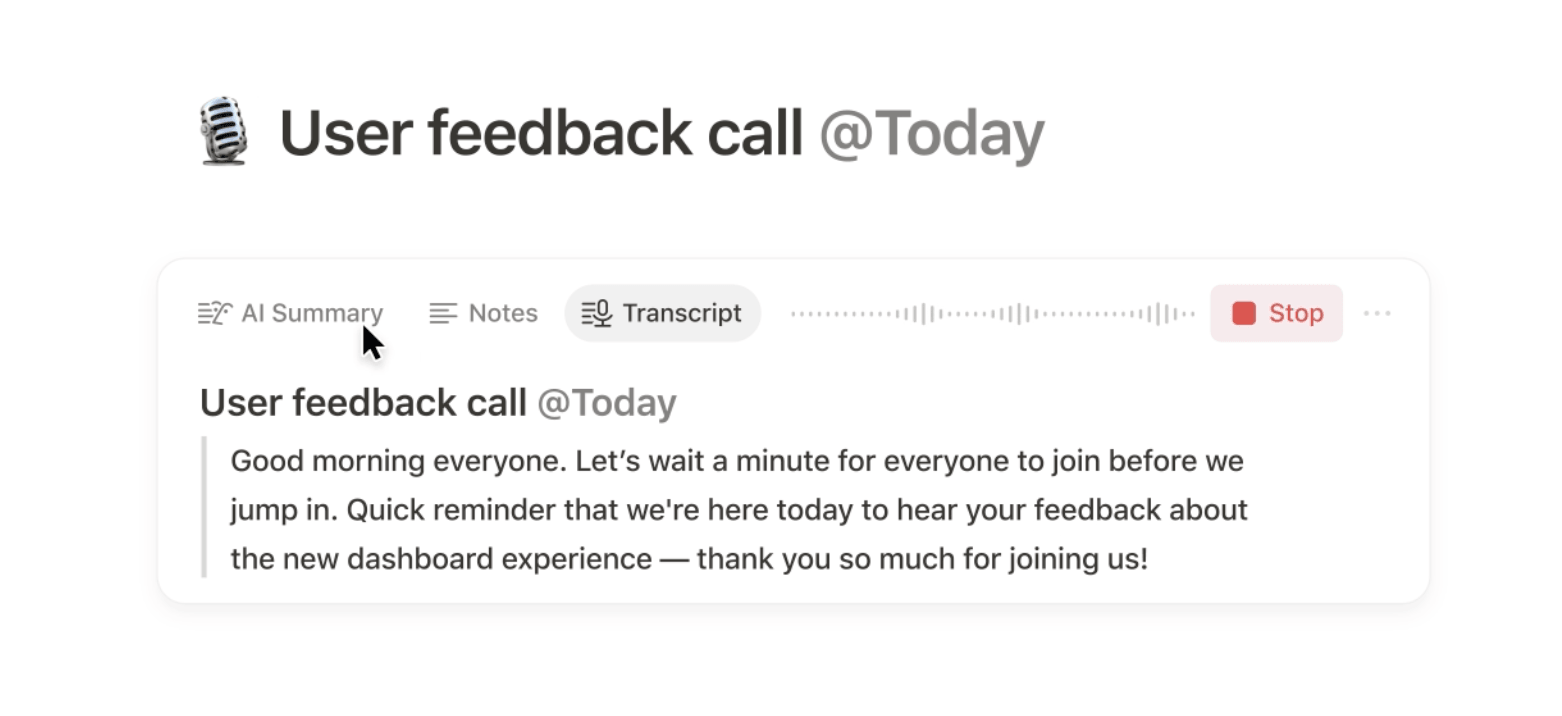
The process starts in  Modjo, used to record calls. After each interaction, a structured report is automatically produced and shared in Slack.
These notes include the main information discussed during the conversation: service usage, what the client appreciates, difficulties encountered, and requested improvements.
But Moka.Care doesn't stop at these individual reports.
The company has developed an agent that collects all the notes published in Slack and analyzes them every Monday morning at 8 a.m.
It produces a summary around four topics:
- The main strengths of Moka.Care and ways to enhance them.
- Critical issues that could lead to churn.
- Improvement requests that could feed the roadmap.
- Recommendations for future developments.
The results are then recorded in a Notion database, with indicators to classify the feedback.
“We have an agent that retrieves client call notes in Slack and summarizes them every Monday at 8 a.m. It identifies our strengths, churn risks, and possible improvements. The results feed into a Notion database that is then used to build our product roadmap.”
Pierre-Étienne himself consults these analyses, which are also used by the product teams.
Thus, Modjo is no longer just used to record calls. The conversations also become a source of information for product development.
Every employee can create their own AI agents
At Moka.Care, creating AI agents is not reserved for developers.
Employees can build their own automations, with great freedom in usage. However, the company has defined some rules to guide the developments.
All agents must be created from Moka.Care's professional Claude or Notion accounts. Teams must also use a list of authorized MCP connections.
“We have structured the technical part: developments must be done in Moka.Care's Claude or Notion accounts, with a list of authorized MCPs. However, regarding usage, we leave the teams completely free.”
This freedom also applies to expenses.
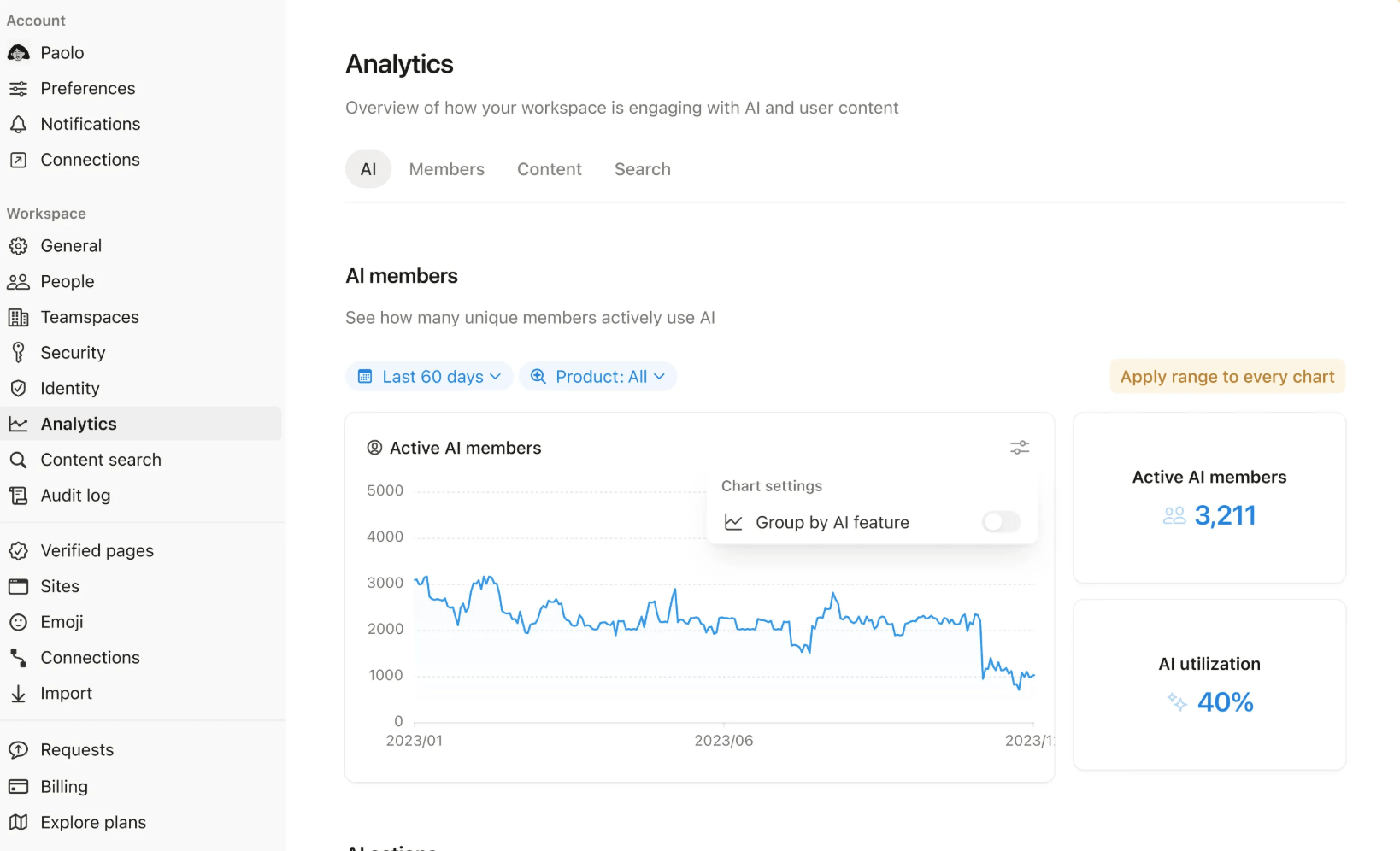
Moka.Care sets token limits per employee. One person oversees all the agents developed in Claude and Notion. According to Pierre-Étienne, they conduct a review of their usage and associated expenses approximately every quarter.
Agents that are no longer useful can be deleted. Those that become too costly are re-evaluated to seek optimizations.
“If you want to spend several dozen euros to test your agent, you can do so without asking anyone's permission. However, we regularly monitor costs. If an agent is no longer used, we remove it. If it becomes expensive, we look to optimize it.”
This organization allows employees to develop their own automations without routing all initiatives through a central team, while maintaining control over access and expenses.
Pierre-Étienne has also included a specific line for artificial intelligence in Moka.Care's financial management.
“I would like AI expenses to represent between 3% and 5% of our payroll within a maximum of two years. It's difficult to make predictions, but I would like us to quickly reach this magnitude.”
How does Claude automate the management of Moka.Care's BSPCE?
Among the agents developed internally, Pierre-Étienne cites a fairly concrete example: the automation of BSPCE management.
Moka.Care allocates BSPCE to all its employees. Their administration involves tracking various issuances, vesting dates, allocation conditions, and potential exercises.
With the increasing number of beneficiaries, this management quickly becomes tedious.
Moka.Care has therefore developed an agent to automate part of these operations. The process is relatively simple. The team provides the agent with a CSV file containing the necessary information: employee identity, start date, probation period validation, and allocation conditions.
From this file, the agent prepares the documents to be signed and can update the cap table when an employee exercises their BSPCE.
“At Moka.Care, we issue BSPCEs for everyone. It had become complicated to manage, between vesting dates, issuances, and the cap table. Today, we have a Claude agent: we provide it with a CSV, it prepares the documents to sign and updates the cap table when there is an exercise.”
This process involves a limited number of people but allows for the automation of previously burdensome administrative tasks, from document preparation to updating financial information.
Pierre-Étienne also mentions the existence of other agents developed internally.
Why does Moka.Care keep Claude and Notion AI despite their overlaps?
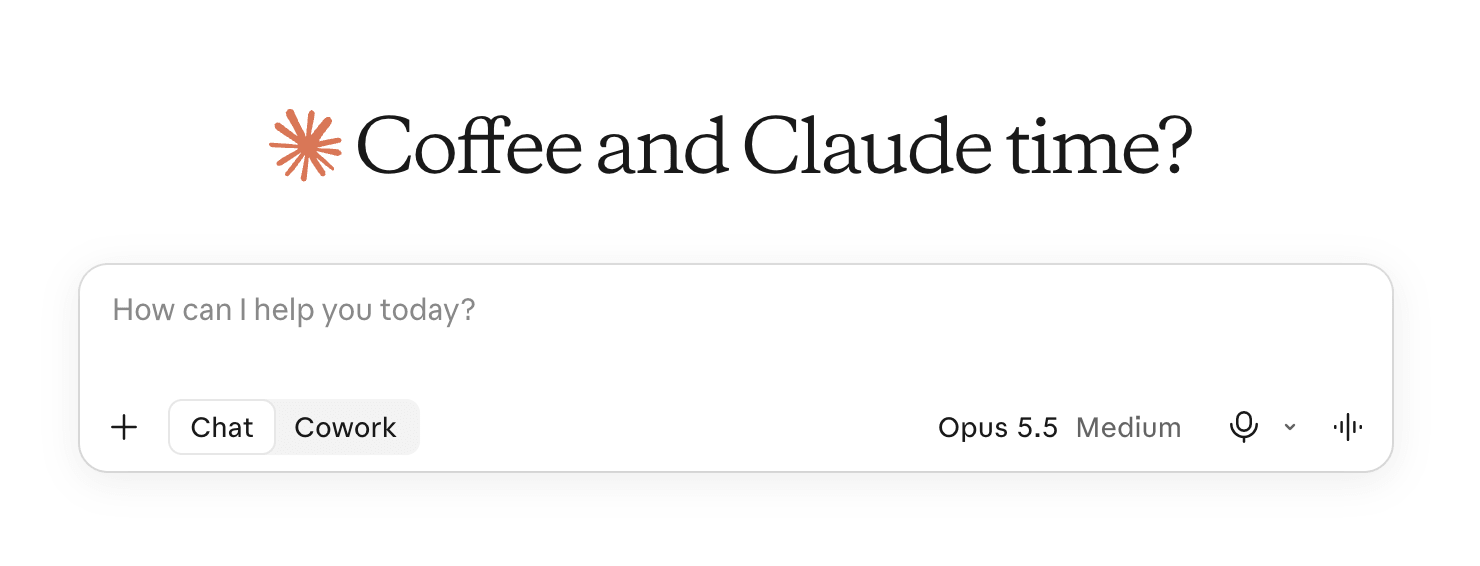
Moka.Care uses both  Claude and Notion AI, even though their features are beginning to overlap. Pierre-Étienne readily acknowledges these redundancies, but the two software still have quite different uses within the company.
Notion AI is mainly used to access internal knowledge: retrieving a decision, querying documentation, answering employee questions, or automating certain processes.
Claude is more used for production: developing and reviewing code, creating mock-ups, drafting documents, creating presentations, producing visual aids, or building specific agents.
“Today, Claude and Notion AI overlap quite a bit. But we need Claude for our developers, and we use it a lot to produce documentation, slides, and design. Notion AI, on the other hand, is mainly used to easily access our internal data.”
For now, this complementarity is enough to justify maintaining both subscriptions. Moka.Care prefers to keep the tools that the teams actually use, even when some features overlap.
Claude and Notion AI are gradually replacing Canva and Granola
The arrival of Claude and Notion AI has also changed the use of more specialized software.
This is particularly the case with  Canva, which Moka.Care previously used to create visual materials. This use was relatively limited, and the teams now increasingly use Claude Design to produce their visuals.
Pierre-Étienne thinks there might still be one last Canva license in the company, for an amount not exceeding €100 per year. The tool has simply become less and less necessary.
A similar evolution occurred with  Granola, which some employees used to record and summarize their meetings. These uses have gradually been taken over by Notion AI, particularly for note-taking during video meetings.
Moka.Care nevertheless maintains a distinction between internal meetings and conversations with clients.
For sales calls and customer relationship exchanges, the company continues to use Modjo, which offers specific recording, tracking, and analysis features.
Metabase for data manipulation, Notion for visualization
To consult and manipulate its data, Moka.Care uses Metabase.
According to Pierre-Étienne, at least half of the employees have access to it, with rights adapted to the nature of the information.
He appreciates the data manipulation capabilities of the tool but is less convinced by its visualization features.
“Metabase is very good for manipulating data, but I find that the data visualization is not great. So we are starting to use more charts in Notion, with the idea of connecting them to Metabase.”
Moka.Care is therefore beginning to explore the charts available in Notion, with the idea of connecting them to Metabase data. The company wants to retain Metabase for working on data while using Notion to present it better, without considering replacing its business intelligence tool at the moment.
Summary of the software this article mentions in Moka.Care's stack
| Status | Workflow | Tool | Usage |
|---|---|---|---|
| In use | Documentation and collaboration | Notion | Decisions, knowledge base, structured and graphical databases |
| In use | AI and automation | Notion | HR questions, internal research, meeting notes and agents |
| In use | AI and development | Claude | Code, documentation, presentations, design and agents |
| In use | AI design | Anthropic | Creation of visual materials |
| In use | Internal communication | Slack | Internal exchanges and centralization of customer feedback |
| In use | ProductivityDocument storage | Google Workspace | Collaboration and connected toolsDocumentation accessible via AI connections |
| In use | Conversation analysis | Modjo | Call recording and exploitation of customer feedback |
| In use | Finance |  Qonto | Software that can be connected to agents via MCP |
| In use | Design | Canva | Usage almost abandoned in favor of Claude Design, a residual license possible |
| Replaced by Notion AI | AI note-taking | GranolaReplaced by Notion AI | Formerly used for certain meetings, replaced by Notion AI |
| In use | Business intelligence |  Metabase | Data manipulation and reporting, with exploration of Notion graphs |