



At  Ringover, customer conversations are at the heart of the product, but also increasingly at the heart of how the sales teams work. This is the shift observed by Fabian Stanciu, who leads European sales with a scope that also covers part of Revenue Operations and Go-to-Market Growth.
The French vendor, historically specialized in telephony, has gradually expanded its offering to the analysis and automation of conversations. The company announced it had surpassed $50 million in ARR in 2026 and has 350 employees, with teams mainly in France, the United Kingdom, Spain and the United States.
For Fabian, this shift goes beyond the Ringover product alone. Conversations are gradually taking a more central place across the entire sales stack:
“Today, it's no longer the conversation that gets bolted onto the CRM. It's rather the CRM that is starting to organize itself around conversations.”
The CRM is not disappearing:  Salesforce continues to structure accounts, opportunities and the pipeline. But calls and other conversations are gradually becoming a much more important source of information for understanding what is really happening in a deal.
Why are conversations becoming central in the sales stack?
In a classic CRM architecture, a call can be treated as an activity attached to a contact or an opportunity.
Fabian partly reverses this view. A conversation directly contains the objections, needs, questions and signals that make it possible to understand where a deal really stands. With automated transcription and analysis, this material becomes much easier to use.
This shift is also bringing together software categories that used to be more distinct.
Fabian notably cites  Salesloft and
 Lemlist in sales engagement. These vendors can gradually add telephony, analysis or other adjacent functions.
Ringover is taking the opposite path. Having historically started from telephony, the vendor is gradually adding capabilities around the conversation.
How has Ringover's offering expanded beyond telephony?
Fabian's vision is also explained by the evolution of Ringover itself. Historically positioned on cloud telephony, the vendor is now building a broader offering around the conversation.
It can be read as three main layers: communicating, understanding and automating conversations.
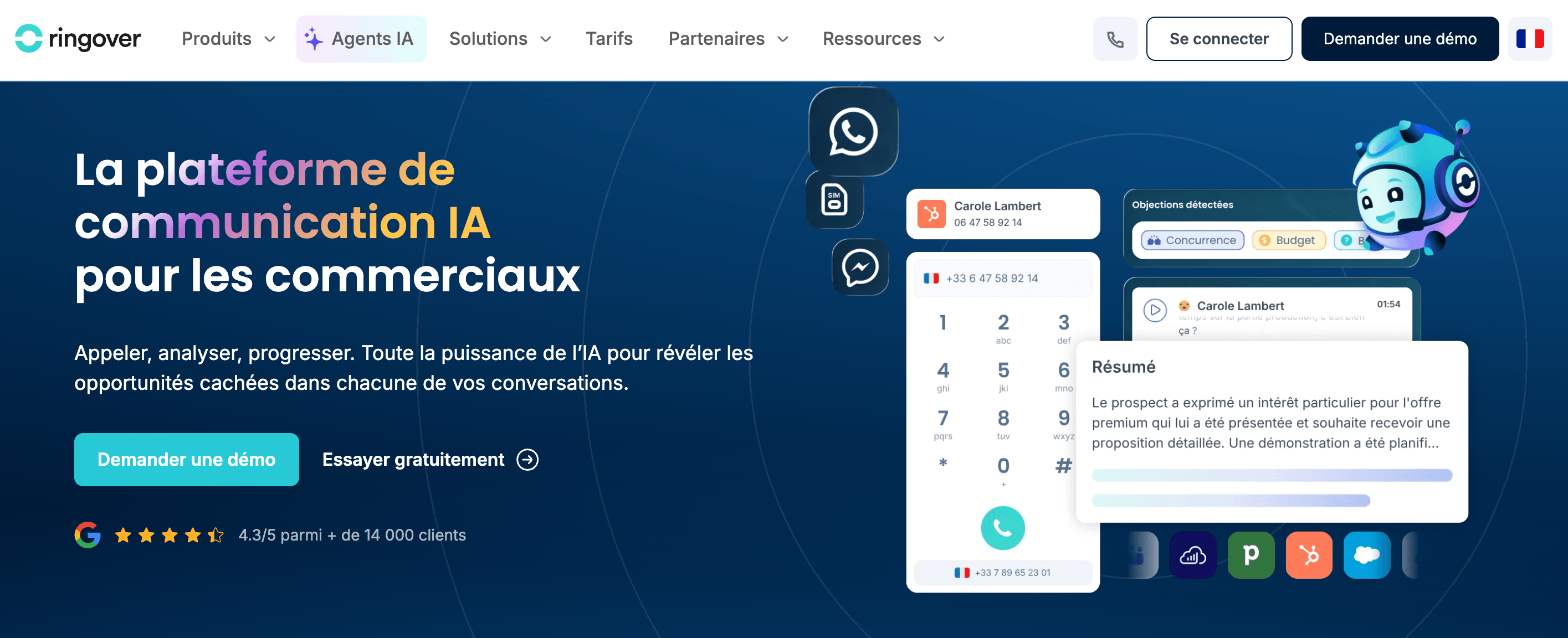
The first remains the historical foundation: Ringover. The platform lets sales, support or recruiting teams manage their calls and other communication channels such as SMS, WhatsApp or video conferencing, while connecting these exchanges to CRMs and other business tools.
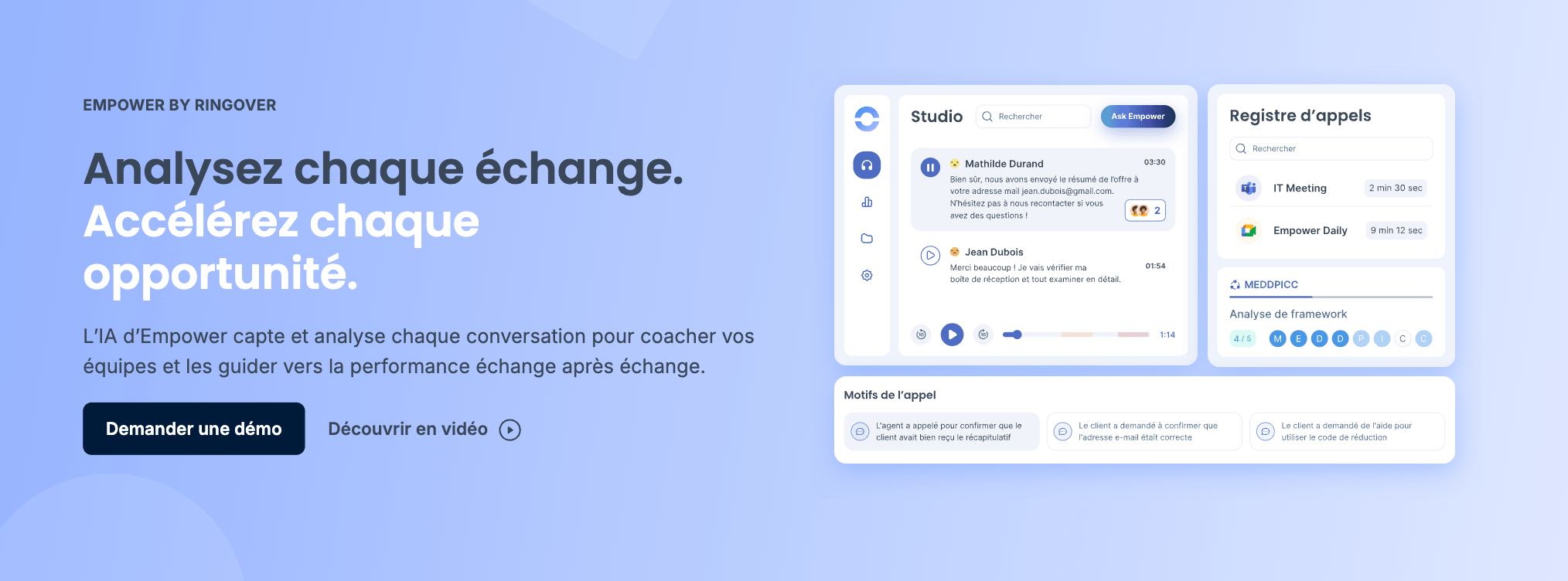
The second layer is Empower, dedicated to conversation intelligence. It makes it possible to transcribe and summarize exchanges, but also to analyze what is said during conversations.
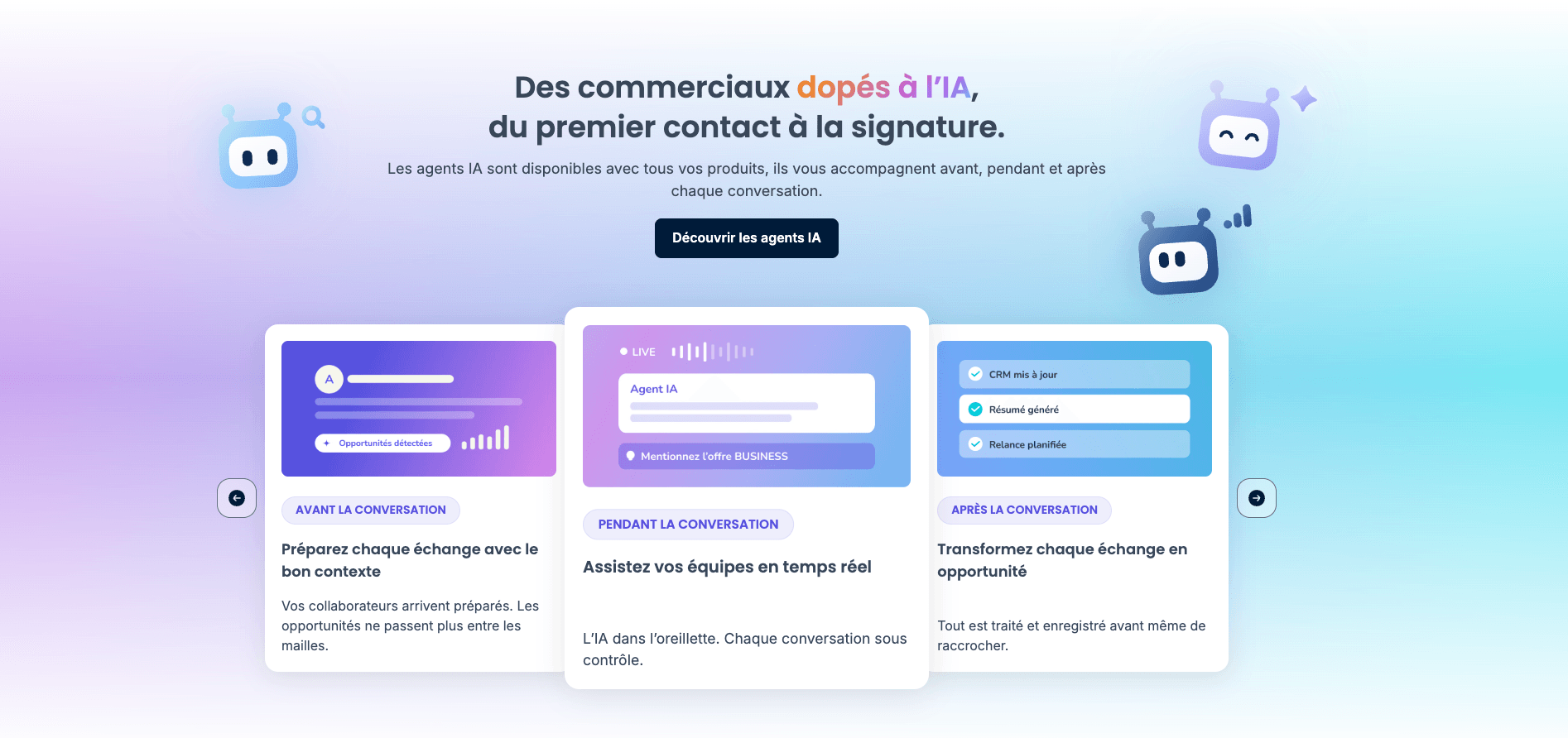
Ringover is gradually extending Empower beyond after-the-fact analysis. Pitch Room, for example, makes it possible to practice on simulated conversations with AI, while Live AI Coach can assist team members during their exchanges. Ask AI then makes it possible to query past conversations to extract information from them.
Empower thus gradually covers the three stages of a conversation: before, to prepare and train the teams; during, to assist them; after, to analyze the exchanges and use the information they contain.
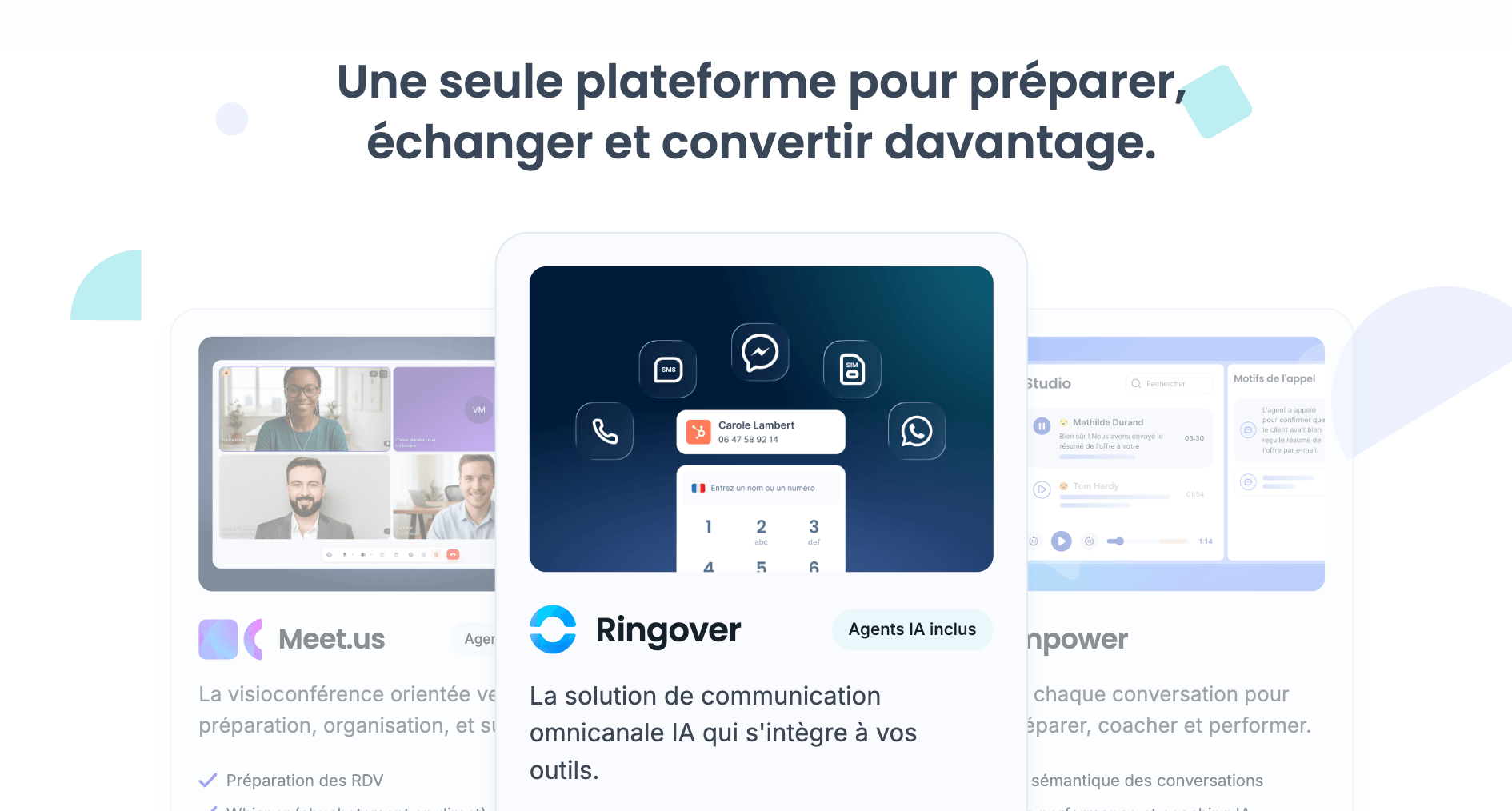
The third layer concerns automation with Airo. Ringover's AI voice agent can directly handle certain inbound calls, answer requests, qualify a caller or route the call to the right person.
The distinction matters: Empower mainly seeks to make better use of conversations led by humans, while Airo Voice can handle certain conversations in their place.
This shift offers another reading of Ringover's positioning. The company no longer seeks only to provide the infrastructure for making a call. Ringover captures the conversation, Empower helps understand it and conduct it better, while Airo can automate part of the exchanges.
This is also what makes Fabian's thinking about the CRM interesting. The more a conversation can be transcribed, analyzed and structured automatically, the less it boils down to a simple activity logged in Salesforce.
How does Ringover use Empower to analyze conversations?
Ringover naturally uses its own solutions for its communications.
Ringover is the historical telephony and communication building block. Empower handles conversation intelligence, notably to transcribe and analyze conversations.
Fabian says Empower was already in use when he joined the company, about two and a half years ago. Ringover thus seeks to make more of the material contained in conversations rather than treating the call as a simple activity attached to the CRM.
This logic does not mean, however, that Ringover forces its entire offering on its customers.
A customer can use Ringover for telephony while keeping  Modjo or
 Gong for conversation intelligence. Conversely, a company can use
 Aircall for telephony and Empower to analyze its conversations.
“We give customers the option to choose the tools that are best suited to their needs.”
This flexibility also comes down to change management. When a piece of software is already widely deployed, a company does not necessarily benefit from immediately changing its teams' habits to rationalize its stack.
Ringover nevertheless makes the case for bringing more building blocks together when doing so reduces costs, simplifies integrations and provides a more unified view of communications.
Empower holds a central place in this strategy: it lets Ringover move from managing the communication channel to making use of what is actually said in conversations.
What role does Salesforce keep in Ringover's Sales stack?
Despite this conversation-centered vision, Salesforce remains Ringover's sales CRM. The company has been using it for more than five years to structure its accounts, opportunities, pipeline and other sales data.
Fabian's thinking is therefore not about the disappearance of the CRM, but rather about the source of sales information.
Salesforce structures the deal. Conversations make it possible to understand what is really happening in it.
As calls can be recorded, transcribed and analyzed automatically, this second layer becomes much more usable.
Why did Ringover choose Crono for Sales engagement?
For Sales engagement and sequencing, Ringover now uses  Crono, an Italian vendor.
Ringover benchmarked several solutions before making its choice. The relationship with Crono also counted. According to Fabian, Ringover is one of the vendor's major customers, and the vendor has adapted several features to its needs, notably its integration with Salesforce.
Fabian's feedback is positive:
“We are extremely satisfied with the relationship with Crono and with their product.”
The salespeople had to change some habits, a difficulty Fabian considers fairly typical when switching prospecting tools.
What role do Cargo, Cognism and Scalelist play upstream of conversations?
Before a salesperson talks with a prospect, another part of the stack handles data and orchestration.
Ringover now uses  Cargo for workflows ranging from list building to enrichment and orchestration. The relationship with the Cargo team, its proximity as a French player, the support during the POC, a better fit with certain orchestration needs, and the cost.
In parallel, Ringover uses  Cognism and
 Scalelist for functions related to the database, list building and enrichment.
The stack thus works in layers: data and enrichment feed GTM orchestration, then sales engagement and conversations. Salesforce, for its part, keeps the structured sales data.
The thinking is therefore not only about features. Ringover also looks at what the multiplication of software costs in integrations, data flows, team adoption and cumulative spend.
What will the CRM's role be if conversations become a central source of sales data?
Ringover's experience does not support the conclusion that Salesforce or CRMs are going to disappear. If anything, it is the opposite: Salesforce remains deeply integrated into the company's sales workflows.
What is changing is the nature of the data the sales teams can use.
When a call can be automatically recorded, transcribed and analyzed, a conversation is no longer just an activity to log in the CRM. It becomes a direct source of information about prospects, their objections and opportunities.
The evolution of the Ringover offering pushes this logic further. The platform makes it possible to manage communications, Empower to make use of what is said in the exchanges and AIRO to automate certain conversations. The CRM keeps its role of structuring accounts and opportunities, but a growing share of sales knowledge can be produced elsewhere.
This is the shift Fabian sums up when he explains that the CRM is starting to revolve around conversations.
At Ringover, this shift is already visible in the way Salesforce, Ringover, Empower, Crono and the other building blocks of the GTM stack fit together.
Summary of the software this article mentions in Ringover's stack
| Status | Workflow | Tool | Usage |
|---|---|---|---|
| In use | Communication / telephonyConversation intelligenceAI voice agentAI conversation coaching | Ringover | The teams' communication foundationTranscription and analysis of conversationsAutomation of certain inbound callsAssistance to team members during conversations |
| In use | AI sales training | Pitch Room | Conversation simulation |
| In use | CRM |  Salesforce | Central sales CRM |
| In use | Sales engagement | Crono | Sales engagement and sequencing |
| In use | GTM orchestration | Cargo | Lists, enrichment and orchestration |
| In use | Data / enrichment | Cognism | Database and enrichment |
| In use | Data / enrichment | Scalelist | Lists and enrichment |