



Alain Garnier, president and co-founder of Jamespot, discusses the software used by his company to manage sales, marketing, customer support, and product development. Interviewed by Soft Atlas, he shares his feedback on the tools adopted, those that have been replaced, and the challenges encountered over the years.
Pipedrive for CRM, Webmecanik for marketing automation, Linear for product management, and PostHog for analytics. Jamespot uses several specialized SaaS, while heavily relying on its own software for collaboration and customer support.
This organization is based on a rule that Alain Garnier has applied for a long time:
“One of Jamespot's rules is to know how to buy in order to know how to sell. When a function becomes too important relative to our size, we look to see if there are dedicated external tools.”
Founded about twenty years ago, Jamespot has seen its needs evolve with the growth of its teams and the expansion of its product portfolio. Some software, like  Pipedrive, have accompanied the company for several years without showing particular limitations. Others have required much more work than expected, such as
 PostHog, whose deployment has engaged the teams for about a year.

Tools in this section
Jamespot uses its own software for internal collaboration
Jamespot develops a collaborative suite that brings together several applications usually purchased from different publishers. Internally, employees use their own software for messaging, emails, video conferencing, document editing, intranet, and project management.
The messaging serves a role similar to  Slack, while the project management application offers Kanban boards similar to
 Trello. The Jamespot suite thus constitutes the main working environment for the teams.
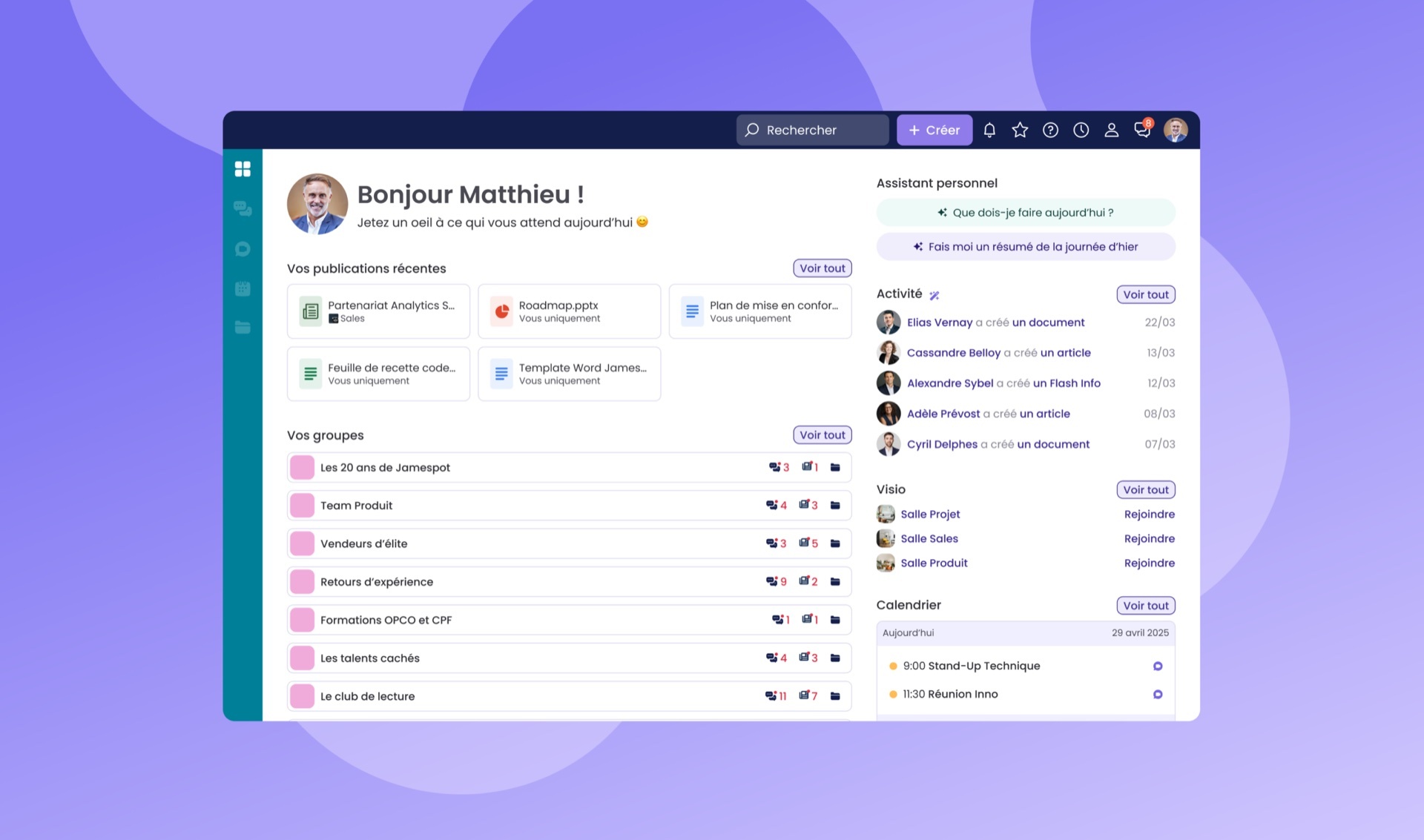
But Alain Garnier does not seek to do everything with his own products. When a function becomes significant and needs become more complex, he sometimes prefers to adopt specialized software rather than continue to develop or adapt an internal application.
This is notably what happened with  Linear. Jamespot already had its own Kanban, but the multiplication of products and Product Owners eventually justified the adoption of a dedicated tool.
Why does Jamespot remain loyal to Pipedrive instead of migrating to Salesforce or HubSpot?
Pipedrive is one of the software Alain Garnier is most satisfied with.
Jamespot adopted it several years ago when the company was still relatively small. Since then, the teams have grown, activities have diversified, and new companies have joined the group. Yet, the CRM has never been replaced.
“Pipedrive absolutely does the job for companies of our size. It's super well done, it has evolved well, it's clean. Today, it can be queried by AI: you put an MCP on it and you can do everything.”
Solutions like  Salesforce or
 HubSpot have already been discussed internally, but Alain Garnier sees no reason to migrate as long as Pipedrive meets the company's needs.
The software is used by salespeople and Customer Success Managers. Employees of Alinto, a company acquired in 2026, are also integrated into the CRM. The sales team now represents about eight salespeople, including Alinto.
This satisfaction does not mean that Pipedrive will necessarily remain Jamespot's CRM at all stages of its growth.
“With Pipedrive, frankly, we have no limits today. Afterward, I don't know if it would work as well if we were much more international. And I don't know if, when we double in size, we will still be happy with it.”
Jamespot remains relatively uninternationalized. With more countries, teams, and commercial processes to manage, needs could evolve. For now, Pipedrive does the job and no migration is planned.
How do Pipedrive and the internal CRM DCSM work together?
Customer Success Managers do not work solely in Pipedrive. Jamespot has also developed DCSM, an internal tool connected to its “forge”, the system that allows generating and managing its clients' platforms.
DCSM gathers operational information related to products and customer environments, while Pipedrive retains commercial data. The two software are connected to allow sales and Customer Success teams to share a common view of customers, without trying to fit all technical data into the CRM.
Tools in this section
Webmecanik replaces Plezi for marketing automation
While Pipedrive has remained stable over the years, Jamespot's journey in marketing automation has been different.
The company previously used  Plezi, a French software specialized in marketing campaigns and nurturing. However, the difficulties encountered by the publisher led Jamespot to seek an alternative. Plezi was placed under judicial reorganization in July 2025, then underwent judicial liquidation and a transfer plan in November 2025. Its activity was then taken over by the Lundi Matin group.
Jamespot turned to  Webmecanik, now used for newsletters, customer communications, prospecting campaigns, nurturing, and landing page creation.
Alain Garnier does not consider Webmecanik to be the most modern software on the market in terms of interface. But he appreciates its reliability and the fact that the marketing teams are satisfied with it.
“Webmecanik is a bit more rustic from an interface point of view, but it's quite reliable: it gets the job done.”
WordPress: an open CMS project
The situation is quite different for the website. Jamespot's website runs on  WordPress.
“For the website, we are on WordPress. Evolving it requires a real technical effort, and it's a project that remains open.”
A redesign is being considered, although a replacement solution has not yet been chosen.
The subject returns to the new marketing management, which will set the schedule.
Why does Jamespot change prospecting tools so often?
Prospecting and enrichment software are probably the ones that have changed the most at Jamespot.
The company notably used lemlist, before abandoning it due to its price. It also went through Snov.io, while Clay is among the tools used by the teams at the time of the interview to enrich prospect lists.
Alain Garnier notes that he follows these topics from a bit of a distance and does not intervene directly in all the choices made by the marketing teams.
“We had lemlist, but we stopped it because it was too expensive. Then we put Snov.io back, then we take something else. In ten years, it must have changed thirty times.”
Beyond the software changes, Alain Garnier takes a rather critical view of the commercial enrichment market.
According to him, some providers take liberties with data collection rules and sometimes approach the limits imposed by the GDPR. He believes that new entrants may seem more efficient simply because they take more risks in building their databases.
He also observes a recurring cycle in marketing teams: a new tool generates a lot of enthusiasm, only to disappoint a few months later.
“Regarding enrichment tools, marketers get excited about a solution, then six months later they condemn it. For me, that's part of how this market operates.”
Why did Jamespot replace Livestorm with Wisembly?
To organize its webinars, Jamespot previously used  Livestorm. The company then switched to
 Wisembly, a French platform specializing in events.
The change addresses a concrete need: organizing events with multiple sessions, rather than managing each webinar independently.
Alain Garnier cites the example of the Digital Sovereignty Week organized by Jamespot, which involved 28 hours of live streaming and more than 500 registrants.
“With Wisembly, you really create a full week, with a program and an event. People register for the entire event or for certain sessions. It allows you to manage a complex event at an SME price.”
Alain Garnier says he is satisfied with the software, even though its use led to a small mishap.
At the launch of the event, a participating public agency reported that it was not receiving the video stream. After some checks, the Jamespot teams discovered that the organization's IT network was blocking the Wisembly broadcast.
The same event was still accessible on YouTube. The problem therefore came from the filtering rules of the participating organization, not from a Wisembly failure.
Tools in this section
How does Jamespot resolve about 80% of support requests through self-diagnosis?
For its customer support,  Jamespot also uses its own software.
The company has developed an application that combines ticketing, automation, FAQ, and a chatbot connected to  SafeBrain, its artificial intelligence solution. Alain Garnier compares its general operation to that of software like
 Zendesk.
But what interests him most is the result achieved: about 80% of requests are resolved directly by customers through self-diagnosis.
And contrary to what one might imagine, artificial intelligence is not the main driver of this result.
“When you ask your question in Jamespot support, similar questions are suggested to you. Just by seeing the titles and the beginning of the answers, people often find their solution. It's almost like self-service search, but it works remarkably well.”
The requests often concern common operations: retrieving a password, adding a user, or deleting an intranet page that has links to other elements.
The chatbot connected to SafeBrain then intervenes when the classic search is not enough.
“We also have a chatbot with SafeBrain, but it serves more as a second blade. It's really the search in the FAQ that clears the most requests.”
At Jamespot, a good search in the knowledge base seems to resolve more requests than the AI chatbot itself. Artificial intelligence provides additional assistance, but the primary source of efficiency remains the clients' ability to easily find existing answers.
Tools in this section
Why did Jamespot replace its internal Kanban with Linear?
For a long time, the product teams at Jamespot used internally developed Kanban boards.
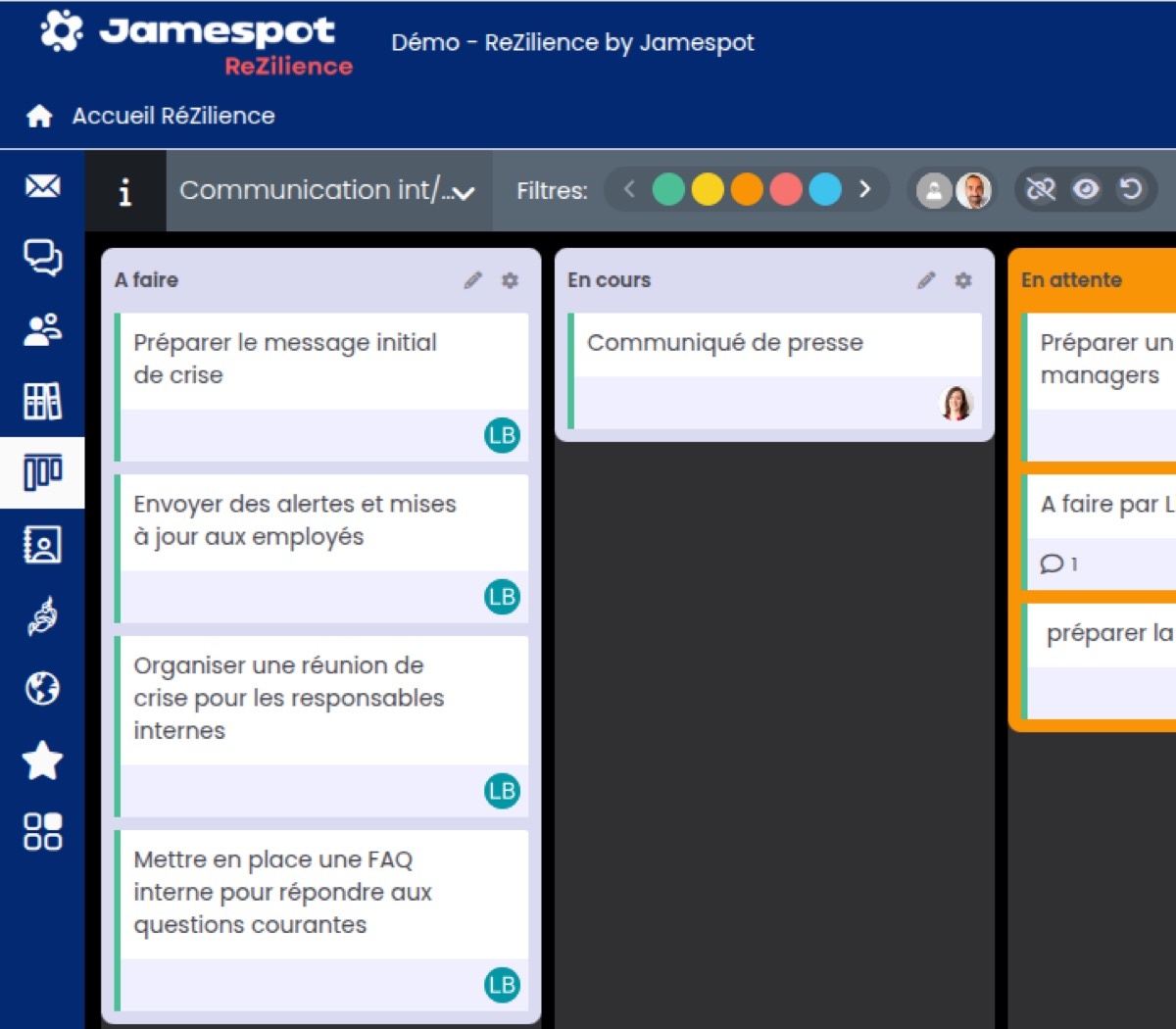
The system worked well when the product organization was relatively simple. But the company gradually expanded its product portfolio, especially after the acquisitions of SafeBrain and Alinto. The number of projects and people involved increased.
Jamespot now has about five to six Product Owners.
“Before, for a single Product Owner, our board tool was great. It's simple, straightforward, it works well. But with five or six POs and many products, we needed a more specialized professional tool.”
This led the company to adopt Linear during the summer of 2026.
Alain Garnier summarizes his perspective with a personal rule: “one, two, three, many.” As long as the number of managers or projects remains limited, a simple tool can suffice. But beyond a certain level of complexity, needs change.
The migration to Linear is still recent at the time of the interview, but the initial feedback is positive.
Alain Garnier himself uses the MCP of Linear, as well as email notifications, to track topics that require his intervention. The company still lacks perspective to provide a complete assessment, but the software currently meets the need that motivated its adoption.
Tools in this section
Why did it take Jamespot about a year to deploy PostHog?
Among all the software mentioned during the interview, PostHog is probably the one whose deployment required the most work.
Jamespot was looking to better understand how its clients use its applications: the events triggered, the features viewed, the transitions between different parts of the product, and user journeys.
The company had previously used  Matomo and then
 Plausible. These tools allowed tracking certain analytics data but no longer sufficiently met the needs of the product teams. Matomo also posed maintenance and performance issues.
Jamespot therefore turned to PostHog, aiming for a much more detailed analysis of usage. But the implementation proved to be significantly longer than expected.
“PostHog is good, but it's comprehensive and complex. We've been working on the project for a year and haven't even extracted all the essence yet. You have to instrument the applications, and it's much more burdensome than you initially imagine.”
The difficulty doesn't come solely from configuring the software. To properly analyze an event in PostHog, that event must first be recorded in the application.
However, the teams' needs evolve as they begin to use the data.
A Customer Success Manager might, for example, want to understand how a client uses a specific feature. But when they make their request, the technical team sometimes discovers that the corresponding event isn't recorded, an API entry point is missing, or a user ID hasn't been added to the logs.
It is then necessary to go back into the code, add the necessary information, create a pull request, and deploy the changes.
“With PostHog, you bring the CSMs into the loop and they request new events. You discover that an ID is missing in the logs or that an API needs modification. These are iterations that go deep into the machine.”
Added to this is the technical architecture of Jamespot.
The company operates several cloud environments, some of which meet specific security requirements, particularly those related to SecNumCloud. Each environment is instrumented according to its own rules.
Alain Garnier distinguishes between two situations. For a new SaaS, it is possible to anticipate the events to follow from the development of the first features. But when you have to instrument several existing applications, with their technical history and specific constraints, the work is much more significant.
After about a year of deployment, Jamespot has not yet exploited all the possibilities of PostHog. The software meets a real need, but its implementation requires deep modifications in the applications.
Why does Jamespot keep Kibana in addition to PostHog?
The adoption of PostHog has not replaced the technical monitoring tools already used by Jamespot.
The company continues to rely on  Kibana and Elasticsearch to explore logs, identify errors and understand the issues encountered in production.
The two use cases remain different. PostHog is used to analyze user behavior, while Kibana allows technical teams to examine logs and search for the origin of a malfunction.
What software does Jamespot use for human resources?
For human resources, Jamespot mainly uses  Silae for payroll and
 Lucca for expense reports. Alain Garnier appreciates Lucca, even though the company only uses part of its features. Some HR modules, particularly 360-degree evaluations, have not been deployed.
With the group's growth, Jamespot is starting to consider a more comprehensive HR solution. The topic is led by the human resources department, without Alain Garnier's direct involvement in the selection of tools.
The financial functions, on the other hand, rely on several billing and subscription management software. Their data is consolidated in  Metabase. This organization is detailed in another article dedicated to Jamespot's multi-system architecture.
Summary of the software this article mentions in Jamespot's stack
| Status | Workflow | Tool | Usage |
|---|---|---|---|
| In use | Collaboration and office tools | Jamespot | Messaging, documents, intranet, video conferencing, support and Kanban |
| In use | CRM | Pipedrive | Sales and Customer Success |
| In use | Internal CRM | DCSM | Operational data of client platforms |
| Replaced by Webmecanik | Marketing automation | PleziReplaced by Webmecanik | Former solution replaced by Webmecanik |
| In use | Marketing automation | Webmecanik | Newsletters, nurturing and landing pages |
| In use | CMS | WordPress | Website, redesign planned |
| Replaced | Sales prospecting |  lemlistReplaced | Abandoned due to cost |
| In use | Commercial enrichment |  Clay | Enrichment of prospect lists |
| Replaced by Wisembly | Webinars | LivestormReplaced by Wisembly | Former solution replaced by Wisembly |
| In use | Event management | Wisembly | Organization of multi-session events |
| In use | Artificial intelligence | SafeBrain | Support chatbot and internal assistance |
| In use | Product management | Linear | Coordination of Product Owners, recent adoption |
| In use | Product analytics | PostHog | Event and journey analysis, instrumentation in progress |
| Replaced | Web analytics | MatomoReplaced | Old tool, maintenance and performance issues |
| Replaced | Web analytics | PlausibleReplaced | Former analytics tool |
| In use | Observability | Kibana | Technical monitoring and debugging |
| In use | Infrastructure and logs | Elasticsearch | Storage and analysis of logs |
| In use | Payroll | Silae | Payroll management |
| In use | Human resources | Lucca | Mainly expense reports, partial use |
| In use | Business intelligence | Metabase | Consolidation and financial reporting |