





Clément Bouillaud, Director of Operations at Partoo, looks back on the software choices that supported the company's growth to €40M in ARR: the move from Pipedrive to Salesforce, the adoption of specialized tools for the sales teams, process automation and the development of AI agents. He explains the reasons behind these choices, but also their limits.
Partoo has used Salesforce for more than eight and a half years. The CRM has become central to the sales organization, but the company chose to keep specialized software for contracts, commissions, prospecting, support and billing.
With more than €40 million in ARR and 300 employees at the end of 2026, nearly two thirds of whom work directly with customers, Partoo has to evolve its tools without multiplying custom developments.
For Clément Bouillaud, Director of Operations at Partoo for 9 years, the priority is no longer necessarily to add software. It is above all about making better use of the existing tools, especially with artificial intelligence.
Why did Partoo replace Pipedrive with Salesforce?
Partoo started with  Pipedrive, an inexpensive CRM that was quick to set up. The tool suited the company's early years, but its limits became apparent as key account sales developed.
At the time, average deal sizes reached about €20,000 and salespeople were managing increasingly complex sales cycles. Pipedrive no longer met all their needs. Teams started multiplying Excel files alongside the CRM to work around its limitations.
When those files became too numerous, Partoo decided to migrate to  Salesforce. Clément Bouillaud led the implementation in-house himself.
The goal was to have software able to support the company for several years, with a common foundation for the Sales and Customer Success teams and the ability to gradually connect other tools to it.
Why did Partoo choose HubSpot over Pardot?
Partoo preferred  HubSpot over Pardot for three reasons: a lower cost, a simpler setup and an integration with
 Salesforce already widely proven at SaaS companies.
After the Salesforce rollout, both solutions had been considered for marketing automation.
“The first issue is a price gap. Pardot is much more expensive and more complicated to set up. And above all, the HubSpot pairing for marketing automation, plugged into Salesforce, works pretty well and was already widely used in the ecosystem.”
Choosing a widespread combination also made it possible to benefit from other companies' experience and to more easily hire people familiar with this software.
Partoo therefore preferred to keep two specialized tools, Salesforce for the CRM and HubSpot for marketing, rather than centralize everything in the Salesforce ecosystem.
Tools in this section
Why does Partoo limit how much it customizes Salesforce?
Salesforce makes it possible to customize almost every aspect of the CRM. But from the start, Partoo sought to limit custom developments.
“We tried to reduce the customization of Salesforce as much as possible, not to do too much custom development. The idea was to keep something fairly simple and to align as closely as possible with the Salesforce logic.”
That did not prevent the CRM from evolving to meet the needs of the Sales, Customer Success and support teams.
Some legacy customizations are nonetheless a problem today. Clément cites in particular six different fields corresponding to opportunity amounts in Salesforce. Some are used to record converted amounts, others to perform specific calculations, or they correspond to former sales organizations.
An experienced employee can understand these differences, but they become hard to interpret for a newcomer. And the problem now also arises for Claude and the AI agents connected to the CRM via MCP, which risk selecting the wrong field.
How does Partoo use Tomorro to manage its sales contracts?
Partoo mainly replaced  DocuSign with
 Tomorro to go beyond electronic signature and make collaboration between salespeople and legal easier.
For a long time, the company used DocuSign to generate and sign its contracts from templates built into Salesforce. Tomorro now makes it possible to manage a larger part of the contract process.
“The difference between Docusign and Tomorro lies notably in the collaboration between the Sales teams and legal. Salespeople can generate documents from templates, then track their legal review directly in Tomorro.”
Salespeople prepare their contracts in Tomorro, then the legal teams can work on the documents, track changes, add comments and manage the different versions. Exchanges with customers can also be centralized, rather than circulating several Word files by email.
Clément nonetheless believes Partoo could make more of certain features, in particular AI-assisted contract review, whose level of adoption by legal he does not know precisely.
Today, the majority of sales contracts go through Tomorro. A few exceptions remain when some customers impose their own signature platform or ask for a handwritten signature.
Tools in this section
How does Qobra automate the calculation of sales commissions?
Partoo uses  Qobra to automate commission calculations, make the amounts more reliable and give salespeople more visibility into their variable compensation.
At Partoo, commissions are calculated from each signed deal, taking into account a base rate, quota attainment and the salesperson's past performance. With about 40 Sales reps, managing these calculations in individual files was becoming complicated.
Qobra is connected to Salesforce and fed with the information needed to calculate commissions, including the billing dates provided by finance.
“Qobra is a very good tool for managing sales commissions. It allowed us to make the calculations reliable, save time and above all bring much more transparency to Sales reps about their variable compensation.”
Every month, salespeople receive a detailed statement. They can find the amounts associated with each opportunity, understand the rules applied and validate their compensation. Exceptions are documented as well.
For Clément, one of the main benefits is keeping a reliable history of calculations and approvals, rather than depending on scattered files.
Partoo now plans to extend Qobra to the Customer Success teams, whose variable compensation also requires quarterly calculations and approvals.
Tools in this section
Why does Partoo keep specialized software around Salesforce?
Salesforce remains Partoo's sales system of record, but the company prefers to use specialized software for certain needs, including prospecting, contact enrichment and telephony.
For prospecting, several Sales Engagement tools have followed one another. Partoo first used  Salesloft, with fairly different adoption across teams.
“We had Salesloft for a while, heavily used especially on the BDR side, where prospecting is the core of the job, a little less adopted by the Sales reps. We had to take two runs at it.”
The company then tested Salesforce Sales Engagement, before settling on  Lemlist. To find and enrich contacts, the teams of course use LinkedIn as well as
 Surfe &
 Lusha.
 Kaspr was also among the tools used in the past.
The same specialization applies to telephony. Partoo has used Ringover for nearly ten years, with an integration with Salesforce. The company also has  Modjo for analyzing, summarizing and coaching sales calls.
Clément believes  Ringover does its job properly. The call quality problems encountered in the past were, in his view, more related to the office Internet connection than to the software. The company's move to new offices, about three or four years before the interview, improved the situation.
The main difficulties today concern certain European countries, where getting a local number may require having a company registered there.
How does Chameleon let marketing teams change the product experience?
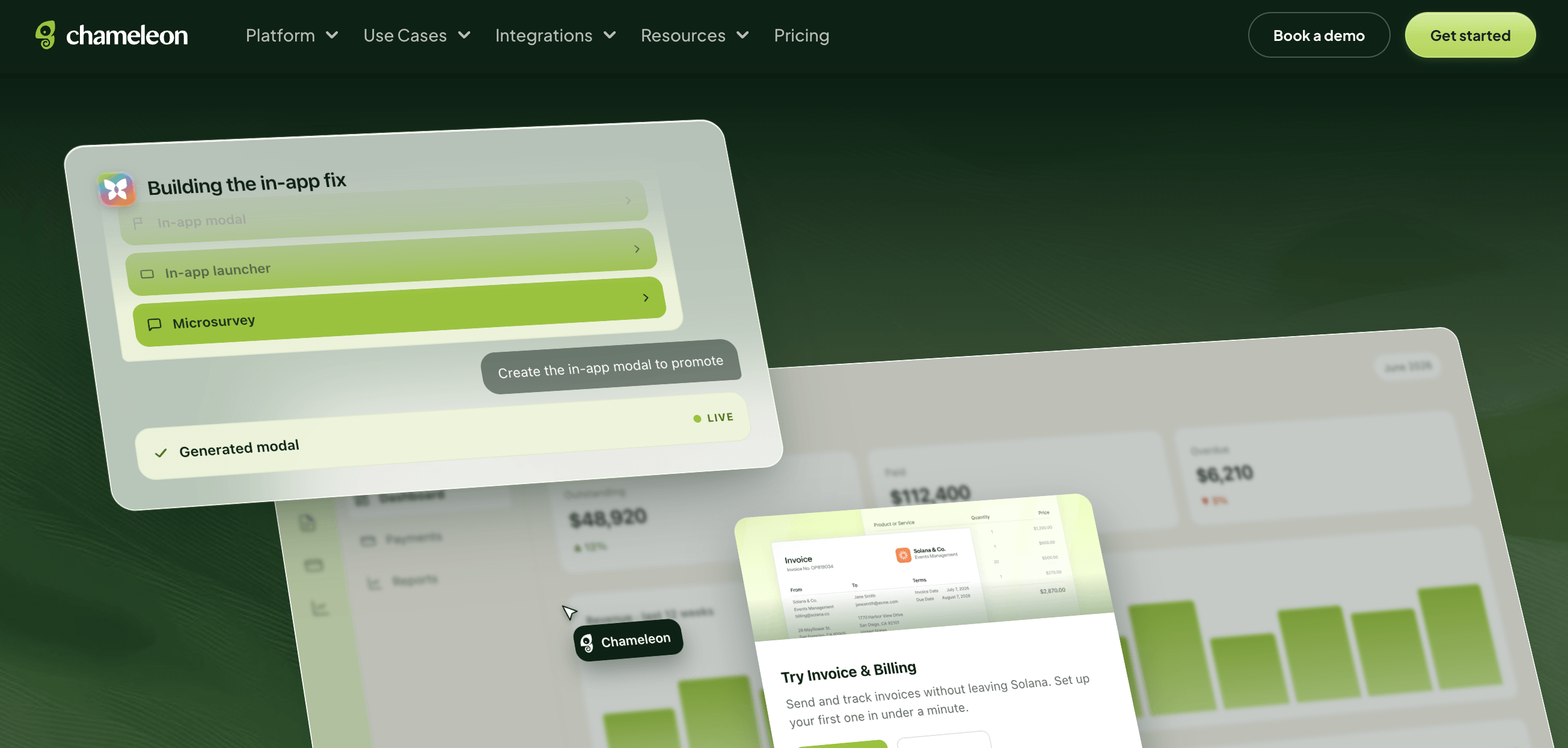
Partoo uses  Chameleon to let the Product Marketing teams add interactive elements directly in its application, without systematically calling on developers.
“Chameleon is a very good tool, with good value for money. It gives the Product Marketing teams a lot of autonomy to create guided flows and improve the user experience without depending on developers.”
Once the technical placements are in place, the teams can publish messages, announce a new feature or guide users as they discover it.
Chameleon is used in particular to create product tours and guided flows. Clément also mentions other possibilities, such as searching a knowledge base or accessing support directly from the application.
Tools in this section
Why did Evoliz reach its limits at Partoo?
Partoo is working on an overhaul of its finance stack, notably because the legacy integrations between its billing software and Salesforce have become hard to maintain.
“Evoliz is an excellent tool up to a certain company size, with very good value for money.”
The company historically used  Chargebee to manage subscriptions for part of its business and
 Evoliz for another significant part of its billing.
Evoliz has been in the organization for about eight years. The software long offered good value for money, but its limits became apparent as needs grew more complex.
Partoo notably built several custom integrations between Evoliz and Salesforce. These developments supported the company's growth, but they now complicate certain operations.
This is notably the case with  Upflow, used for customer reminders and collections. Clément considers Upflow good software, but believes the difficulties encountered at Partoo come mainly from legacy configurations and existing integrations.
The goal of the overhaul is to have more granular data and more flexible billing processes.
For spend management, Partoo also uses  Spendesk for purchasing, budgets and employee expenses. The software covers the essential needs, even though he finds its user experience less smooth than before.
Tools in this section
What other software does Partoo use for its internal functions?
Beyond the sales and finance teams, Partoo uses several pieces of software for its internal functions.
For recruiting, the company moved from  Lever to
 Teamtailor. Clément found Lever hard to use for managers who hire only occasionally. Teamtailor seems more accessible to him. He even compares Teamtailor to HubSpot for its relative simplicity and Lever to Salesforce for its complexity. A view based on his experience as a manager who hires occasionally.
On the HR side,  Lucca is also among the software mentioned, as is the move from
 Swile to
 Worklife for employee benefits. Clément was not directly involved in these choices.
For webinars, Partoo replaced  Livestorm with
 Contrast. The decision was driven by marketing, mainly for reasons of cost and features.
Finally,  Google Workspace remains the company's office suite, including Gmail and Google Sheets.
Tools in this section
Why does Partoo use Make and Claude rather than n8n for its AI agents?
Partoo chose to build its AI agents with  Make and
 Claude, mainly because some teams had already mastered Make.
The company is developing several agents to automate some of the tasks of salespeople and Customer Success managers: local visibility audits, checking an account's contacts or preparing customer presentations.
Make was already used for various no-code workflows. Clément would initially have preferred to explore  n8n, which he considers potentially better suited to technical, customizable automations.
But Partoo ultimately favored continuity with Make, in order to limit the number of tools to maintain and build on existing skills.
Clément does not rule out a migration to n8n if needs become more complex. For now, the goal is above all to build automations that the teams know how to run and maintain over time.
Summary of the software this article mentions in Partoo's stack
| Status | Workflow | Tool | Usage |
|---|---|---|---|
| In use | CRM | Salesforce | Sales and customer system of record, connected to the other tools |
| Replaced by Salesforce | CRM | PipedriveReplaced by Salesforce | Partoo's first CRM, replaced by Salesforce |
| In use | Marketing automation | HubSpot | Marketing automation connected to Salesforce |
| Dropped | Marketing automation | PardotDropped | Alternative to HubSpot within the Salesforce ecosystem |
| Replaced | Electronic signature | DocuSignReplaced | Former main solution for generating and signing contracts |
| In use | Contract management | Tomorro | Generation, negotiation, legal review and signature |
| In use | Sales commissions | Qobra | Calculation of Sales commissions, extension to CS planned |
| In use | Spreadsheet | Google Sheets | Google Workspace spreadsheet, comparison with manual calculations |
| In use | Telephony | Ringover | Sales calls, Salesforce integration |
| In use | Conversation analysis | Modjo | Call analysis, summaries and coaching |
| In use | Sales prospecting | lemlist | Sales Engagement and prospecting |
| In use | Enrichment | Surfe | LinkedIn contact search and CRM integration |
| In use | Professional network |  LinkedIn | Prospect and contact search |
| In use | Enrichment | Lusha | Contact data search and enrichment |
| Replaced | Sales prospecting | SalesloftReplaced | Former solution, adopted mostly by BDRs |
| Replaced | Sales prospecting | Salesforce Sales EngagementReplaced | Solution tested before Lemlist |
| In use | Product adoption | Chameleon | Product tours, guided flows and in-app communications |
| In use | Billing | Evoliz | Legacy billing, overhaul of the finance stack underway |
| In use | Collections | Upflow | Customer reminders and collections tracking |
| In use | Spend management | Spendesk | Purchasing, expenses and budgets |
| Replaced | Recruiting / ATS | LeverReplaced | Former recruiting tool |
| In use | Recruiting / ATS | Teamtailor | Tool that succeeded Lever |
| Replaced | Employee benefits | SwileReplaced | Former employee benefits solution |
| In use | Employee benefits | Worklife | Solution that replaced Swile, according to the interviewer |
| Replaced | Webinars | LivestormReplaced | Former webinar platform |
| In use | Webinars | Contrast | New platform chosen by marketing |
| In use | Productivity | Google Workspace | Office and collaboration suite |
| In use | Messaging | Gmail | Business email |
| In use | Automation | Make | No-code workflows and AI agent development |
| In use | Artificial intelligence | Claude | AI agents, audits and querying CRM data via MCP |
| Dropped | Automation | n8nDropped | Alternative to Make considered for automations |
| In use | Collaboration |  Slack | Internal messaging and conversational interface considered for Salesforce |