



Julien Frèche joined Folk about three years ago to grow the revenue and sales operations of the French CRM. He looks back at the software the company uses, the tools it has replaced and the growing role of AI agents in its organization.
When Julien Frèche joined Folk, the company was generating a few hundred thousand euros in ARR. Three years later, the business has grown significantly, but the philosophy remains the same: choose the best software for each use, then connect them together.
This logic runs through Folk's entire stack. The company uses  Lemlist for prospecting,
 Clay for enrichment,
 Folk for the CRM, Claude for AI agents,
 Intercom for customer relations,
 Amplitude for product analytics and
 Stripe for billing.
Some choices have changed. Folk notably went back from LaGrowthMachine to Lemlist and is considering replacing Webflow with a site developed with Claude and hosted on Vercel. Other legacy tools, such as Ringover, Calendly or Grain, are still in use.
Over the course of the interview, Julien discusses these trade-offs, the limitations he ran into and the uses for which AI is starting to replace certain specialized software.
Why does Folk favor specialized software over an all-in-one solution?
Folk builds a CRM primarily aimed at B2B teams of 5 to 50 people. The product bets on ease of use, integrations with everyday tools and the ability to work with CRM data through AI agents.
Internally, the company applies a fairly similar philosophy.
“The idea is not to go all-in-one, but to choose a tool that is good in its vertical and then connect it with the rest of the stack.”
Folk therefore prefers to select specialized software rather than impose a single platform on all its teams. This takes more work to connect the tools and move data between them, but it means each solution can be chosen for its strengths on a specific use.
There are nevertheless a few exceptions. Julien notably cites Lemlist, whose features have expanded enough to replace several prospecting tools.
Conversely, some legacy software could become less useful. With the arrival of Claude, a sophisticated visual interface is no longer always essential: an AI agent can sometimes access the data directly and carry out the requested actions.
Tools in this section
From LaGrowthMachine to Lemlist: why Folk went back
When Julien joined Folk, the company was already using Lemlist. The team then decided to switch to  LaGrowthMachine, before returning to Lemlist about a year and a half before the interview.
LaGrowthMachine had one advantage Julien particularly appreciated: the flexibility in building campaigns. It was possible to build complex scenarios with multiple branches, adapting the actions to prospects' replies and behavior.
But Lemlist gradually expanded its features. The tool now makes it possible to manage email campaigns, LinkedIn and standard calls from a single interface. Julien also mentions the options for prospecting via WhatsApp.
“The advantage of LaGrowthMachine was the flexibility in building campaigns. The big advantage of Lemlist is the all-in-one side, which lets the sales team have a single tool to manage their prospecting.”
For the salespeople, this centralization makes day-to-day work simpler. Julien also appreciates being able to connect several sending accounts and organize campaigns directly in Lemlist.
He does, however, distinguish prospecting from email marketing. Lemlist works well for simple communications, but seems less suited to him for newsletters with elaborate HTML templates. He notably cites HubSpot as a point of comparison on this topic.
The return to Lemlist thus illustrates a very concrete trade-off: Folk preferred to centralize its prospecting further, even at the cost of losing some of the flexibility offered by LaGrowthMachine.
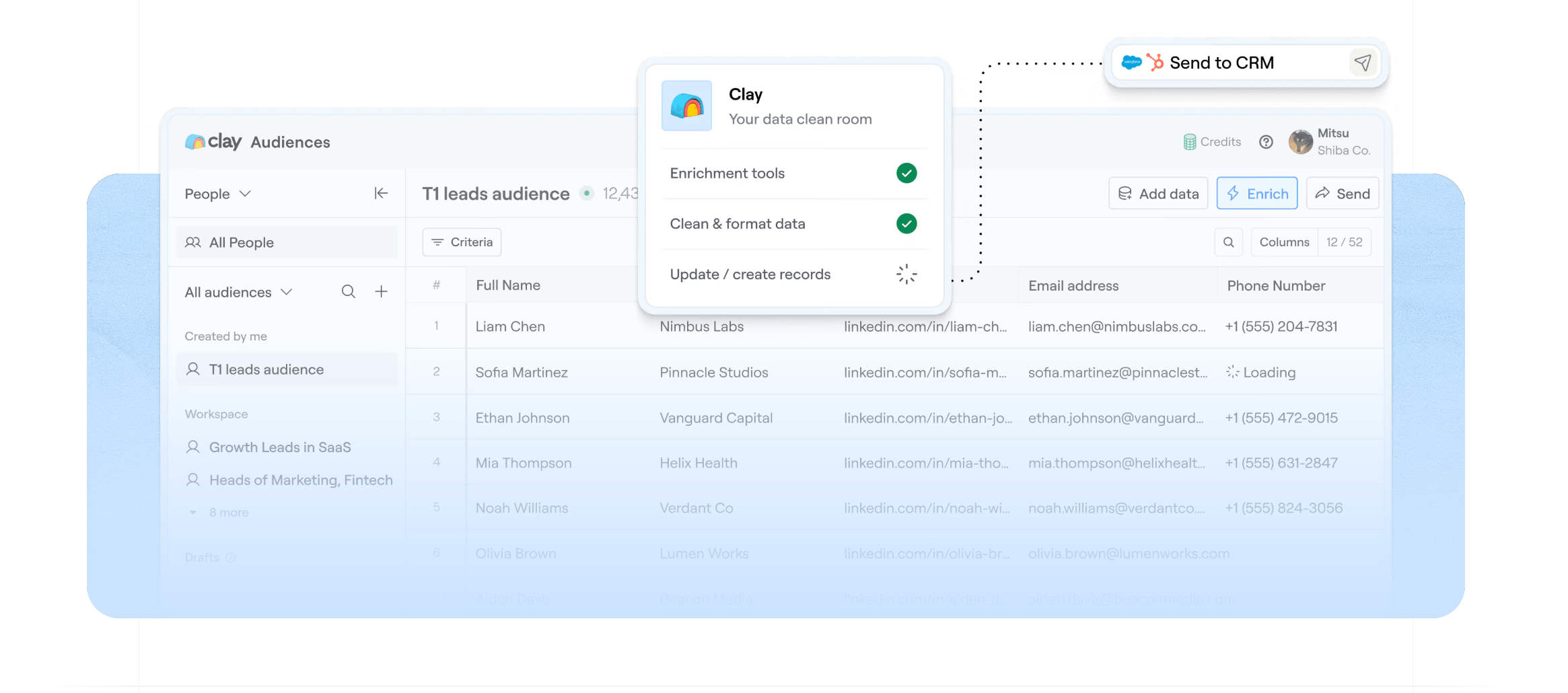
Clay for repeatable automations, Claude for complex research
Folk has been using Clay for several years, notably to enrich information about the people who create an account.
When a user signs up,  Segment collects the event and sends the data to Intercom. Clay then fills in the available information, notably about the company and the new user's profile.
This enriched data is sent back to Intercom to personalize onboarding communications. Some qualified profiles can also be added to prospecting sequences in Lemlist.
For Julien, Clay remains particularly well suited to this type of process, because the steps are known in advance and repeat with every sign-up.
“For signups, we stick with Clay because it's deterministic and it's always the same process.”
On the other hand, when it comes to less predictable research, Julien turns more to  Claude.
An agent can, for example, search for companies, identify potential contacts, consult different data sources and decide what to do next based on what it finds. It is no longer necessary to define every step and every branch in advance.
Folk also relies on several enrichment providers integrated with its CRM:  Apollo,
 Dropcontact,
 Datagma,
 Prospeo and
 Wiza, notably to retrieve information about companies, contacts or their phone numbers.
The distinction between Clay and Claude is therefore quite clear: Clay remains relevant for deterministic workflows, while Claude brings more flexibility to research that requires variable decisions.
The prospecting and enrichment workflows are detailed in another Soft Atlas article devoted to Claude, Clay and Lemlist.
Ringover or Lemlist: how Folk organizes its sales calls
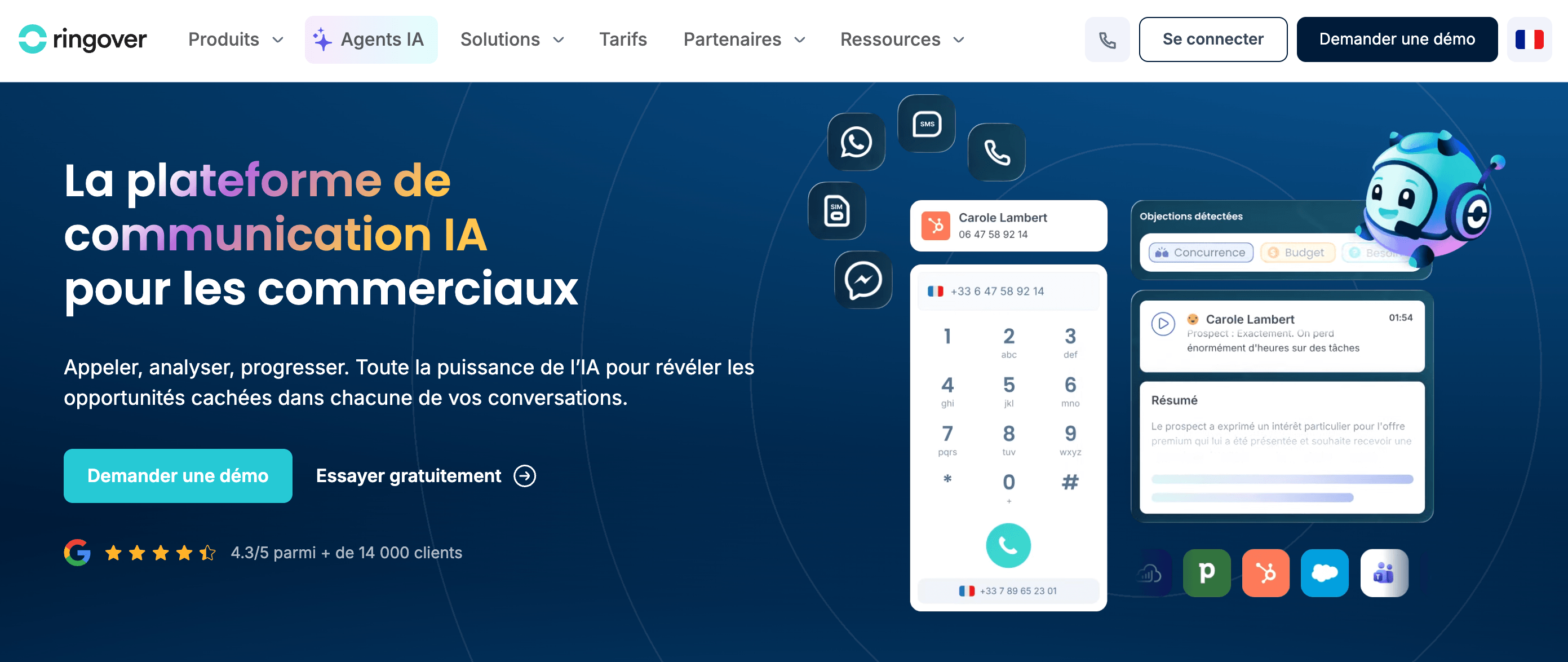
 Ringover is one of Folk's legacy tools. The company has been using it for about three years for its sales calls, mainly to follow up with prospects already in the pipeline.
Julien is fairly satisfied with the service, but more critical of its usability. He finds the interface dated and particularly regrets how hard it is to easily create call lists for the salespeople.
At the same time, Folk is starting to use the standard calling features of Lemlist, especially when calls are part of a prospecting sequence.
The two tools therefore keep different uses: Ringover for one-off follow-ups, Lemlist for calls built into campaigns. Julien is also interested in parallel dialing solutions, such as  Minari, which, according to him, can launch up to five calls simultaneously.
Why is Folk considering replacing Webflow with Vercel?
Folk's website was historically built on  Webflow. The tool lets teams create and edit pages without working directly in the code.
But with coding assistants, Julien is starting to question this choice. He is now considering generating and editing the code with Claude, then deploying the site on  Vercel.
“Now that you create everything from Claude, Webflow limits that range of action.”
This setup would give him more freedom to evolve the site and improve its technical performance. Julien also reports feedback from startups suggesting that sites built on Vercel get better SEO results.
There is still one good reason to keep Webflow, however: its CMS.
The team likes being able to create, edit and maintain articles in a visual interface. Reproducing that experience on a custom-built site would require additional work.
“The only advantage we still see in Webflow is its CMS: we have a visual interface to edit and maintain articles. We could recreate it on Vercel, but that takes work.”
For now, the migration has not been decided. Folk still has to weigh the freedom offered by AI-assisted development against the simplicity of managing content in Webflow.
How does Folk use Ahrefs, Promptwatch and Claude for its SEO and GEO?
To guide its content production, Folk mainly uses  Ahrefs and
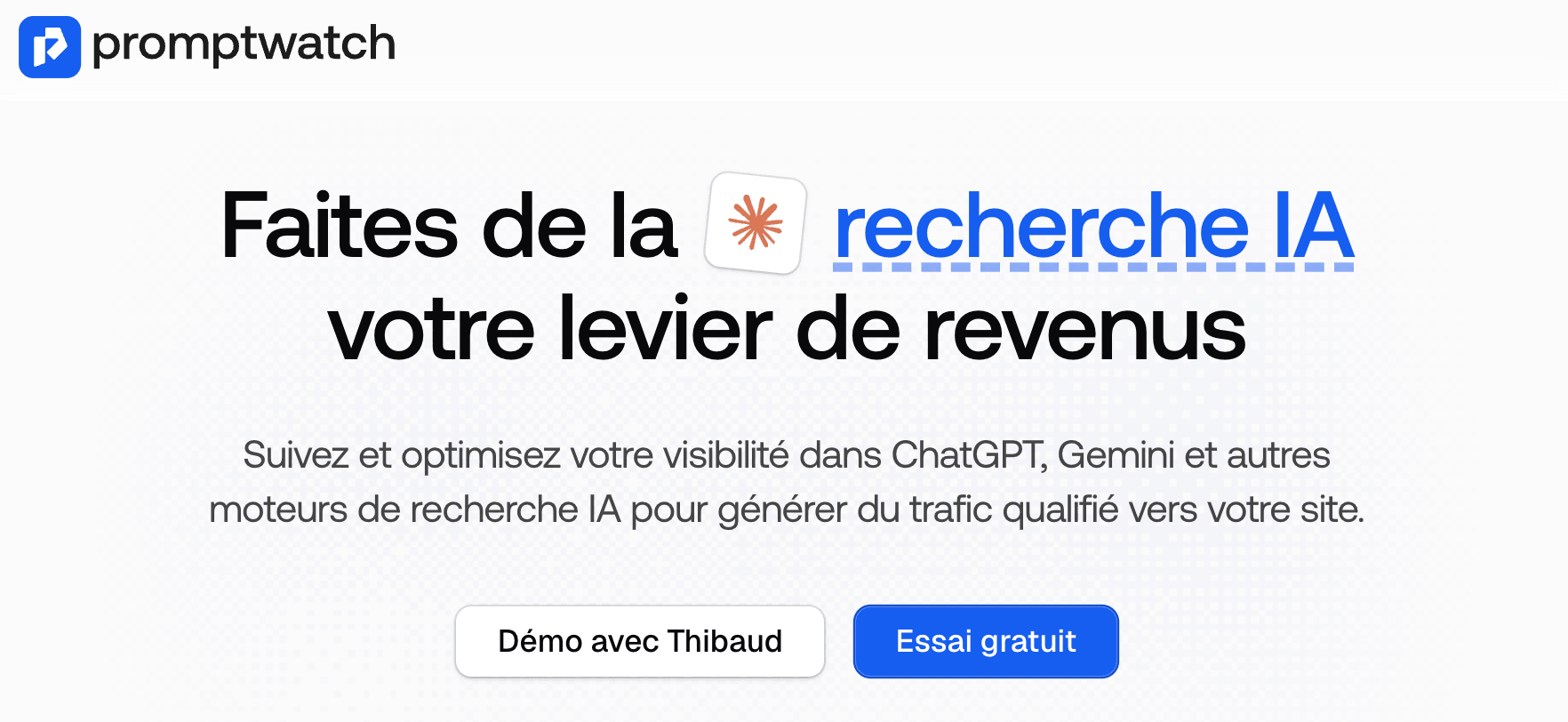
 Promptwatch.
Ahrefs is used to analyze keywords, search volumes and competition. Promptwatch measures Folk's presence in the answers generated by AI models. Above all, the team aims to work on topics close to purchase intent, rather than producing articles solely to attract traffic.
To select opportunities, it looks at three criteria: search volume, competition and likelihood of conversion. This last criterion is assessed using an internal scale from 1 to 3.
Julien also mentions  Semrush as an alternative for SEO and GEO.
“With Promptwatch, we can choose the LLMs we want to track and run prompts every day to observe our ranking over time, model by model.”
Why Folk keeps a human in the loop for SEO writing
To produce its articles, Folk combines Claude and human input.
Julien notably found that content generated entirely by AI got weaker SEO results than articles written or substantially reworked by someone who truly knows the subject.
“When we write the articles entirely with AI, we don't get the same ranking results as when a human expert on the topic writes these articles.”
This finding does not lead Folk to abandon AI for producing its content. The company keeps using it, but maintains significant human input on substance and domain expertise.
Folk's data stack: Segment, AWS, Metabase and Amplitude
At Folk, several pieces of software are involved in collecting, centralizing and analyzing data.
On the website, Google Tag Manager and  Google Analytics are used to track traffic and interactions. In the product, Segment collects user events and sends them notably to Intercom to tailor onboarding communications.
Folk also has a data warehouse hosted on AWS, which centralizes information from the various systems and makes it possible to redistribute it to the relevant applications.
To query this data, the company uses  Metabase. The product teams also have Amplitude, which lets them run certain analyses without systematically calling on a data analyst.
But this autonomy has sometimes caused problems.
Julien explains that some analyses were skewed because the people running them did not have a good enough grasp of the data model.
He gives the example of tracking free trials. When a user moves from a free trial to a paid plan, their status changes. If the analysis does not take this history into account, it can lead to wrong conclusions.
“Letting anyone and everyone run analyses can lead to mistakes when you don't know the whole data model.”
Folk therefore keeps its data analyst involved in the most complex analyses, while letting teams access the data directly for simpler needs.
What software does Folk use for HR, expenses and payments?
For its administrative functions, Folk uses several specialized solutions.
On the HR side,  PayFit handles employees based in France, while
 Deel takes care of international team members. Julien notably mentions teams in Europe and a salesperson based in Canada to address the US market.
On the finance side, the company uses  Qonto for its French banking operations and
 Spendesk to centralize invoices and manage certain expenses.
For customer payments and billing, Folk chose Stripe.
The solution covers the entire process, from payment and invoicing through to collections. This integration fits Folk's sales model well, as its plans are largely standardized, including when they are sold by a salesperson.
The company notably accepts credit card payments, SEPA and payment methods suited to the US market.
Julien appreciates this centralization, but acknowledges two drawbacks: the cost of Stripe and the dependency created by its integration into the billing processes.
“Stripe's prices are very high, but we use Stripe end-to-end. Stripe automates all our billing, from creating invoices to collections. It's very advanced, but as soon as you want to add another player or do something custom, it gets more complicated.”
This dependency notably makes it harder to add a solution like  GoCardless, which could meet certain payment needs of key account customers.
Stripe therefore greatly simplifies day-to-day management, but also makes introducing another provider more complicated.
How does Folk use Intercom beyond customer support?
Intercom plays a central role in Folk's relationship with its users.
The tool is not only used to answer support requests. It also manages customer information, onboarding communications, emails and messages built directly into the product.
The data collected by Segment and the data coming from the data warehouse make it possible to personalize these communications based on user behavior.
Julien acknowledges that Intercom is expensive, but considers that the breadth of its features justifies keeping it.
“Intercom is very expensive, but we're happy with it. It lets us centralize user tracking, customer sequences, chat support and in-product pop-ups.”
Folk has also used Intercom's product tours, the guided walkthroughs that help users discover a piece of software. The company has, however, scaled back their use, as Julien often finds these experiences frustrating for users.
It does, on the other hand, keep using pop-ups and messages built into the product.
Fin lets Folk keep a single person on support
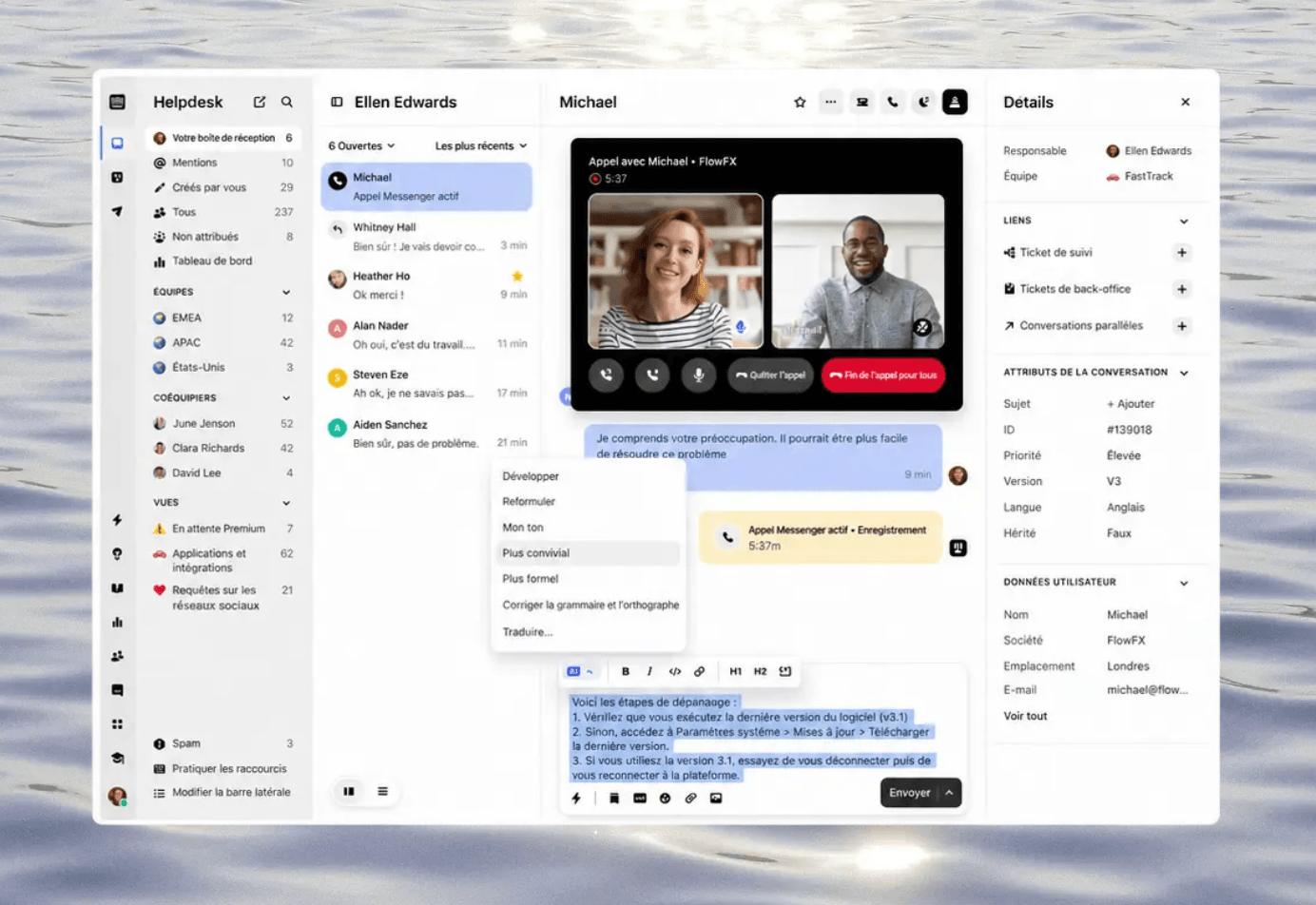
For support, Folk now relies on Fin, Intercom's AI agent, which handles a large share of requests without having to grow headcount at the same pace as the business.
The result speaks for itself: despite Folk's strong growth, the company has kept a single person on support.
How Fin works, the rules for escalating to the teams and the human checks are detailed in a dedicated Soft Atlas article.
Summary of the software this article mentions in folk's stack
| Status | Workflow | Tool | Usage |
|---|---|---|---|
| In use | CRM | folk | Central CRM and sales management |
| In use | AI | Anthropic | AI agents, development and writing |
| In use | Prospecting | lemlist | Multichannel sequences and calls |
| Replaced by Lemlist | Prospecting | La Growth MachineReplaced by Lemlist | Replaced by Lemlist, flexible campaigns |
| In use | Enrichment | Clay | Automated enrichment of sign-ups |
| In use | Customer data | Segment | Event collection and forwarding |
| In use | Customer relations | Intercom | Onboarding, communications and support |
| In use | Enrichment | Apollo.io | Data provider integrated with the CRM |
| In use | Enrichment | Dropcontact | Data provider integrated with the CRM |
| In use | Enrichment | Datagma | Data provider integrated with the CRM |
| In use | Enrichment | Prospeo | Data provider integrated with the CRM |
| In use | Enrichment | Wiza | Phone contact details, integrated with the CRM |
| In use | Telephony | Ringover | Sales calls and follow-ups |
| Dropped | Parallel dialing | MinariDropped | Solution being considered for simultaneous calls |
| In use | Website / CMS | Webflow | Website and content management |
| Dropped | Web hosting | VercelDropped | Migration being considered with Claude |
| In use | SEO | Ahrefs | Keyword and competitor research |
| In use | GEO | Promptwatch | Tracking visibility in LLMs |
| In use | Tracking |  Google Tag Manager | Tracking tag management |
| In use | Web analytics | Google Analytics | Web traffic analysis |
| In use | Data infrastructure | AWS | Data warehouse hosting |
| In use | Business intelligence | Metabase | Data visualization |
| In use | Product analytics | Amplitude | Self-service product analysis |
| In use | HR / payroll | PayFit | Management of French employees |
| In use | HR / international | Deel | Management of international team members |
| In use | Banking | Qonto | French banking operations |
| In use | Financial management | Spendesk | Invoices and expenses |
| In use | Payments / billing | Stripe | Payments, billing and collections |
| In use | Scheduling |  Calendly | Legacy booking tool |
| In use | Transcription |  Grain | Legacy transcription tool |