




This article was written by Atlas following an interview with Antoine Fort, Co-founder and CEO, conducted on September 4, 2026.
Qobra now generates nearly half of its revenue internationally. The United States has become its fastest-growing market, according to Antoine Fort. The company now has about fifty employees, a sales team of around 15 people and more than 300 customer companies, including Eleven Labs, Partoo, Contentsquare and Doctolib.
To support this growth, Qobra has gradually changed the way it prospects. In particular, the team has cut back on fully cold prospecting in favor of a model based on intent signals: a website visit, an interaction with Qobra content, hiring or a job change.
“The thing that wasn't working was truly cold outbound. You've enriched the accounts that are supposedly the right accounts, you call them, but they've never heard of you.”
Qobra therefore built a sales stack able to detect these signals, enrich them, prioritize them and then pass them on to the right salesperson.  Userled and
 Vector detect intents,
 Cargo orchestrates them, several tools enrich the data, then
 Lemlist and
 Salesforce take over.
The arrival of Claude and MCP connections added a new layer to this organization. Notably, Antoine Fort built his own AI “Chief of Staff,” able to pull information from several of the company's software tools and automatically produce briefings on the business.
How did Qobra build its sales stack?
Two principles have historically shaped Qobra's organization: move fast and stay very focused on its ICP.
Antoine Fort in fact considers that the periods when the company drifted away from this ICP were more difficult. The software stack follows directly from this philosophy: invest early in specialized tools as soon as they help speed up execution.
“We've always tended to buy quite a lot of software, telling ourselves we wanted to be state of the art in terms of processes and systems.”
Salesforce has been part of the stack from the start. The choice also had a product dimension: many of Qobra's customers use Salesforce, and the team wanted to work in the same environment as them.
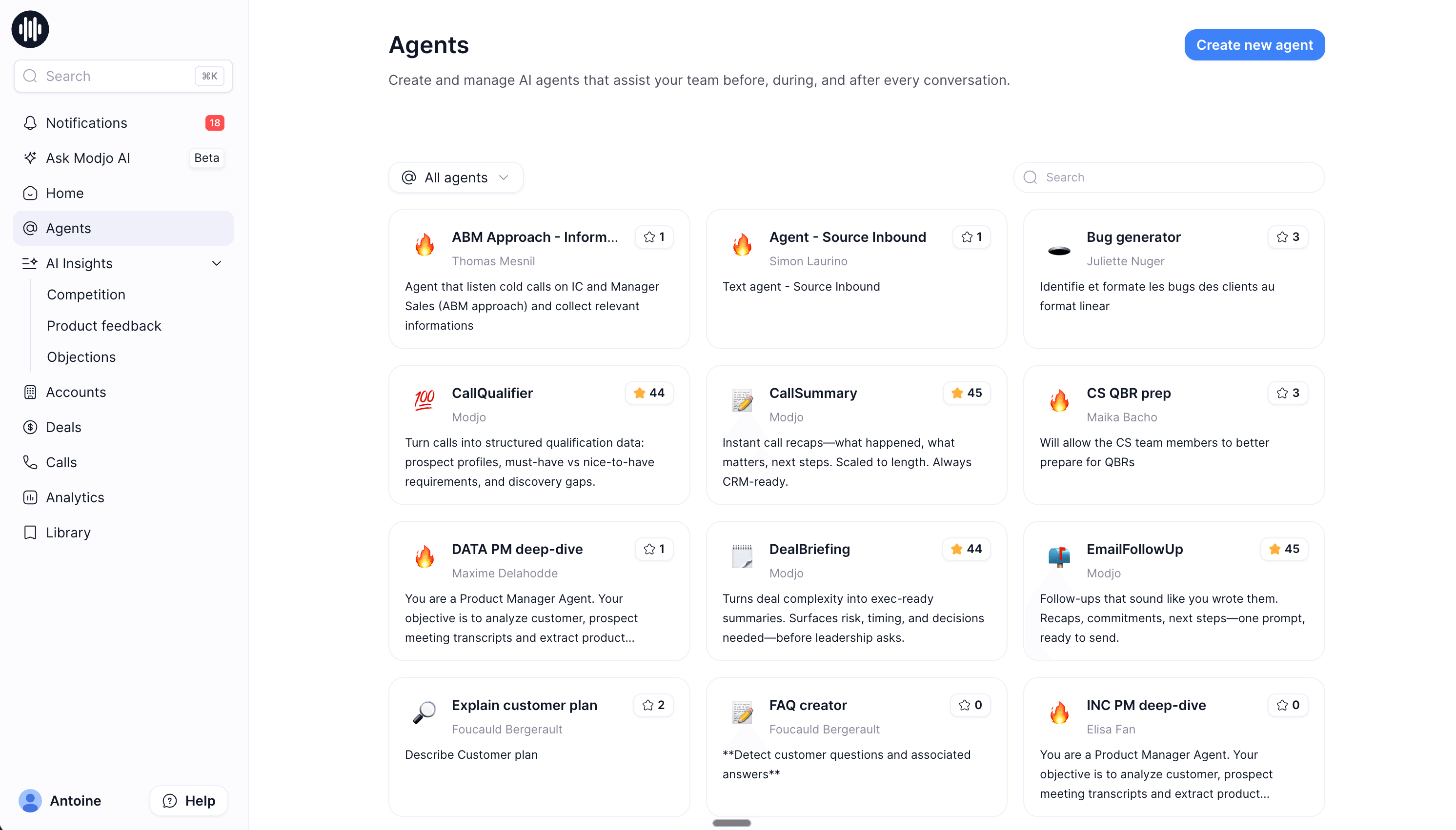
 Modjo has also been there since day one. Over the years, all the sales and customer conversations centralized in it have become a true internal memory for the company. Naturally, Qobra uses its own software to manage its teams' variable compensation.
On the finance side,  Pennylane arrived about a year and a half to two years after the company was founded, on the recommendation of its accountant. Pennylane remains central for accounting today, while SaaS billing has been handed over to
 Hyperline.
This foundation was gradually expanded with software dedicated to intent detection, data enrichment, orchestration and the execution of sales cadences.
“We built our own thing. We rely on lots of different tools rather than going with an all-in-one solution.”
The team looked in particular at more integrated platforms like Clay, but ultimately did not subscribe. Antoine Fort believes the setup assembled in-house costs them less.
Why did Qobra stop part of its cold prospecting?
For a long time, Qobra used a classic outbound approach: identify companies matching its ICP, enrich their contact details, then prospect them.
The team gradually saw the limit of this approach: perfectly matching Qobra's ICP does not necessarily mean a company is interested in its solution at the moment it is contacted. Qobra therefore sharply reduced this type of prospecting. Account Executives now prioritize companies on which an intent signal has already been detected.
The most direct signal is a visit to Qobra's website.
Userled allows the team to identify the companies visiting the website and the pages they view. This information can then flow directly into  Slack. A message can, for example, flag that a prospect or target company has just visited the website, then provide the enriched contact details the salesperson needs to reach out quickly.
The logic is simple: contact a company when it is already showing interest, rather than deciding, based on its profile alone, that it should be interested.
Which intent signals does Qobra use to prioritize its prospects?
Website visits are the signal Antoine Fort considers the strongest.
Qobra also uses Vector to complement this data with other signals.
Among those tracked by the team:
- a person's or a company's interaction with Qobra content on LinkedIn
- a recent job start
- a company hiring salespeople heavily
- the hiring of RevOps profiles
- job postings related to compensation or sales roles.
Antoine Fort clearly distinguishes the value of these different signals.
A person browsing Qobra's website shows much more direct interest than a company that has simply opened a Revenue Operations position. Both pieces of information can be useful, but they imply neither the same level of intent nor the same sales approach.
In the United States, depending on the sources used, Qobra may also have more precise information at the individual level. In Europe, the workflow described by Antoine Fort relies more on identifying the company, for reasons related to GDPR regulations.
This hierarchy of intents is then taken into account throughout the sales workflow.
How does Cargo turn intent signals into sales actions?
Detecting more signals is not enough. You still have to be able to process them and quickly turn them into sales actions. Qobra uses Cargo to connect its various intent sources with sales execution.
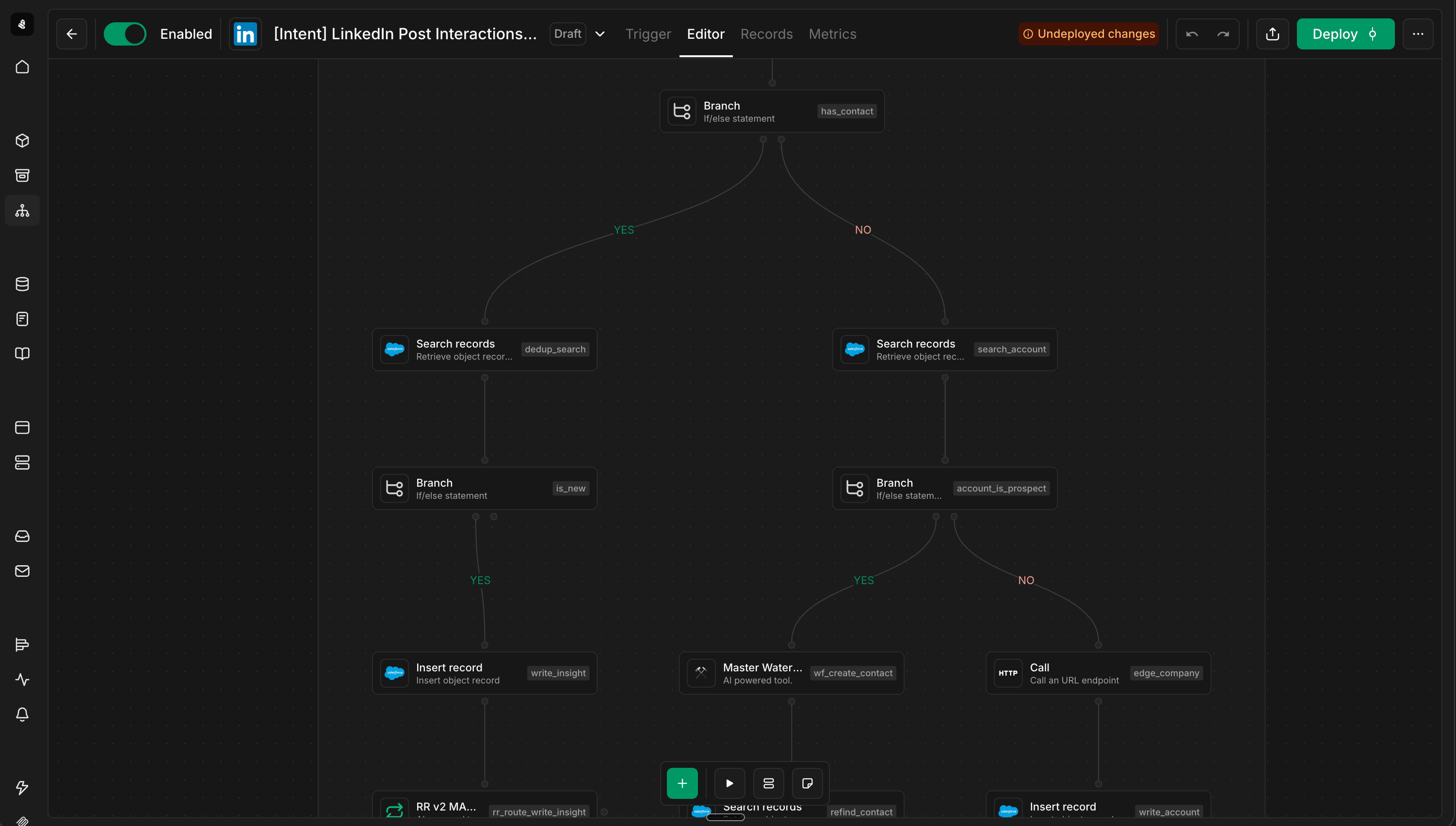
Cargo receives signals coming from several tools, then applies different rules: enrich the data, retrieve an email or a phone number, determine the salesperson in charge and trigger the appropriate sequence.
The message sent depends in particular on the nature of the signal.
A prospect who has just browsed Qobra's website does not necessarily get the same approach as an account identified because it is hiring several Compensation Analysts.
Cargo also handles round robin. Sales round robin is a distribution rule that spreads leads evenly across several eligible sellers. At Qobra, these rules take into account territory, company size and the distinction between the United States and Europe, among other things.
The workflow can therefore be summarized as follows:
Userled / Vector → Cargo → enrichment → Salesforce → Lemlist → salesperson
The enrichment tools cited by Antoine Fort include  Captain Data,
 Lusha and
 Kaspr.
Why does Qobra use Lemlist rather than Outreach?
Qobra previously used  Outreach to manage its sales cadences. The company then switched to Lemlist.
Antoine Fort cites several reasons: the ability to build in LinkedIn actions, a UX he finds better suited to a sales team of about fifteen people, and a lower cost than Outreach.
That said, the cadences are not fully automated.
They combine automated emails with actions carried out directly by the salespeople, such as a call or a LinkedIn message.
How does Qobra use Modjo to manage its sales?
At Qobra, Modjo is no longer used only to record calls.
The conversations centralized in it form a knowledge base that salespeople, managers, product teams and now internal AI agents can draw on. The product team, for example, receives regular insights from exchanges with prospects and customers: objections, product feedback and satisfaction signals.
This information makes it possible to identify topics that come up frequently in conversations without asking salespeople to manually consolidate their feedback.
On the Sales side, Antoine Fort talks about “high velocity coaching.”
The VP Sales oversees many salespeople and several opportunities at once. Before a pipeline review, he can get a summary of recent conversations and come in already familiar with the main deals.
Antoine Fort himself uses a daily report.
“I have a report that lands every morning and tells me which sales calls happened the day before, what happened and what I need to know, in a very condensed way.”
The value of Modjo also lies in the richness of the available context. Qobra uses  Aircall for telephony, but recording only phone calls in Aircall would not provide the same view of the account.
Modjo centralizes several types of interactions around a deal, including calls, video meetings and emails. When a manager wants to understand the status of an opportunity or the next steps to take, he can therefore work from a much broader context.
How did Antoine Fort build a Chief of Staff with Claude and MCP?
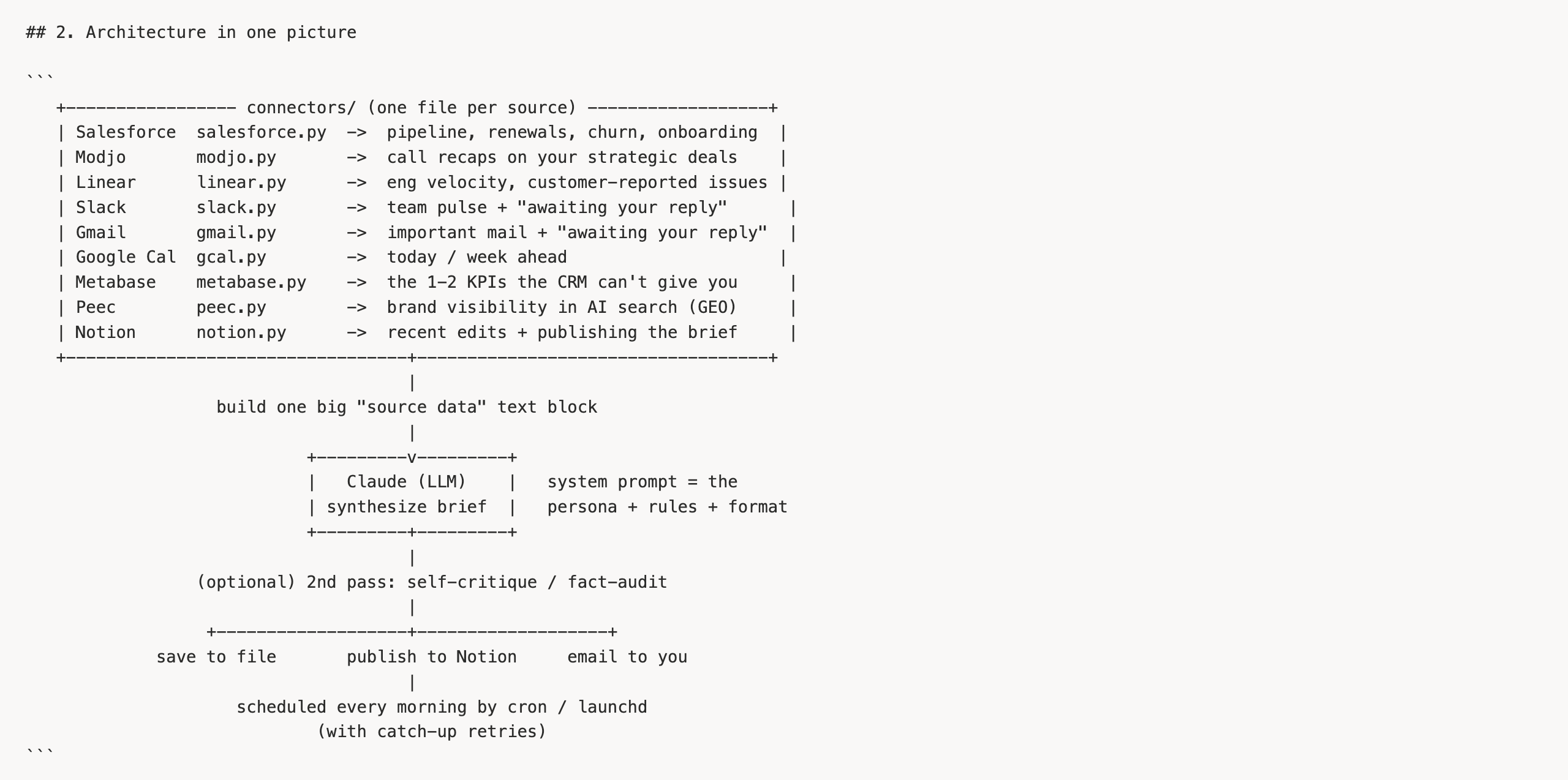
Antoine Fort himself built an agent in  Claude that acts as his personal Chief of Staff. The agent is connected to several of Qobra's software tools via MCP. Its main sources include Modjo, Salesforce and
 Metabase.
Every Monday morning at 8 a.m., a routine generates a briefing covering several areas of the company: Sales, Marketing, Product and Customer Success.
A “Claude routine” here refers to a set of instructions prepared in advance and run on a recurring basis. Claude queries different sources within a defined framework, analyzes the information obtained and then presents it in a standardized format.
Antoine Fort did not, however, let the agent freely explore each source. He told it precisely where to retrieve certain information.
To analyze deals won or lost against competitors, for example, Claude receives precise instructions on which information to look up in Salesforce. The goal is to limit the risk of incorrect interpretation or hallucination.
“I gave it precise instructions: here is the query you need to run to reduce hallucinations. It knows very precisely where to look.”
This approach illustrates an important principle in using AI agents on sales data: connecting a model to the CRM is not enough. You also have to tell it what the sources of truth are and how to query them.
Some analyses then become shared. When a deal is lost to a competitor, for example, an alert can feed a Slack channel dedicated to closed lost deals. The teams then have the conversations, emails and verbatims they need to run a post-mortem.
How do Qobra's salespeople enrich Salesforce from LinkedIn?
Qobra also uses  Surfe for a very specific workflow.
When a salesperson is working on an account in LinkedIn Sales Navigator and identifies a new decision-maker, they can add that person to Salesforce and enrich their information without having to enter it manually.
The benefit is above all operational: the salesperson can stay in their prospecting environment while keeping the CRM up to date.
How does Qobra use GEO as an acquisition channel?
Qobra's marketing stack includes  HubSpot,
 n8n,
 Webflow and
 Peec AI.
Peec AI (just like its excellent French competitor Meteoria) is used to track a company's visibility in the answers generated by AI engines and assistants. This has become a particularly important issue for Qobra.
According to Antoine Fort, about 80% of signed deals now come from inbound. Within that inbound, about three quarters of prospects say they discovered Qobra through LLMs like ChatGPT or Gemini.
“It has become an overwhelmingly dominant acquisition channel. So it's super important that we improve and monitor how we're doing every week. Improving our visibility on Soft Atlas could typically help us position ourselves better in GEO”
The company's website has been built on Webflow since the beginning.
 RevenueHero rounds out the setup for routing inbound meetings. Antoine Fort describes it as a less expensive alternative to
 Chili Piper or
 Calendly: when a prospect wants to talk with Qobra, the tool offers them a time slot with the right salesperson.
Why did Qobra move from Pennylane to Hyperline for billing?
Qobra still uses Pennylane for its accounting.
In its early years, the company also used it to issue its customer invoices. The process, however, remained very manual. The team relied on reminders, for instance, to know when to invoice each customer.
This setup was becoming less suited to a SaaS company whose contracts can involve different renewal dates, several products, additional licenses or multiple currencies.
Qobra therefore adopted Hyperline about two years ago to manage its customer billing.
This change illustrates a principle found elsewhere in Qobra's stack: keep a software tool for its core use, but add a specialized solution when a workflow becomes complex enough to justify it.
What results is Qobra getting with this approach?
In the interview, Qobra does not share before/after conversion rates that would make it possible to attribute its growth precisely to its new prospecting approach.
Several figures nonetheless give an idea of the company's trajectory.
Qobra now has more than 300 customer companies and generates more than half of its revenue internationally. The United States is now its market, and also the one growing the fastest.
On acquisition, about 80% of signed deals come from inbound, according to Antoine Fort. Within that inbound, about three quarters of prospects say they discovered Qobra through LLMs.
Beyond these figures, the sales stack has above all changed the way the teams work.
Salespeople now prioritize accounts showing an intent signal. Cargo turns several intent sources into actionable workflows. Managers come to pipeline reviews with more context. The product team automatically receives feedback drawn from sales conversations. Antoine Fort, for his part, can follow part of the company's activity thanks to a briefing generated by his Claude agent.
The data accumulated over several years in Salesforce, Modjo and the other tools thus takes on new value with the arrival of AI agents.
“With AI, Claude and MCP having access to all our tools, it lets us reap the rewards of this investment in our stack.”
What are the limits and success factors of a strategy based on intent signals?
Qobra's stack is not set in stone.
The company moved from Outreach to Lemlist. It tested Nooks, dropped it, and is now considering going back to it. It uses several intent providers and several enrichment solutions rather than a single tool. It also looked at Clay but ultimately did not choose it.
This modularity makes it possible to pick a specialized tool for each need. In return, it requires more orchestration between the different building blocks.
Cargo plays exactly this role in the intent workflow.
The second condition concerns data quality.
Antoine Fort's Claude agent works because it is not simply asked to “look at Salesforce.” Precise instructions tell it which data to look up and where to find it.
Finally, not all intent signals are equal.
Qobra considers a website visit to be much closer to purchase intent than a job posting or a job change. Automating signal collection therefore does not remove the need to rank them.
This is probably the main lesson from Qobra's evolution: moving from cold prospecting to a strategy based on intent signals is not simply a matter of adding a new source of leads. You have to build the system able to detect these signals, qualify them and quickly turn them into sales actions.
Summary of the software this article mentions in Qobra's stack
| Status | Workflow | Tool | Usage |
|---|---|---|---|
| In use | Sales CRM | Salesforce | Centralizing accounts, contacts, opportunities and sales data |
| In use | Conversation intelligence | Modjo | Centralizing calls, video meetings, emails and deal context |
| In use | Variable compensation |  Qobra | Managing the teams' variable compensation |
| In use | Accounting | Pennylane | Accounting and financial management |
| In use | SaaS billing | Hyperline | Managing subscriptions, invoices, licenses and currencies |
| In use | Personal AI | Claude | AI Chief of Staff and automations connected to tools via MCP |
| In use | BI | Metabase | Data source queried by Claude for some analyses |
| In use | Collaboration | Slack | Intent alerts, closed-lost and sales notifications |
| In use | Documentation |  Notion | Documentation and automatic creation of briefings |
| In use | Website intent | Userled | Identifying companies and visitors on the website |
| In use | Sales intent | Vector | Detecting additional signals related to accounts and prospects |
| In use | RevOps orchestration | Cargo | Centralizing, enriching, routing and processing intents |
| In use | Sales engagement | lemlist | Running email, phone and LinkedIn cadences |
| Replaced by Lemlist | Sales engagement, former | OutreachReplaced by Lemlist | Former cadence tool, replaced by Lemlist |
| In use | Enrichment | Captain Data | Enriching prospect data |
| In use | Enrichment | Lusha | Finding contact details, especially phone numbers |
| In use | Enrichment | Kaspr | Finding prospect contact details |
| In use | Telephony | Aircall | Managing sales calls |
| In use | CRM from LinkedIn | Surfe | Adding LinkedIn contacts to Salesforce |
| In use | Marketing automation | HubSpot | Marketing operations and automations |
| In use | Automation | n8n | Automations, especially on the marketing side |
| In use | GEO monitoring | Peec AI | Tracking Qobra's presence in LLM answers |
| In use | Meeting routing | RevenueHero | Assigning and booking meetings with salespeople |
| In use | Website | Webflow | CMS for Qobra's website |
| Dropped | Evaluated platform |  ClayDropped | More integrated alternative that was considered but not chosen |