




iAdvize develops an AI Shopping Assistant for retailers and e-commerce businesses. The company has about 150 employees and supports just over 400 clients in Europe and the United States.
Yves has been working at iAdvize for eight years and currently leads the marketing team. He previously worked on Product Marketing and participated in the creation of the Data and CRM teams. This experience gives him a broad view of the company's Marketing stack.
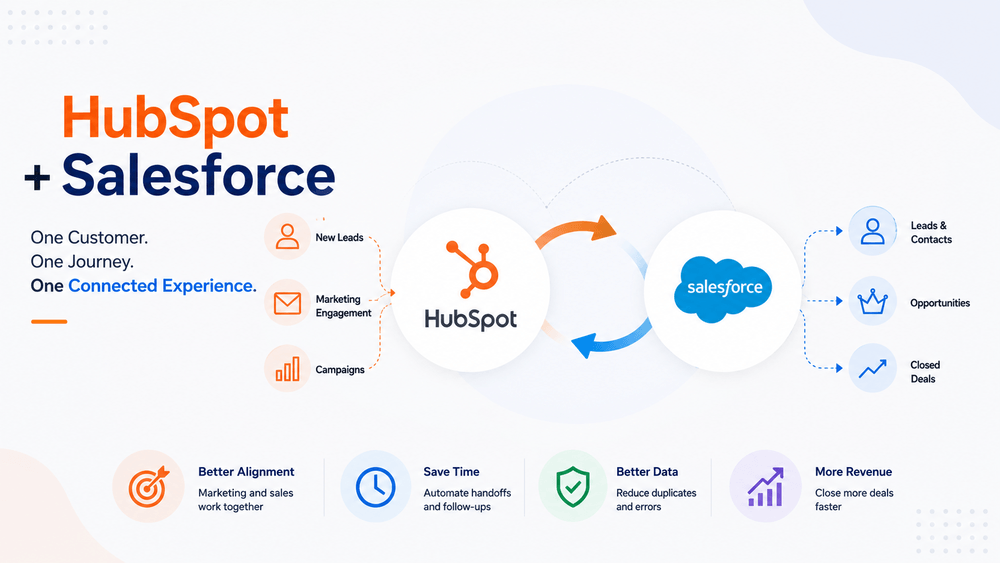
This stack is composed of several components: HubSpot manages marketing automation and the website, Salesforce remains the commercial source of truth, Claude is increasingly involved in marketing production, and Cargo orchestrates some of the data used by salespeople.
The Salesforce CRM and HubSpot Marketing duo
The core of the stack still relies on the  Salesforce-
 HubSpot pair.
iAdvize was among the very first HubSpot clients in France and has been using the solution since its inception. Today, HubSpot is used for marketing automation and as the CMS for the website (iadvize.com). Salesforce plays another role: sales CRM, contract management, and business source of truth.
This separation is historical. Before Salesforce, salespeople worked with  Pipedrive and Base. At the time, Yves Le Grouyer felt that HubSpot's CRM was not mature enough to support iAdvize's growth ambitions, internationalization, and multi-market management.
Since then, the context has changed. But not enough to make a migration a priority.
“A CRM migration is clearly not our priority, even if it could bring simplicity.”
The integration between Salesforce and HubSpot is considered robust enough. The commercial information needed by marketing flows into HubSpot, while the commercial timeline and attribution remain in Salesforce.
“The source of truth in the company from a business perspective is Salesforce.”
Maintaining both platforms is therefore mainly a pragmatic choice.
How does Claude change the use of HubSpot at iAdvize?
iAdvize has kept its site on HubSpot rather than migrating to  Webflow or
 WordPress. But the way it is managed is evolving rapidly.
 Claude Cowork, Claude Code, and
 Figma are now involved in creating modules and pages. For the most critical components, a freelance developer continues to verify the robustness of the code. Once these modules are secured, the marketing team can reuse them and produce new pages much more quickly.
Yves Le Grouyer also uses Claude to translate the site, search for dead links, detect incorrect metadata, or spot messaging inconsistencies between several pages.
The team also relies on a “Message Map” stored in Google Docs. It gathers the brand platform, vision, differentiators, personas, use cases, and product structure. A skill then allows this base to be used in Claude and  Dust to maintain a consistent message.
These new uses are also beginning to change roles within the team.
“My designers are no longer just designers, they are also integrators in a way.”
Why does iAdvize use Cargo to orchestrate its go-to-market data?
In terms of data, iAdvize makes little use of HubSpot's native enrichment and intent functions.
Yves Le Grouyer associates them with the acquisition of  Clearbit, a B2B data specialist, at the end of 2023, then developed Breeze Intelligence from this acquisition.
iAdvize instead uses  Cargo to orchestrate its various go-to-market data sources.
This choice is particularly suited to its market. To qualify a retailer or an e-commerce business, workforce and revenue are not always sufficient. The team also looks at website traffic and the technology stack used.
 Similarweb provides some of the traffic data. BuiltWith is used more occasionally for technology data. Yves Le Grouyer also mentions
 Apify and databases from Data.gouv among the orchestrated sources.
He compares the role of Cargo to that of a  Zapier or an
 n8n specialized in go-to-market.
Clay is also mentioned, but not as a tool used by iAdvize. For Yves Le Grouyer, it may suffice for companies with more standard segmentation needs. iAdvize preferred an architecture capable of aggregating data more specific to retail and e-commerce.

How does iAdvize transform its intent signals into commercial actions?
The data orchestrated by marketing is then fed into Salesforce to be made available to BDRs and Account Executives.
iAdvize had previously built a sophisticated scoring system. Yves Le Grouyer ultimately decided to revert to something simpler, considering the complexity disproportionate to the volumes involved.
The team started again with fairly direct signals, such as website visits or LinkedIn engagement. They gradually add more indirect signals: the appointment of an e-commerce director, for example, or a change in technology stack.
At this stage, the organization relies more on a hierarchy of signals and processing SLAs than on a complex score.
Prospecting then notably involves  lemlist, used for BDR email and telephony.
 Modjo remains more present among Account Executives and salespeople to record and leverage their conversations.
In the United States, iAdvize also uses  RB2B to identify certain website visitors at an individual level. During the interview, the tool had been deployed for about three months. Yves Le Grouyer therefore considered it too early to assess its ROI.
What tools does iAdvize use for GEO, video, and product tours?
For product tours, iAdvize uses  Navattic.
The choice is mainly due to the expertise already present internally. For Yves Le Grouyer, changing solutions would create more friction than value today. He also appreciates the responsiveness of the Navattic team and considers its cost reasonable.
Webinars are conducted through  Livestorm.
For video creation, iAdvize combines  Runway and
 ElevenLabs. Runway is particularly used to generate human scenes and advertising videos, while ElevenLabs produces voice-overs.
The company is also beginning to explore new possibilities with Claude for motion design.
For organic visibility,  Semrush is still used for SEO and
 Qwairy for GEO.
At the time of the interview, iAdvize was tracking a little over 200 prompts in Qwairy. The team uses it to monitor its visibility and that of its competitors, detect content and backlink opportunities, and also analyze the site's readiness for generative search.
Why did iAdvize reduce the number of software in its stack?
In 2021-2022, iAdvize initiated a significant rationalization of its software.
“We had reached the point where two teams could purchase licenses for the same tool.”
This approach notably explains the role  Google Workspace has taken in the organization.
Google Drive replaced  Dropbox. Docs, Sheets, and Slides cover office tasks and part of the documentation. Google Chat is used for internal messaging.
iAdvize currently uses neither  Notion nor
 Slack. The principle adopted is quite simple: when a function is already covered by a suite paid for by the entire company, a specialized software must provide enough additional value to justify its cost and adoption.
“To add an extra tool, you really have to prove its ROI.”
On the support functions side,  Lucca covers most HR topics and
 Swile handles meal vouchers.
The interview also mentions Regate for purchase management and virtual cards (since acquired by  Qonto).
Summary of the software this article mentions in iAdvize's stack
| Status | Workflow | Tool | Usage |
|---|---|---|---|
| In use | CRM |  Salesforce | Sales CRM and business source of truth |
| In use | Marketing automation / CMS | HubSpot | Marketing automation and website (CMS) |
| Replaced | CRM | PipedriveReplaced | Former sales CRM |
| In use | AI | Claude Cowork | |
| In use | AI Development | Claude Code | |
| In use | Design | Figma | Design system |
| In use | AI | Dust | Message Map and more tech-oriented uses |
| In use | Documentation | Google Docs | Office tools |
| In use | GTM / data | Cargo | Orchestration of sources and signals |
| In use | Enrichment / intent | Breeze Intelligence | Underutilized HubSpot features |
| In use | Web intelligence | Similarweb | Traffic data |
| In use | Technographics |  BuiltWith | Technological data |
| In use | Data | Apify | Source orchestrated via Cargo |
| In use | Open data | Data.gouv | French public databases |
| In use | Enrichment |  FullEnrich | Enrichment cascade |
| In use | Sales engagement | lemlist | BDR email and telephony |
| In use | Conversation intelligence | Modjo | Sales conversations |
| In use | Visitor identification | RB2B | Visitor identification |
| In use | Product tours | Navattic | Product tours |
| In use | Webinar | Livestorm | Webinars |
| In use | AI Video | Runway | Video generation |
| In use | AI Audio | ElevenLabs | Voice-over |
| In use | SEO | Semrush | SEO |
| In use | GEO | Qwairy | Tracking of over 200 prompts |
| In use | Collaboration | Google Workspace | Central collaborative suite |
| In use | Storage | Google Drive | Replaced Dropbox |
| In use | Spreadsheet | Google Sheets | Office tools |
| In use | Presentation | Google Slides | Office tools |
| In use | Messaging | Google Chat | Internal messaging |
| Replaced by Google Drive | Storage | DropboxReplaced by Google Drive | Replaced by Google Drive |
| In use | HR | Lucca | Majority of HR topics |
| In use | Employee benefits | Swile | Meal vouchers |
| In use | Finance | Regate | Purchases and virtual cards |