





This article was written by Atlas following an interview with Yanis Boukhrissi, Global Revenue Operations Director at Shine/Cegid, conducted on September 21, 2026. It documents the rationalization of the Revenue, data and web stack of a group built through successive acquisitions.
Today the Shine group has about 2,500 employees and generates €450 million in ARR across 12 to 15 brands, with almost as many legacy stacks.
This diversity comes from a series of mergers and acquisitions. Shine had previously joined Ageras, which brought together several companies and as many different stacks, before the merger with Cegid. The scope now includes brands and products such as EBP, Sevdesk, Billy, Employes, Salary, Storebuddy, Contasimple, Vendus, Quadra and Loop.
For the Revenue Operations team, the undertaking is substantial: supporting the various business units on their existing tools while gradually bringing together CRMs, websites, lifecycle tools, telephony solutions, CPQ and billing systems.
“Little by little, my team is going to both help each of these business units individually with their existing stack and [...] standardize the websites, the Revenue stacks, the CRMs, the lifecycle tools, the CPQs, etc.”
The goal, however, is not to mechanically replace ten tools with a single one. The group serves very different customers and sales motions. The target stack therefore has to strike a balance between standardization and specialization.
How is Revenue Operations organized at Shine and Cegid?
The organization Yanis describes rests on three pillars.
- The first is systems and automation. The team connects the data, builds the HubSpot environments, sets up automations with n8n and supports the Revenue, Sales and Customer Success teams in their day-to-day use of the tools. This team also works with the events generated in the products. A click or a lifecycle event can, for example, trigger a HubSpot workflow, alert a salesperson or feed a churn prevention scenario.
- The second pillar is Sales Ops: defining territories, compensation plans, pipeline forecasting and tracking sales performance. It also covers Risk & Compliance and Sales Enablement topics.
- Finally, the third pillar is Web, a less common scope for a Revenue Operations organization. The team brings together developers and web project managers, but also covers CRO, tracking and analytics.
This organization lets Revenue Operations keep control over a large part of the funnel, which is especially important for Product-Led Growth activities, where the website is directly the front door to the business.
The Marketing teams, for their part, remain mainly organized by country and business unit.
Why does the stack have to handle both Product-Led Growth and complex sales?
The difficulty of rationalization comes in particular from the coexistence of three sales motions.
- Product-Led Growth mainly concerns micro-businesses and entrepreneurs. A large part of the journey is self-service. Salespeople can nevertheless step in at specific moments, for example when a prospect abandons a particularly long bank account opening flow.
- Small Business is more sales-led and targets companies with up to about 50 employees, with larger deal sizes.
- Finally, the accountants segment is closer to a mid-market or enterprise model, with sales cycles that can last up to six months.
This diversity explains why the target is not necessarily to have a single piece of software per category. A tool that is very effective for a PLG journey may be less suited to a complex catalog or to a sale handled by several salespeople.
Rationalization is therefore as much about removing legacy as it is about identifying the tooling differences that truly reflect differences in the business.
How do Snowflake and Hightouch feed the Revenue stack?
The company's data relies on  Snowflake, but Revenue Operations deliberately does not work directly in the data warehouse. The Data team provides them with a mirror of the tables they need (reverse ETL). This lets the Revenue teams use the data without touching the core infrastructure.

It is from  Hightouch onward that Yanis's team really starts working with the data. The reverse ETL makes it possible to fetch the information available in Snowflake and send it to the operational tools, HubSpot in particular.
The team had previously worked with  Segment, since acquired by Twilio. Without having used Hightouch in depth himself, Yanis reports positive feedback from his team.
“We manage to do what we want. We manage to get fresh data, not too expensive in terms of data refresh. So it works pretty well.”
 Databricks was also used previously on the Cegid side. Yanis mainly points to its cost, while noting that his team rarely worked directly in the tool.
The philosophy of the architecture is therefore clear: leave the data infrastructure to the specialized team, then expose to Revenue Operations a layer simple enough for them to build their workflows.
Why is HubSpot becoming Shine and Cegid's central CRM?
After Hightouch, the data lands in what is meant to become the center of the Revenue stack:  HubSpot. The choice is deliberate. Yanis has worked on several CRMs and has a clear preference for HubSpot.
“I've worked on pretty much every CRM and I think HubSpot is my favorite.”
The target is to build a HubSpot instance large enough to support several countries, business units and sales motions.
This convergence is still underway.  Salesforce is still used notably for part of Cegid Small Business and for the accountants scope. EBP already uses HubSpot, with about 100 users.
Not all migrations are equally difficult.
In Product-Led Growth, relatively few salespeople use the CRM directly. The migration therefore mainly involves the pipelines and the connections with the databases, so that the data stays fresh.
The undertaking becomes much heavier with Cegid and EBP, which together account for nearly 250 salespeople to take into account in the migrations.
The team has the technical skills for this kind of project, but does not have enough internal resources to absorb the workload on its own. It therefore plans to rely on KANÔ, a RevOps agency founded by former PayFit employees that Yanis already knew and about which he had heard good things.
The CRM consolidation thus illustrates a recurring pattern in the transformation: the problem is not only selecting a piece of software, but absorbing the organizational complexity of the migration.
How do HubSpot and Braze split CRM and lifecycle?
HubSpot is not meant to cover every use.
For communications tied directly to behavior in the product, the team uses  Braze. The tool makes it possible in particular to trigger communications from events: a given action in the product can lead to a specific message being sent.
The team mainly uses in-app and trigger-based communications. Email is already in use and WhatsApp is also being launched.
Yanis particularly appreciates how relatively simple the setup is, with an SDK connected to the product.
The split with HubSpot follows the sales motions. For sales-led activities, field marketers, events or webinars, HubSpot remains the natural tool. For Product-Led Growth, Braze takes over to a greater extent.
This separation also addresses an economic issue. Since HubSpot is billed in particular based on the number of marketing contacts that can be reached, moving a large share of PLG contacts to Braze significantly lowers the HubSpot bill, according to Yanis.
Technically, Braze is connected to HubSpot, Hightouch and directly to the product. Product events can thus feed the scenarios without necessarily going through a single system.
Why are Aircall and Genesys complementary for telephony?
Telephony clearly shows why rationalization does not necessarily mean selecting a single tool.
- At Shine,
 Aircall is used for calling, with fairly positive feedback, especially on outbound calls.
- EBP also uses
 Genesys, which could remain in the target stack for inbound calls.
The group does handle large volumes of inbound calls. According to the feedback Yanis has received, Genesys is more robust for this kind of use and in particular makes it possible to pull up the contact record quickly.
Aircall, on the other hand, seems better suited to outbound.
The decision to migrate everything to a single solution has therefore not been made. The uses are different enough for coexistence to make sense.
A similar logic applies to support.  Intercom is used notably at Shine, while
 Zendesk remains present in some entities. Here too, the work consists of distinguishing what reflects a real need from what is merely legacy fragmentation.
Why are enrichment and intent data less important in this stack?
Unlike many B2B organizations, enrichment is not a central undertaking.
In PLG, companies are often too small to be easily enriched. In Small Business, volumes are large and include verticals such as auto repair shops or construction, where companies can be hard to identify in standard databases.
The case of accountants is different again: Yanis estimates their number at about 12,000 in France and believes the group already knows this market well enough to have less need for enrichment tools.
Intent data has therefore not yet been the subject of a major project, even though Yanis believes the topic could become relevant for the accountants segment.
Why are Shine and Cegid evaluating DealHub to replace Salesforce CPQ?
CPQ becomes especially important as soon as you move away from Product-Led Growth journeys.
Part of the group still uses  Salesforce CPQ. Yanis acknowledges that the product works properly, but points to a classic limitation of the Salesforce ecosystem: maintaining it requires a great deal of technical expertise and resources.
“Salesforce CPQ works, honestly, it even works pretty well. It's just that, like everything with Salesforce, it takes a crazy amount of technical expertise and people to maintain it.”
This complexity contributes to the desire to gradually move away from Salesforce.
HubSpot is seen as more accessible, but its CPQ features are not considered robust enough for current needs.
The team is therefore in talks with  DealHub.
The native integration with HubSpot and the deal rooms interest the team, but another use case could be even more significant.
EBP works with more than 500 resellers. Giving all of them a CPQ license would hardly be feasible. DealHub offers an API that could make it possible to provide them with a CPQ without paying for an individual license for each one. The goal would also be to standardize the way resellers build their proposals and to avoid invoices that vary too much.
DealHub, however, is not in use yet. The product is still being evaluated.
Yanis also points to high pricing, while believing that a significant negotiation seems possible.
Why could Chargebee and Zuora continue to coexist?
Billing and subscription management also reflect the differences between PLG and sales-led.
 Chargebee is used at Shine, mainly in a Product-Led Growth environment.
 Zuora is used for more sales-led activities, notably at EBP and Cegid.
Yanis does not necessarily think a single solution will win out. Chargebee seems lighter to him once catalogs become complex, while some of the group's sales-led activities have catalogs that are particularly hard to manage.
The complexity is such that some people work specifically on managing these catalogs. The goal nevertheless remains to simplify this organization.
Other solutions still exist in some entities, notably  Frisbii in Germany and
 Moneybird. They illustrate the scale of the rationalization work still to be done.
How is Affilae used to manage partnerships?
The stack also includes  Affilae, used for partnerships and affiliate marketing.
Yanis looked into the topic himself, trying to understand the level of spending associated with the tool.
The most strategic partnerships are managed directly one-to-one. Affilae seems rather to meet the need to manage, at a larger scale, many small partnerships with other brands, notably for sending leads or business.
The tool is therefore less about influence than an infrastructure for industrializing part of the partnerships.
Tools in this section
How do GA4 (Google Analytics), AppsFlyer and Mixpanel split analytics?
Analytics relies on several tools that observe different stages of the user journey.
 Google Analytics (GA4) is still mainly used to analyze the website.
 Mixpanel is more product-focused. It makes it possible to analyze events and behavior once the user is in the application. Yanis simply describes it as the equivalent of GA for the product, with A/B testing and session replay capabilities as well.
 AppsFlyer covers a different issue: mobile attribution.
Since all the products are available as apps, some users never go through the website before downloading the app. AppsFlyer then makes it possible to understand where these conversions come from and to better track journeys between web and mobile.
“AppsFlyer lets us close the loop.”
The team has just reviewed its AppsFlyer contract and says it is satisfied with the tool for its current use. Yanis considers it better suited than GA4 in particular for cross-attribution between mobile and web, web-to-app or mobile-to-app.
Braze, for its part, uses the same types of product events, but for a different purpose. Where Mixpanel reads them to analyze behavior, Braze uses them to trigger actions.
This distinction avoids artificially looking for a single tool: the same data feeds several specialized pieces of software depending on the need.
Tools in this section
AB Tasty, Convert or Webyn: which A/B testing tool to choose?
A/B testing is one of the categories still being rationalized.
Cegid used  AB Tasty, while Shine uses
 Convert.
The two solutions involve different trade-offs. Yanis considers AB Tasty relatively expensive and a bit light for some needs. Convert works, but in his view remains complex to manage.
The team is therefore benchmarking several solutions.
Among the alternatives mentioned is  Webyn, identified by Yanis's Head of Web. The tool notably seems to make it possible to create many variations, tests and flows.
This choice is particularly important in the current context. The convergence of the brands means rethinking the websites' navigation: should there be a double, triple or quadruple navigation? How do you showcase several products without making the experience too complex?
The Revenue Operations teams work on these questions with the Brand and Design teams. A/B testing should make it possible to test the different options against real user behavior.
Why does Shine use Prismic and Strapi, while EBP uses WordPress?
The web estate directly reflects the history of the acquisitions.
Two websites are particularly important today.
- Shine France uses
 Prismic. For now, the site will remain specific to France and is meant to gradually host the various segments and products aimed at the French market.
- Shine.co uses
 Strapi for all the other countries.
Yanis does not pass definitive judgment on Prismic. He mainly points out that the environment is highly custom, partly because the site is old and was historically built in a bespoke way. This limits the ability to easily hand control to non-technical teams.
Strapi offers more flexibility on templates.
The central team can create the navigation, widgets and templates with the Brand team, then give more autonomy to the local Product Marketing Managers and Content Managers.
Countries can thus take control of the landing pages they need for their campaigns, but also of some blog pages or product pages based on predefined templates.
Legacy sites follow yet another logic.
A large share has been moved to  WordPress, notably because the tool is simple to build with and it is much easier to find freelancers able to work on it. The team outsources some of these sites and therefore favors a technology that is very widely mastered on the market.
EBP.com is one of these environments.
Finally, sevdesk uses  Webflow.
In the short term, the Web strategy is therefore not about imposing a single CMS, but about gradually bringing the sites together while taking into account maintenance costs, the countries' autonomy and the availability of technical resources.
Tools in this section
How does Claude Enterprise help with CRM migrations?
The use of AI is not limited to customer-facing interfaces.
The teams have a  Claude Enterprise plan with monthly allocations and restrictions on the applications the AI can connect to. Claude is used notably with the
 n8n and HubSpot MCPs.
One of the main use cases concerns data quality: cleaning, deduplication and preparing migrations.
“Claude saves us an insane amount of time on deduplication and data cleaning. For the migrations too, it's going to help us a lot.”
In an organization that has to bring together many CRMs and legacy databases, this use is directly tied to the rationalization effort.
Adoption happened fairly organically. The teams mostly trained themselves and share skills with one another, notably ones they find on GitHub.
Why is Modjo appreciated but underused?
 Modjo is used to record and analyze sales calls.
Yanis's assessment of the tool is particularly interesting because it separates the quality of the software from its actual level of adoption.
Extracting data from conversations is well used. The coaching potential, on the other hand, is harder to fully exploit.
Even when a company has a Sales Enablement team, managers and salespeople need to find enough time to go back over the calls and really use the features on offer.
For Yanis, the limitation is therefore not so much the product as the bandwidth it demands from users.
“Modjo is a great tool. It just takes more bandwidth on the user side than what's being sold, I think.”
This is a broader lesson about the Revenue stack: the theoretical value of an advanced tool does not automatically turn into real usage.
How do Linear and Teamtailor round out the stack?
For internal ticketing and the Web and Product roadmaps, the teams use  Linear.
Yanis initially felt that the tool might be oversized compared with solutions like Asana or Monday. His opinion changed with use: as soon as an organization handles a lot of development, Linear seems relevant to him for structuring tickets, roadmaps and internal requests.
 Slack is used for internal communication.
For recruiting, Yanis currently uses  Teamtailor, whose experience he finds pleasant.
The rationalization of HR tools, however, is less advanced than that of the Revenue stack. Several tools still coexist depending on the team, notably for leave management. HiBob is mentioned in this environment, but Yanis does not yet know which target the HR organization will move toward.
What target architecture is emerging for the Revenue stack?
The ongoing transformation does not seem to be leading toward a single suite capable of replacing all of the group's software.
Rather, it outlines an architecture organized around a central foundation, complemented by specialized tools when differences in use justify them.
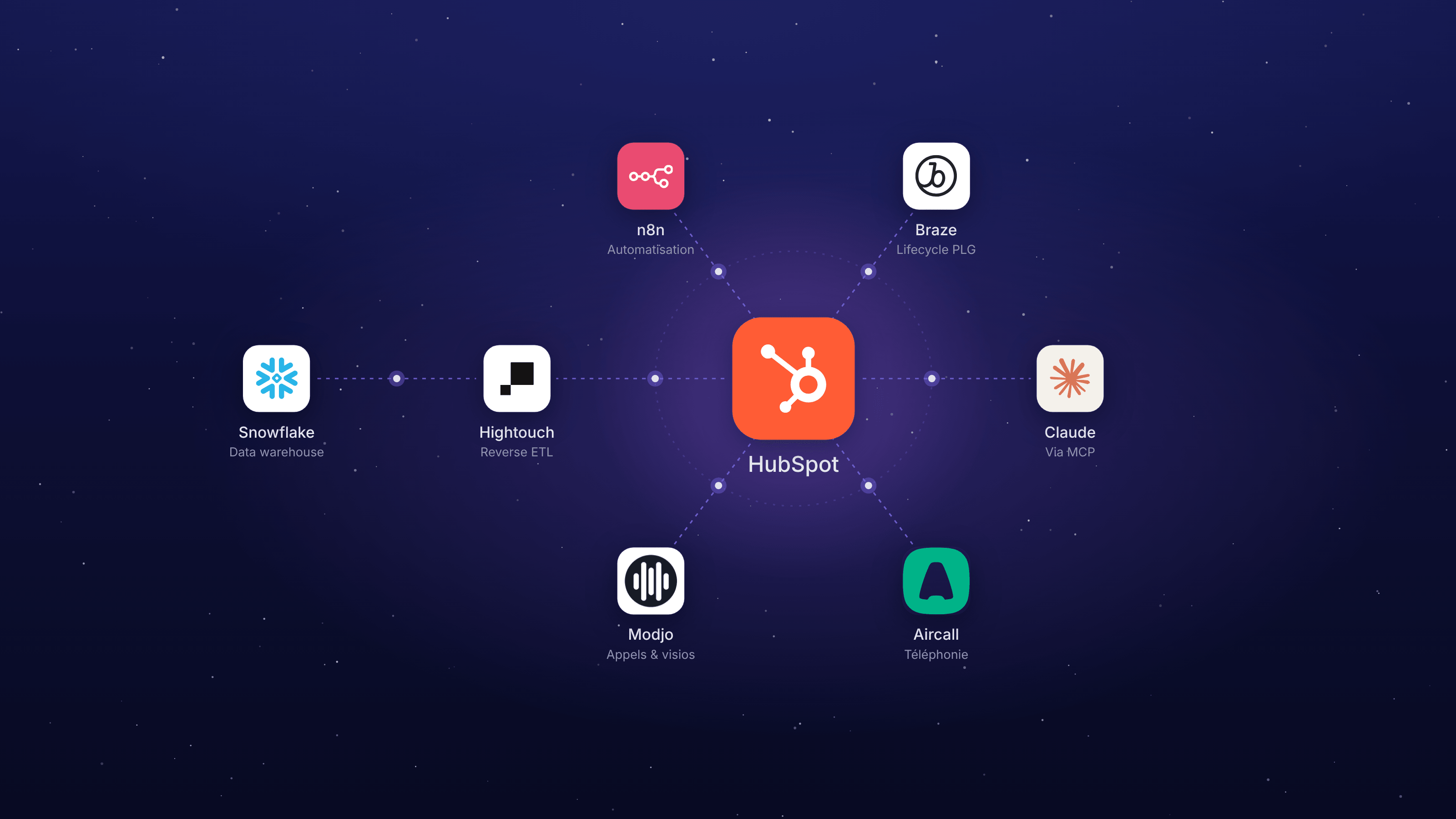
Snowflake centralizes the data. Hightouch lets Revenue Operations use it without working directly in the data warehouse. HubSpot is gradually becoming the central CRM for Sales and Customer Success activities. Braze handles a large part of the Product-Led Growth lifecycle.
Around this core, some tools keep a specific role: AppsFlyer for mobile attribution, Mixpanel for product analytics, Aircall for some outbound calls, Genesys for large inbound flows, and Chargebee and Zuora for different billing models.
Other categories are still open: DealHub is being evaluated for CPQ, Webyn is among the options considered for A/B testing and  Rose could be tested as a conversational agent.
This architecture also makes it easier to understand the rationalization led by the team. The goal is not only to reduce the number of software tools, even though Yanis estimates he can eventually cut about €200,000 in licenses.
The real work consists of distinguishing the stack differences justified by the business models from those inherited from the group's history. In an organization built through acquisitions, standardizing for the sake of standardizing can simply shift the complexity. The target is rather to build a few solid central building blocks and to keep specialized tools when they meet a genuinely different need.
Summary of the software this article mentions in Shine's stack
| Status | Workflow | Tool | Usage |
|---|---|---|---|
| In use | Data warehouse | Snowflake | Data centralization |
| In use | Legacy data warehouse | Databricks | Previously used on some Cegid scopes |
| In use | Reverse ETL | Hightouch | Making Snowflake data available in Revenue tools |
| In use | CRM | HubSpot | Target CRM and marketing automation |
| In use | Legacy CRM |  Salesforce | Still used on some Cegid scopes |
| In use | Automation | n8n | Automations and connections between systems |
| In use | Lifecycle | Braze | In-app, email and communications triggered by product events |
| In use | Outbound calling | Aircall | Telephony, especially for outbound calls |
| In use | Inbound calling | Genesys | Handling large volumes of inbound calls |
| In use | Support | Intercom | Support, notably at Shine |
| In use | Legacy support | Zendesk | Still present in some entities |
| In use | CPQ | Salesforce CPQ | CPQ still used in part of the group |
| In use | CPQ under evaluation | DealHub | CPQ, deal rooms and potential use for resellers |
| In use | Billing | Chargebee | Billing/subscription, notably for PLG activities |
| In use | Billing | Zuora | Billing for more sales-led activities |
| In use | Billing | Frisbii | Present notably in Germany |
| In use | Billing / accounting | Moneybird | Present in some entities |
| In use | Affiliate marketing | Affilae | Affiliate and partnership management |
| In use | Web analytics | Google Marketing Platform | Website analytics |
| In use | Mobile attribution | AppsFlyer | Attribution and app conversion tracking |
| In use | Product analytics | Mixpanel | Analysis of in-product behavior |
| In use | A/B testing | AB Tasty | Legacy solution on the Cegid side |
| In use | A/B testing | Convert | Solution used on the Shine side |
| In use | A/B testing under evaluation | Webyn | Solution considered in the ongoing benchmark |
| In use | CMS | Prismic | Shine France CMS |
| In use | CMS | Strapi | Shine.co CMS |
| In use | Legacy CMS | WordPress | Used for several legacy sites |
| In use | CMS | Webflow | Used notably by sevdesk |
| In use | Conversational agent under evaluation | Rose | POC considered for lead generation |
| In use | AI | Anthropic | Data cleaning, deduplication and migrations |
| In use | Call intelligence | Modjo | Call analysis and coaching |
| In use | Project management | Linear | Ticketing and Web and Product roadmaps |
| In use | Internal communication | Slack | Team communication |
| In use | ATS | Teamtailor | Recruiting |
| In use | HR |  HiBob | Present in the HR environment, target not yet decided |