

French companies discuss their CRM choices. Many start with Pipedrive, HubSpot is favored by teams focused on inbound, Salesforce is chosen when the sales organization becomes structured, and Attio attracts those wanting to start fresh.
HubSpot or Salesforce: this question arises in almost every company structuring their sales team. Instead of comparing product sheets, we started with what Soft Atlas uniquely offers: its interviews with executives and sales teams, and the stacks it catalogs. Fifteen French companies shared with us the CRM they use, the one they left, and the reason for the change.
The findings are less clear-cut than a comparison might suggest. Several companies have moved from HubSpot to Salesforce, another has made the reverse journey, and many keep both. Two of them have chosen a third player, Attio. And one starting point keeps coming up: Pipedrive.
Which CRM do these 15 companies use?
- Agorapulse: Pipedrive, then HubSpot, then Salesforce in 2022, and back to HubSpot today.
- Ankorstore: leaves Salesforce for Attio, after also considering HubSpot and Monday CRM.
- Collective: leaves HubSpot for Attio after its pivot to SaaS.
- Didomi: HubSpot, then Salesforce after its Series A; HubSpot remains for marketing.
- Figures: replaces Pipedrive with HubSpot about a year after its launch.
- Lucca: Salesforce for sales, and marketing moved from HubSpot to the Salesforce ecosystem.
- MerciYanis: replaces Pipedrive with HubSpot.
- Meteoria: chooses HubSpot over Pipedrive.
- Partoo: moves from Pipedrive to Salesforce, with HubSpot for marketing automation.
- Pleo: HubSpot as the sales CRM, connected to Vitally for Customer Success.
- Qobra: Salesforce from the start, HubSpot for marketing automation.
- Ringover: moves from Pipedrive to Salesforce; HubSpot covers marketing and now Customer Success.
- Saint-Gobain Distribution Bâtiment France: evaluates SAP and Salesforce for its field sales tool.
- Shine and Cegid: HubSpot is set to become the group's central CRM.
- Teamtailor: moves from HubSpot to Salesforce on January 1, 2024.
Why do so many companies leave Pipedrive?
Six of these fifteen companies started with  Pipedrive, or considered it at launch. This is a pattern often seen at Soft Atlas: a simple, low-cost CRM to start with, then a change when the sales team grows or sales become more complex. The destination, however, varies.
At Partoo, Pipedrive was suitable for the early years. Its limitations became apparent with key account sales, when average orders reached around €20,000: teams multiplied Excel files alongside the CRM to work around its limitations. Partoo switched to  Salesforce to provide a common foundation for Sales and Customer Success teams. Ringover followed the same path and has been using Salesforce for over five years.
At Figures, the migration to  HubSpot occurred about a year after launch, for a reason related to its acquisition model.
“I was the one who set up Pipedrive pretty much on my own, and I think it wasn't a good idea. We switched to HubSpot because we're a very inbound-focused company, with 80 to 85% of our activity coming from inbound. HubSpot does a great job for that.”
 Virgile Raingeard, CEO and founder of Figures
At MerciYanis, the switch from Pipedrive to HubSpot addresses another need: bringing Sales and Customer Success teams closer, who managed part of the projects in  Gmail. Guillaume Blanc, CEO, appreciated Pipedrive's simplicity. The change mainly allowed for a simultaneous review of the tool and processes.
When HubSpot prevails
HubSpot is by far the most present CRM in the stacks cataloged by Soft Atlas: it appears more than twice as often as  Salesforce Sales Cloud. In interviews, it is favored by young teams, very focused on inbound, and rarely for a single reason.
At Meteoria, the choice is primarily economic. Idriss Khouader, co-founder and CEO, previously leaned towards Pipedrive in his other companies.
“In my previous companies, we tended to go with Pipedrive. I find it works well and is much cheaper than HubSpot.”
 Idriss Khouader, co-founder and CEO of Meteoria
However, Meteoria chose HubSpot, thanks to a startup offer of a 90% discount for one or two years, knowing that the bill will increase significantly afterward. He also considers HubSpot more comprehensive.
At Shine and Cegid, the preference is embraced by the Revenue Operations team, responsible for aligning the CRMs of the group's various entities.
“I've worked on just about every CRM and I think HubSpot is my favorite.”
 Yanis Boukhrissi, Global Revenue Operations Director at Shine
When Salesforce prevails
Salesforce tends to be chosen when the sales organization becomes structured, recruits, or internationalizes.
Didomi adopted Salesforce after its Series A, particularly to support its expansion in the United States: having Salesforce was almost a requirement to recruit certain American salespeople. The company previously used HubSpot, but the cost of reporting increased with the complexity of the dashboards.
Qobra has been using Salesforce since its inception, for a reason related to its product: many of its clients use Salesforce, and the team wanted to work in the same environment as them.
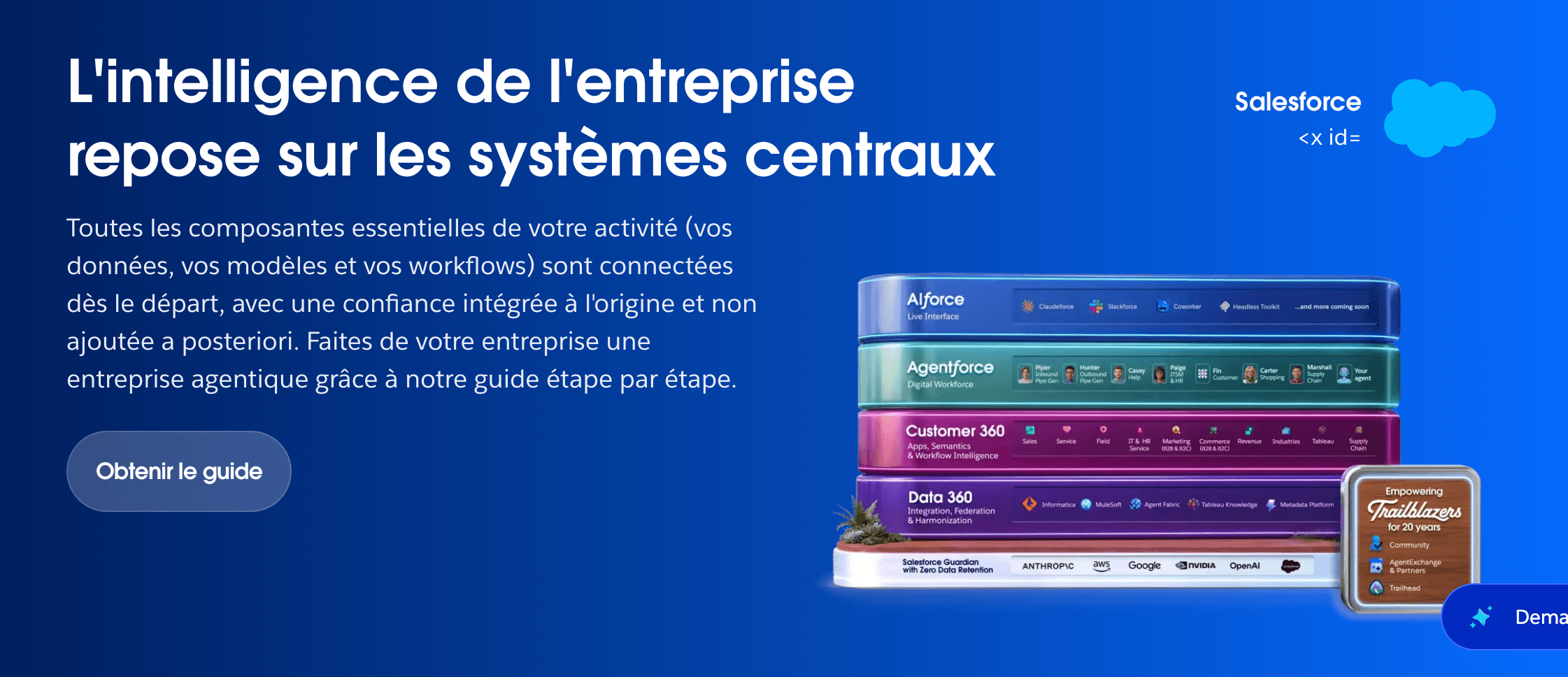
Lucca takes the logic further and centers several components of its stack around Salesforce, even if it means accepting a less pleasant interface than that of specialized tools.
“Our logic is more data first. We might accept a slightly less good UX if, behind it, we have consolidated and clean data.”
 Quentin Lallemand, Marketing Performance Director at Lucca
Teamtailor made the same choice: Salesforce has been the central system for the sales team since January 1, 2024, after HubSpot.
Choosing Salesforce does not mean building everything on it. Partoo sought from the start to limit specific developments.
“We tried to reduce the customization of Salesforce as much as possible, not to do too many specific developments. The idea was to keep something quite simple and to align as much as possible with Salesforce's logic.”
 Clément Bouillaud, Operations Director at Partoo
Do you need one CRM or two?
The duo of Salesforce for sales and HubSpot for marketing often comes up in these interviews: Qobra, Didomi, Partoo, and Ringover use it. Partoo chose it over  Pardot, Salesforce's marketing automation tool.
“The first issue is a price gap. Pardot is much more expensive and more complicated to implement. And above all, the HubSpot duo for marketing automation, connected to Salesforce, works quite well and was already widely used in the ecosystem.”
Clément Bouillaud, Operations Director at PartooChoosing a common combination also allows benefiting from the feedback of other companies and recruiting profiles who know it more easily. At Ringover, HubSpot goes even further: it now equips the Customer Success teams, while the salespeople remain in Salesforce.

This duo has a cost that others have decided not to pay anymore. Lucca replaced HubSpot Marketing with Pardot, then is preparing its transition to  Marketing Cloud Next, so that marketing and sales data live in the same environment. Agorapulse is taking the opposite path for the same reason: to bring marketing and sales together in HubSpot.
What does a CRM change cost?
Deciding to change CRM happens quickly. Doing it takes time. Two interviews provide rare benchmarks.
At Agorapulse, the migration from HubSpot to Salesforce in 2022 took at least nine months.
“The migration from HubSpot to Salesforce CRM cost me nearly €100,000 and took no less than nine months. And now, brace yourself, we're doing the same thing to go back to full HubSpot.”
 Emeric Ernoult, founder and CEO of Agorapulse
The features explain only part of this back-and-forth. The first change follows the arrival of a VP Sales accustomed to Salesforce, the second that of a new Revenue Manager. The weight of salespeople's habits in choosing the CRM often comes up in Soft Atlas interviews.
“Salespeople like Salesforce because they know Salesforce. Not that Salesforce is necessarily better, but they know it and know how to use it.”
Emeric Ernoult, founder and CEO of AgorapulseAt Ankorstore, the team spent a year cleaning up its Salesforce instance, built at a time when the company was testing many things and had more technical resources. Without achieving the expected results.
At Didomi, the question of returning to HubSpot arises, but nine years of integrations, data, and habits weigh heavily in the balance.
“HubSpot in 2019 and HubSpot in 2026 are not at all the same thing.”
 Raphaël Boukris, co-founder of Didomi
Attio, the Third Choice
Two companies made a different decision, each leaving one of the two leaders.  Attio remains rare in the stacks listed by Soft Atlas, on par with Pipedrive and far behind HubSpot and Salesforce. The two companies that chose it explain why.
Ankorstore considered HubSpot,  Monday CRM, and Attio. HubSpot made a good impression, but the team was looking for a more distinct break.
“We thought that choosing HubSpot was like choosing to stay with Salesforce. It wasn't radical and it wasn't going to address our issue.”
 Gabriel de Chazournes, Sales Director France at Ankorstore
Ankorstore chose Attio for its flexibility, based on discussions with companies already using it. According to Gabriel de Chazournes, the CRM Sales bill was reduced by more than three times compared to Salesforce.
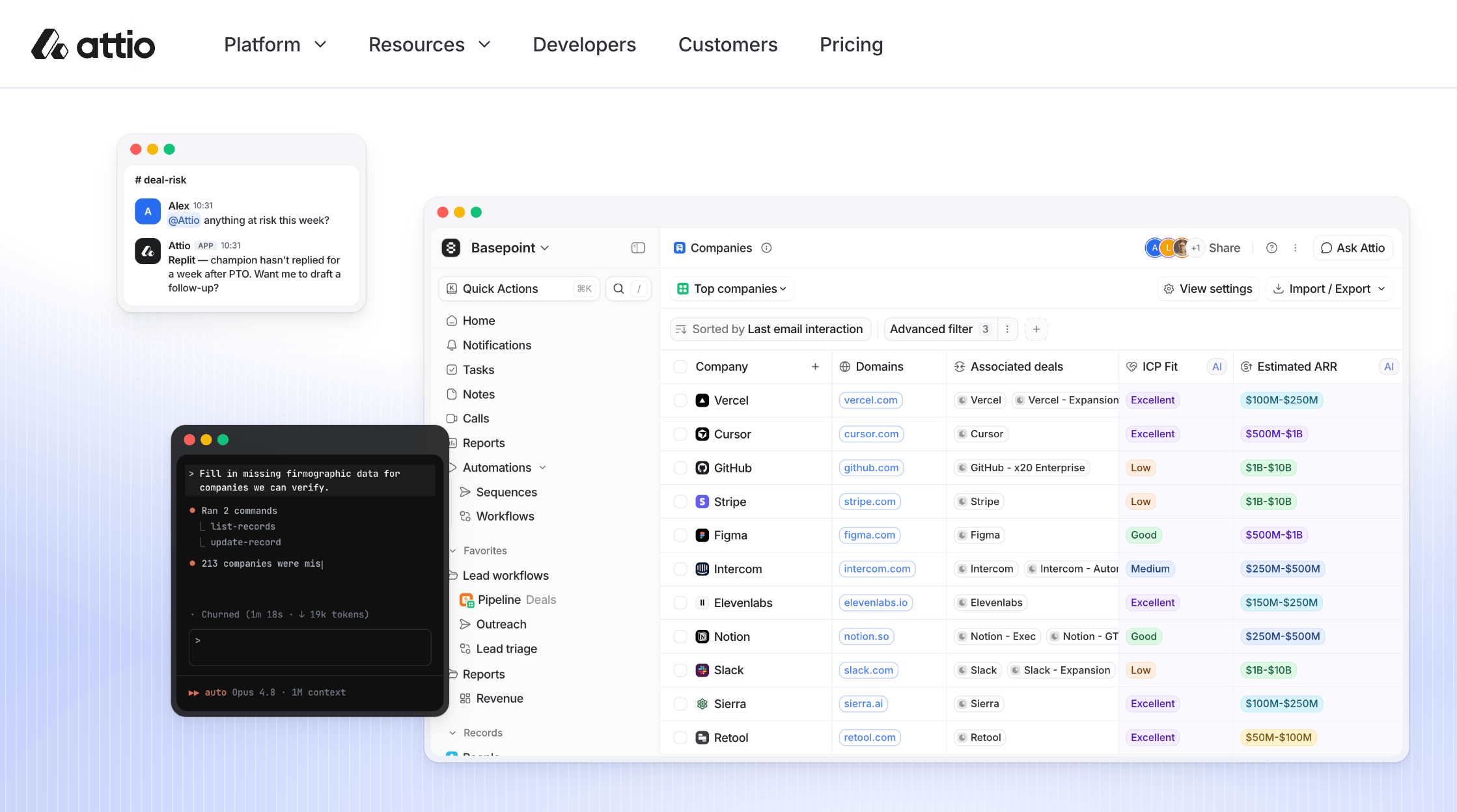
Collective left HubSpot when it pivoted to SaaS. The sales team was reduced and was looking for a lighter, less expensive CRM in its configuration.
“Attio is much simpler and more flexible than HubSpot.”
 Théo Bartholmé, Head of Finance & Operations at Collective
Théo Bartholmé himself adds nuance: a salesperson accustomed to HubSpot might find Attio a bit too basic.
And in a Large Group?
At Saint-Gobain Distribution Bâtiment France, the focus is on the tool for field salespeople. The company is evaluating  SAP Sales Cloud and Salesforce Sales Cloud, as well as an internal development or a hybrid approach. The comparison no longer focuses solely on features: it measures how far AI can automate visit planning, preparation, and reporting.
What AI Changes in CRM Choice
AI is becoming a selection criterion, but not always in the way one might expect. In Soft Atlas interviews, the question arises less about AI integrated into the CRM than about the quality of the data an agent can read there.
For Agorapulse, the issue is not the quality of AI integrated into one CRM or another. It's the consistency of the data: two systems that classify the same company differently produce data that is difficult to exploit with an assistant like  Claude.
“In the age of AI, the cleanliness of this data has become so crucial that now, it really becomes a selection criterion.”
Emeric Ernoult, founder and CEO of AgorapulseAt Partoo, six different fields correspond to opportunity amounts in Salesforce, a legacy of past customizations. An experienced employee can navigate it, but Claude and agents connected to the CRM via MCP risk choosing the wrong field.
At Ankorstore, the ability to connect Attio to Claude via MCP was a factor in the decision. At Qobra, the CEO built an agent connected to Salesforce, with precise instructions on the data to consult to limit interpretation errors.
Frequently Asked Questions
HubSpot or Salesforce for a Startup?
In these interviews, young teams tend to start with Pipedrive or HubSpot due to their simplicity and entry-level pricing, sometimes with a startup offer. HubSpot is particularly suitable for companies that are very inbound-focused. Salesforce is more often adopted for more complex sales, larger sales teams, international recruitment, or clients who use it themselves.
How Much Does a CRM Migration Cost?
Agorapulse mentions nearly €100,000 and at least nine months to transition from HubSpot to Salesforce. Beyond the cost, data, integrations, and some processes need to be reworked, which is why Didomi has refrained from changing after nine years.
Can Salesforce and HubSpot Be Used Together?
Yes, this is even a common setup in these interviews: Salesforce for sales, HubSpot for marketing, at Qobra, Didomi, Partoo, and Ringover. Conversely, Lucca and Agorapulse have chosen to consolidate everything into a single environment to achieve more coherent data.
Is Attio a Credible Alternative to HubSpot and Salesforce?
For Ankorstore and Collective, yes: simpler, more flexible, and significantly cheaper in their setup. However, Collective acknowledges that a salesperson accustomed to HubSpot might find it a bit too basic.
About These Interviews
Soft Atlas interviews executives and sales and RevOps teams about the software they truly use daily: what they have chosen, what they have left, and why. Each interview becomes a use case published on Soft Atlas, reviewed by the company before publication, and complements the company's stack on Soft Atlas. The quotes in this article are extracted word for word; the overall trends come from the stacks recorded by Soft Atlas.