





Théo Bartholmé works on finance, operations and RevOps at Collective.work. He looks back on replacing HubSpot with Attio and explains how the company uses Fibbler, Topo, Pipecorn and Claude to organize its sales prospecting.
In 2024, Collective.work changed its model. The company, until then specialized in connecting collectives of freelancers with companies, refocused on SaaS with sourcing and recruiting software. This pivot came with a sales reorganization and the replacement of HubSpot with  Attio, a CRM that was still relatively little known at the time.
Today, Collective generates about €2 million in ARR with around twenty employees. The company mainly works with recruiting firms, IT services companies, agencies and independent recruiters, in France but also in the Benelux, the United Kingdom and Spain.
To grow this business, Collective relies on four SDRs and several specialized tools: Fibbler to identify the companies exposed to its LinkedIn ads, Topo for sales sequences and  Pipecorn for data enrichment.
Some of the connections between these tools are built directly by Théo with Claude. And yet, he is not a developer.
Why did Collective replace HubSpot with Attio?
Before its SaaS pivot, Collective used  HubSpot to manage its sales activity.
The salespeople knew the software well, but Théo had a rather different experience. He mostly used HubSpot to check forecasts and dashboards, and found the tool hard to get to grips with. Finding a piece of information or building a report sometimes took him a lot of effort.
Above all, he felt that HubSpot offered too many features compared with Collective's needs.
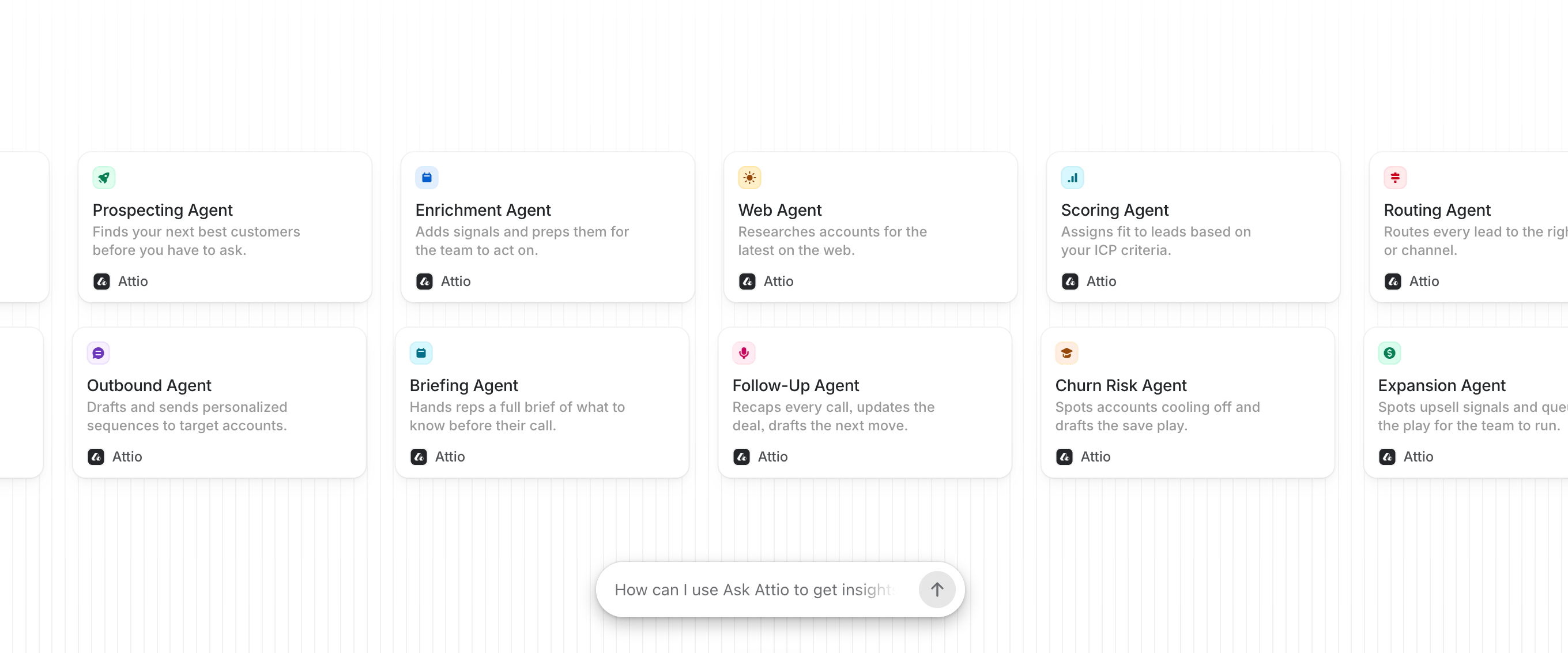
After the pivot, the company downsized its sales team and looked for a lighter CRM. One of the co-founders then suggested Attio, which Collective had been using for about a year and a half to two years at the time of the interview.
Théo particularly likes its interface and the way data is organized around companies, contacts and deals. Price also mattered: in Collective's setup, Attio came out significantly cheaper than HubSpot.
“Attio is much simpler and more flexible than HubSpot.”
A simpler CRM, but not necessarily for everyone
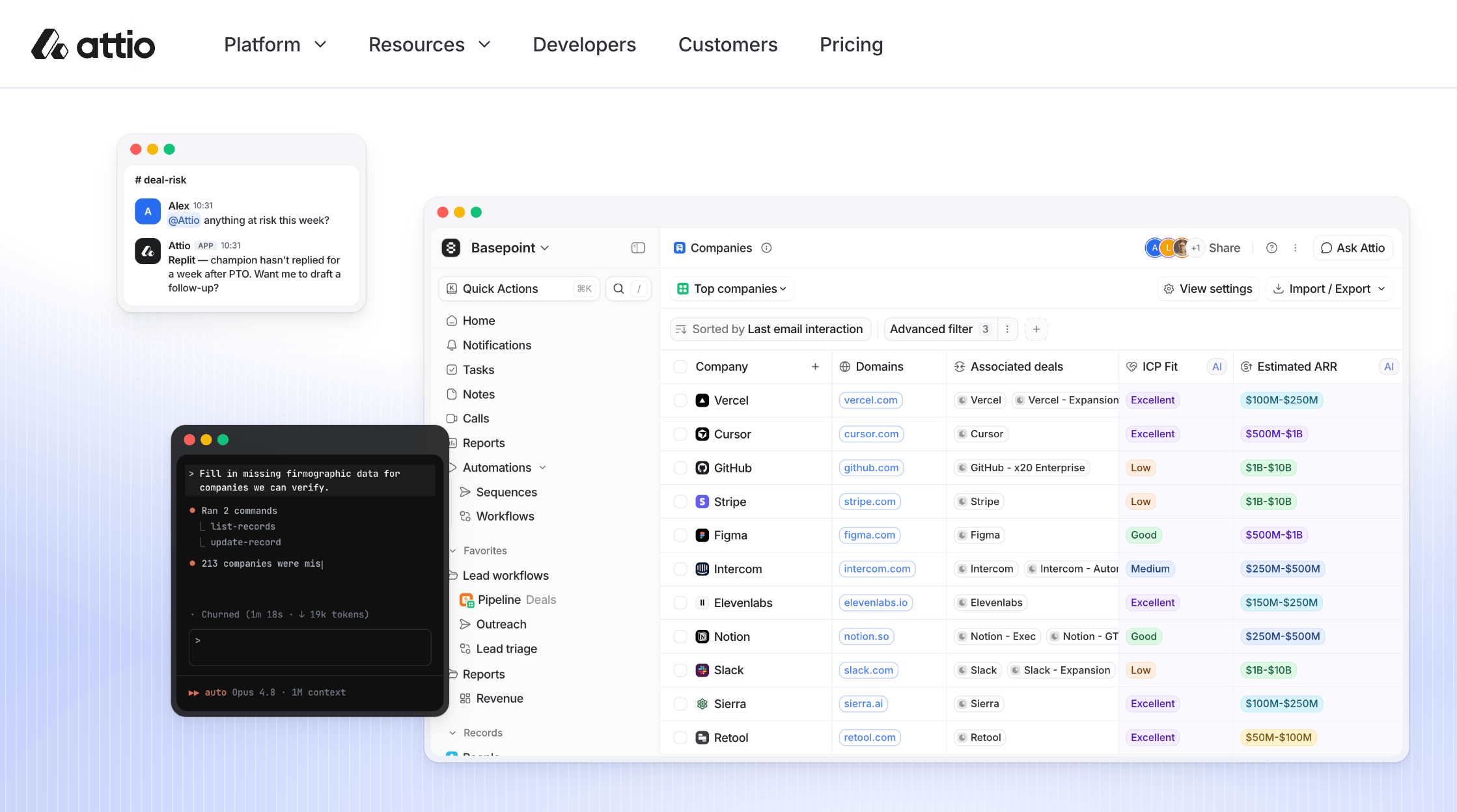
Théo readily admits that his opinion of Attio is a personal one. A salesperson used to HubSpot may find the software a bit too basic. But for someone who works on operations, this simplicity is rather an advantage. He quickly understands how the data is structured, can modify it and customize certain workflows.
Attio also offers a lot of flexibility thanks to its APIs and automation capabilities. Théo can thus adapt the CRM to Collective's needs, without being limited to the integrations offered by the vendor.
On the other hand, Collective lost some of the native integrations it had with HubSpot. Sometimes you have to build connections between tools yourself. In the setup Théo describes, Topo offers an integration with HubSpot, but not with Attio. So LinkedIn and email interactions do not all flow into the CRM yet.
Théo is working on a custom integration to solve this problem. It is one of the trade-offs of choosing Attio: Collective can customize its CRM, but sometimes has to build and maintain connections that already exist natively in HubSpot.
“HubSpot's native integrations are really very well done. With Attio, there are fewer, but the product is super well designed for building your own integrations. You have much more flexibility to connect tools the way you want. They are two different approaches, and each has its advantages.”
How does Collective use Fibbler and Topo to identify its prospects?
Recruiting professionals are especially present on  LinkedIn. Collective therefore chose to build part of its acquisition there, notably through influencer marketing.
To do this, the company works with Obvious, a specialized agency that identifies content creators followed by recruiters.
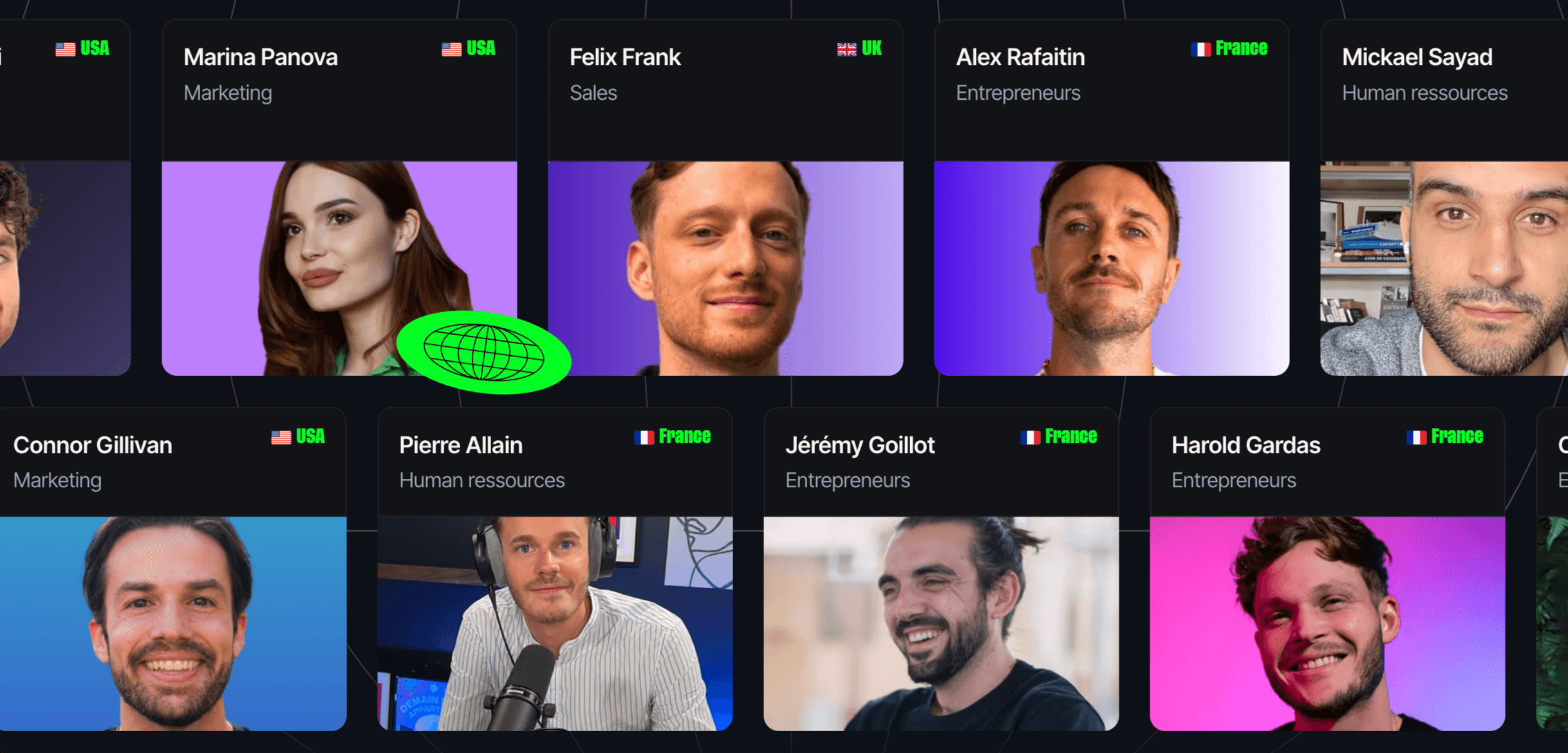
The agency offers them a chance to discover Collective, test the product and, in some cases, share their experience with their audience. Some of these posts are then sponsored on LinkedIn.
Collective has tested several formats, with or without a direct link to a sign-up or a demo. The company is also gradually trying to build a community of customers and ambassadors around its product.
“With Obvious, we work with content creators who know the recruiting world well. The idea is to introduce Collective to their audience, then sponsor some posts on LinkedIn to reach more recruiters.”
Fibbler to identify the companies exposed to LinkedIn ads
To make use of the data from these campaigns, Collective uses  Fibbler, a tool recommended by Obvious. Connected to LinkedIn Ads, Fibbler makes it possible to identify the companies that have been exposed to Collective's ads.
“What's interesting with Fibbler is that we can identify the companies that saw our LinkedIn ads, even if they never clicked or requested a demo.”
Salespeople can thus spot that a company has seen several ads over the last 30 days, even if it has not directly requested a demo. This information then flows into Attio.
When an SDR prepares their prospecting, they can therefore tell apart the companies that have already been exposed to the brand from those that probably do not know it.
A company that has seen several campaigns can thus become a more interesting target than a completely cold account. Théo sees Fibbler as a way to warm up prospects before calling them.
Topo to prospect based on intent signals
In parallel, Collective uses  Topo to identify new prospects and organize its sales sequences. Part of Topo's appeal lies in its ability to make use of intent signals.
Rather than starting only from a list of companies that match certain criteria, salespeople can look for events that suggest a potential need.
Théo gives several examples: a company that starts following a competitor, posts a job opening or has just hired a new Head of Talent Acquisition.
Based on these signals, Topo makes it possible to build prospect lists and launch LinkedIn and email sequences.
Collective can also connect the LinkedIn accounts of several employees. Invitations and messages are then sent from their respective profiles.
A prospect can thus receive a LinkedIn invitation, get a follow-up by email, then be called a few weeks later.
Four SDRs who still make a lot of calls
Collective has four SDRs, and calls remain an important part of its sales activity. Topo comes in mostly upstream, to identify prospects and prepare outreach. When a person reaches the end of a sequence without replying, they can be handed over to an SDR for a call.
The idea is to give the salesperson more context before they pick up the phone.
For now, Collective does not use specialized calling software. SDRs make their calls with regular phones. Théo is considering structuring this activity with a solution such as  Aircall or
 Allo, but no choice has been made yet.
Tools in this section
How does Collective use Pipecorn and FullEnrich to enrich its data?
To complete the information on its prospects, Collective mainly uses Pipecorn, formerly ProntoHQ.
Pipecorn makes it possible to search for companies using criteria similar to those of LinkedIn Sales Navigator, then to retrieve additional information on the companies and their contacts. Théo also uses its phone enrichment features.
The software can query several data providers to find contact details. Théo mentions around twenty providers, without trying to give an exhaustive figure.
He has also seen the product evolve. When he first used it, he found the interface rather unpolished. A recent redesign has significantly improved his experience.
Collective also uses  FullEnrich, but for a rather different need.
The tool works directly inside the Collective product. When a user wants to retrieve a candidate's contact details, the platform can use FullEnrich to enrich the available information.
FullEnrich has also been used for sales prospecting, but Pipecorn now plays a bigger role in some GTM workflows.
Théo is not particularly attached to any enrichment provider. What matters to him above all is the quality of the data retrieved and its price. He therefore prefers to use the tool best suited to each need rather than trying to centralize everything with a single provider.
Tools in this section
How does Collective connect Fibbler, Pipecorn and Attio with Claude?
One of the workflows Théo built illustrates well how Collective uses its various tools.
Fibbler makes it possible to identify a company exposed to LinkedIn ads, but does not always provide its website. Yet Attio relies in particular on the domain name to automatically enrich company records.
So Théo built a connection between the three tools.
Fibbler retrieves the company's LinkedIn URL. Pipecorn finds the matching domain name, then this information is sent to Attio.
The CRM can then enrich the record with additional data, notably on the company's size, industry or revenue.
This information then allows salespeople to better qualify their prospects and check whether they match Collective's ideal customer profile.
This workflow addresses a fairly common problem: two tools can hold information on the same company without using the same identifiers. Théo also notes that some Pipecorn data can differ from Attio's, especially when it comes from LinkedIn.
“With Claude I can pull data from Fibbler, enrich it with Pipecorn and send it to Attio, without having to ask a developer to take care of it.”

Building automations without being a developer
Théo is not a developer. And yet, he builds some of the integrations between Collective's sales tools himself. Claude lets him generate the code needed to connect different tools and build automations he would not have been able to create on his own.
Collective's co-founders encourage this use of AI. The salespeople also have  Claude accounts.
Théo can now test a connection between two tools, modify a workflow or build an automation without systematically going through the tech team.
Collective also uses connections that give Claude access to certain business tools. Théo mentions in particular  ChartMogul for financial information and Attio for sales data.
It thus becomes possible to ask a question directly about a customer, a subscription or a deal, and then retrieve the corresponding information.
Attio also offers its own AI agent, which Théo likes. Depending on the need, he can therefore use the features built into the CRM or go through Claude. These connections, notably via MCP, make it easier to access data and build automations.
What other software does Collective use day to day?
Beyond its sales stack, Collective uses several tools for customer support, note-taking and internal documentation.
 Intercom is mainly used for customer support, but also for part of the email marketing. Collective uses it to send post-sign-up emails, newsletters and new feature announcements.
Théo considers that the tool meets the company's current needs fairly well, even though he believes Collective could improve on personalizing its campaigns. He mentions Customer.io in particular as an example of more specialized software. Intercom's product tour features also remain little used.
For meeting summaries, Collective uses  Circleback. The software generates notes that can be synced with Slack and Attio, in order to share information internally and keep a record of sales conversations in the CRM.
Théo appreciates how relevant the summaries are, even though the choice of Circleback was not based on an in-depth benchmark. The company is considering testing Attio's native note-taking and call recording features.
Finally, Collective uses  Notion,
 Google Docs and
 Slack to share its documentation and internal information.
On this last point, Théo believes the company still has work to do. Notion is used for documentation and meetings, but is not a systematically updated product knowledge base.
Tools in this section
Summary of the software this article mentions in Collective.work's stack
| Status | Workflow | Tool | Usage |
|---|---|---|---|
| Replaced by Attio | CRM | HubSpotReplaced by Attio | Former CRM, replaced by Attio |
| In use | CRM | Attio | Central CRM and automations |
| In use | Advertising signals | Fibbler | Identifying companies exposed to LinkedIn campaigns |
| In use | B2B advertising | LinkedIn Marketing Solutions | Content sponsorship |
| In use | Professional network | LinkedIn | Influencer marketing and prospecting |
| In use | Multichannel prospecting | Topo | Intent signals and sales sequences |
| In use | Sales enrichment | Pipecorn | Company research and enrichment |
| In use | Enrichment | FullEnrich | Candidate contact details in the product |
| In use | AI assistant | Anthropic | Building integrations and accessing data |
| In use | SaaS reporting | ChartMogul | Financial data accessible through Claude |
| In use | Support and marketing | Intercom | Support, newsletters and emails |
| In use | AI note-taking | Circleback | Meeting summaries |
| In use | Collaboration | Slack | Communication and note sharing |
| In use | Documentation | Notion | Internal documentation |
| In use | Documentation | Google Workspace | Documents and product knowledge |