

French companies explain how they record and use their calls. Modjo is the most widespread, Gong wins out when the tool has to cover forecasting or prospecting, and Claap stands out for the quality of its transcriptions.
Recording sales calls has become the norm. The real question lies elsewhere: which tool to choose, and what to do with the conversations once they are recorded? To answer it, we started from the interviews Soft Atlas conducts with executives and Sales, Customer Success and RevOps teams, and from the stacks it catalogs. Thirteen French companies told us what they use, what they left and, above all, what these recordings are used for.
Modjo is the most common tool, used by six of them, and the same is true in the stacks cataloged by Soft Atlas, where it is ahead of Gong and Claap. Gong equips those that want a broader tool, one that also covers prospecting or forecasting. And everywhere, the use is expanding: conversations are no longer just for coaching, they feed the product, marketing and AI agents.
Which tool do these 13 companies use?
- Agorapulse: Gong for sales calls.
- Ankorstore: Modjo for 100% of calls, now open to Product Managers.
- Didomi: Claap, after two other conversation intelligence tools.
- Figures: Claap, first for asynchronous video, then for customer calls.
- Folk: Grain to record and transcribe demos.
- Lucca: Modjo to summarize conversations and help prepare emails.
- MerciYanis: Modjo for about three years.
- Partoo: Modjo for call analysis, summaries and coaching.
- Pleo: Gong for less than a year, for the Customer Success teams.
- Qobra: Modjo since day one.
- Ringover: Empower, its own conversation intelligence module.
- Shine: Modjo, appreciated but underused.
- Teamtailor: Jiminny, currently being replaced by Gong.
Modjo, the most widespread
Companies that have used Modjo for a long time talk about it less as a recorder than as a memory.
At Qobra,  Modjo has been there since day one. The accumulated conversations serve the salespeople, the managers, the product team, and now the internal AI agents. Antoine Fort, co-founder and CEO, talks about “high velocity coaching”: his VP Sales comes to pipeline review with a summary of the recent conversations on each deal.
“I have a report that comes in every morning and tells me which sales calls took place the day before, what happened and what I need to know, in a very condensed way.”
 Antoine Fort, co-founder and CEO of Qobra
Qobra also highlights an advantage over telephony alone: Modjo brings together calls, video meetings and emails around the same deal, whereas  Aircall recordings alone would give a partial view of the account.
At MerciYanis, Modjo was adopted about three years ago for a classic need: replaying video meetings and coaching the teams. The product team then used it to prioritize the evolution of its ticketing, and marketing used it to write its content.
“Our Modjo conversations, for our Marketing content, aren't an average of what exists on the Internet. They're based on real, concrete exchanges.”
 Guillaume Blanc, CEO of MerciYanis
Ankorstore made Modjo its central hub. Sales was already using it, but some Product Managers were working with  Fellow: it was impossible to find all the exchanges with an account in one place. The Product Managers now have their own Modjo licenses, and 100% of calls are recorded there.
At Partoo and Lucca, Modjo is used first and foremost to summarize and coach: call analysis, summaries and coaching at Partoo, preparing and writing sales emails at Lucca.
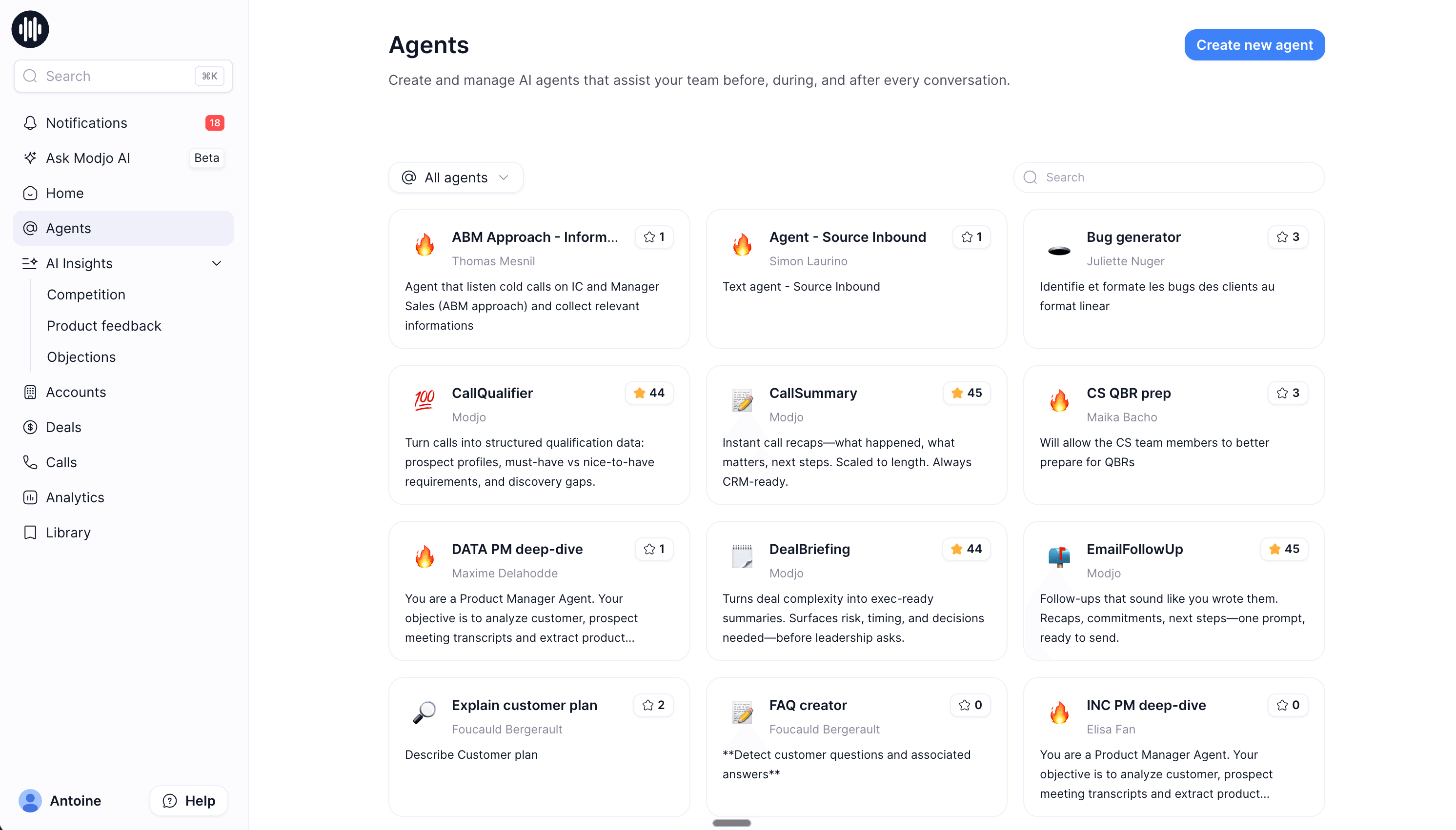
Gong, when the tool has to cover more than calls
 Gong appears at three companies, often for a broader scope than recording.
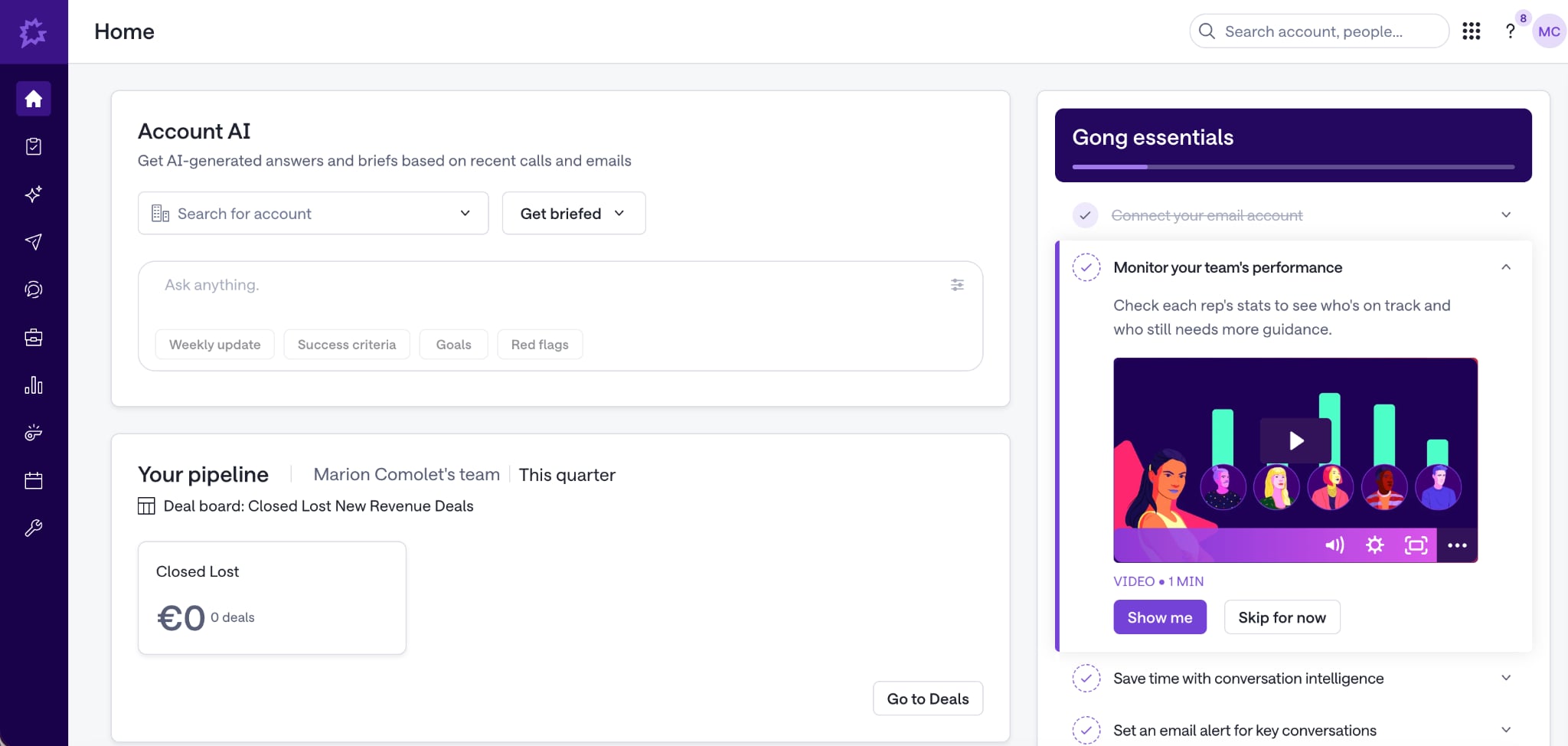
Pleo has been using it for less than a year for its Customer Success teams. All customer calls are recorded, analyzed, then fed into  Vitally, the CSMs' cockpit. Pleo relies mainly on scorecards: one grid for an onboarding call, another for a call related to a churn risk. Gong is also used for churn forecasting, which the CSMs compare each month with the churn actually observed.
“There's nothing like really watching a call to be able to give relevant, tailored feedback.”
 Marion Comolet, Senior Manager Scale CSM at Pleo
Teamtailor is replacing  Jiminny with Gong Foundation for recording, and Salesloft with Gong Engage for prospecting, with a forecasting module on top. The goal: a shared tool that can be rolled out in the more than 90 countries where the company operates.
At Agorapulse, Gong is the salespeople's tool. Emeric Ernoult, founder and CEO, rarely goes into it directly: he mostly opens it when a salesperson points out an interesting customer reaction to him.
Claap, chosen for the quality of its transcriptions
Didomi changed tools twice before choosing  Claap. The first was popular with the teams, but an expected feature was slow to arrive: automatically filling in the MEDDIC qualification in Salesforce. The second offered it, but the quality of its transcriptions was deemed insufficient. Didomi drew a lesson from this: automating qualification is of little value if the information extracted from conversations is not reliable.
Raphaël Boukris, co-founder, considers Claap's transcriptions very good. The closeness to  Lemlist, which Didomi already uses for prospecting and which Claap joined in October 2025, counted, without being enough to explain the choice.
At Didomi, recordings are no longer just for salespeople. Managers use them for coaching, what customers tell the CSMs remains accessible to the teams that were not in the meeting, and the product teams can find a customer's exact words, for example when they announce they will leave if a feature is not delivered before the fourth quarter.
Figures has used Claap since its early days, first for asynchronous video, before the tool shifted toward sales use cases. It is now its default tool for calls.
“Claap is our default tool for recording calls with prospects and customers. We have a lot of loops between Claap and HubSpot to automatically enrich the CRM, but also between Claap, Linear and Slack to surface bugs and feature requests.”
 Virgile Raingeard, CEO and founder of Figures
Grain and lighter tools
Folk records its demos with  Grain and sends the transcriptions to its own CRM, whose AI fields extract the useful information.
“We record the calls with Grain, then we push the transcriptions into the Folk CRM. The AI fields extract the important information, like the number of seats, the competitors being evaluated or the customer's needs, without the sales reps having to fill in the CRM.”
 Julien Frèche, Revenue Operations at Folk
The Folk CRM also pulls in meeting notes from other tools, such as  Fireflies,
 tl;dv or
 Granola: each salesperson can keep their usual tool, as long as the information ends up in the CRM.
The real issue: adoption
It is an observation we often hear at Soft Atlas: recording calls is simple, taking the time to use them is much less so. The value of these tools depends on the time teams devote to them.
Shine considers Modjo excellent, but underused. Extracting data from conversations works well. Coaching, much less so, for lack of time among managers and salespeople.
“Modjo is a great tool. It just takes more bandwidth on the user side than what's being sold, I think.”
 Yanis Boukhrissi, Global Revenue Operations Director at Shine
Ankorstore got around the problem with Modjo's agents. Gabriel de Chazournes, Sales Director France, used to replay one call per salesperson, about an hour each, on a single conversation. Now, every Friday, the Team Leads receive a brief per salesperson built on the whole week: three positive points, three tips, one recommendation and a scorecard.
“You go over all the calls and you bring out real trends that are super interesting.”
 Gabriel de Chazournes, Sales Director France at Ankorstore
Telephony and call analysis: one tool or two?
Most of these companies keep the two separate. Ankorstore, Qobra and Didomi make calls with Aircall and analyze them with Modjo or Claap. Partoo pairs  Ringover, used for nearly ten years, with Modjo.
Ringover made the opposite choice for its own product: its Empower module transcribes, summarizes and analyzes conversations, alongside the telephony. Fabian Stanciu, VP Sales Europe, acknowledges that the two layers remain separable: a customer can keep Ringover with Modjo or Gong, or use Aircall with Empower.
What AI changes
Recorded conversations are becoming a data source for AI agents, often connected through MCP. In Soft Atlas interviews, the ability to connect a tool to an agent is becoming a selection criterion in its own right.
At Ankorstore, the Sales reps receive a brief of their meetings by email every morning, combining the latest exchanges recorded in Modjo with the account's performance data. At Qobra, Antoine Fort has built an agent in Claude that serves as his Chief of Staff, connected in particular to Modjo and Salesforce.
At MerciYanis, a Claude agent analyzes the teams' calls and emails every day. It spotted, for example, that a project manager had advised a customer to use the same password for their computer and for MerciYanis. A security issue that a manager would only have spotted by replaying every conversation.
At Figures, Claude extracts bugs and feature requests from Claap calls, posts a Slack message per request with the link and timestamp of the recording, then Linear attaches each request to the right ticket.
Frequently asked questions
Modjo or Gong?
In these interviews, Modjo mainly equips French scale-ups that want to record, summarize and coach, with integrations with HubSpot or Salesforce. Gong is chosen when the tool has to cover a broader scope: scorecards and churn forecasting at Pleo, prospecting and forecasting at Teamtailor, which is looking for a tool shared across more than 90 countries.
Why do companies change conversation intelligence tools?
Didomi changed twice: first because of a feature that was slow to arrive, then for the quality of the transcriptions. Teamtailor is leaving Jiminny to bring several uses together with a single vendor. Ankorstore, on the other hand, kept Modjo and extended it to the Product Managers.
Should you record every call?
Ankorstore and Pleo record all their calls. That is what makes it possible to coach over an entire week rather than on a single chosen call, and to find what a customer said without depending on a salesperson's summary.
About these interviews
Soft Atlas interviews executives and Sales, Customer Success and RevOps teams about the software they actually use day to day: what they chose, what they left and why. Each interview becomes a use case published on Soft Atlas, reviewed by the company before publication, and adds to the company's stack on Soft Atlas. The quotes in this article are taken from them word for word; the overall trends come from the stacks cataloged by Soft Atlas.